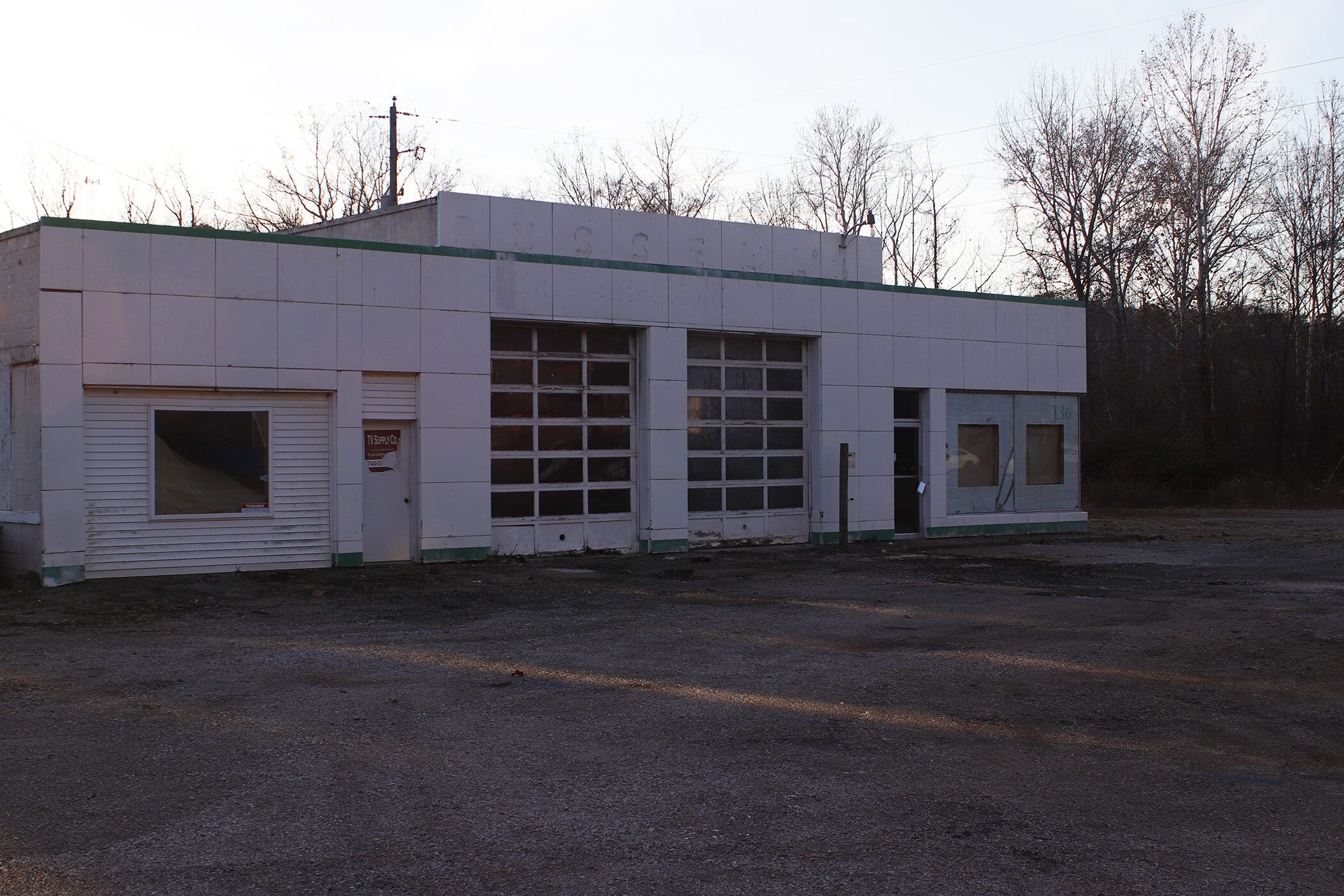
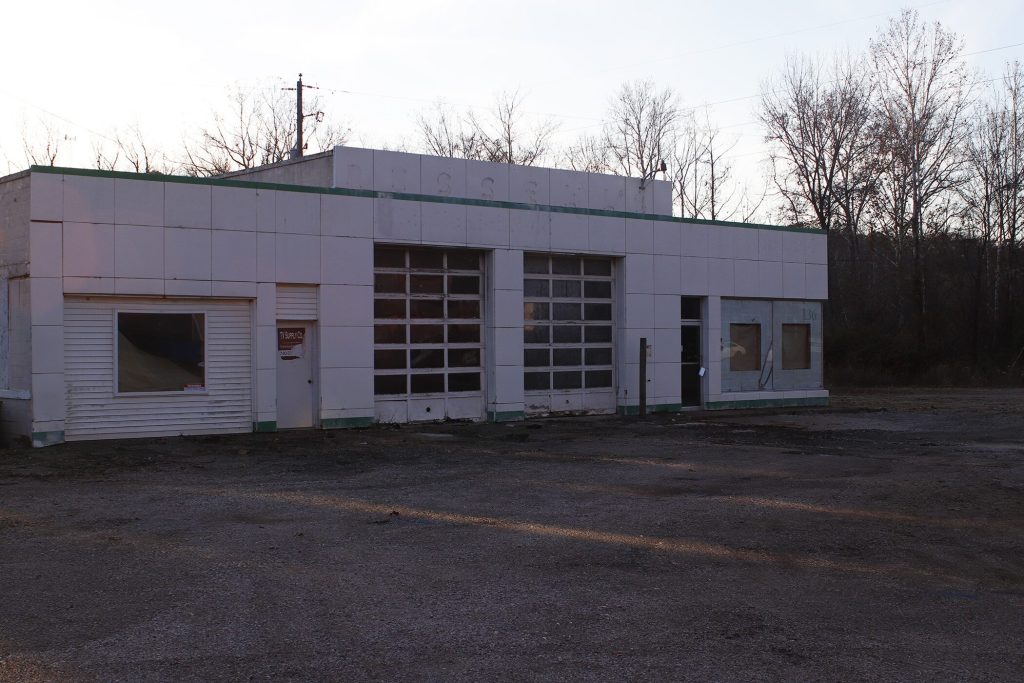
ATHENS, Ohio — 136 Columbus Road in Athens has housed multiple businesses over the years, including a gas station and later an auto repair shop called Russell’s Riverside Service. Now, the Sustainable Ohio Public Energy Council is working to reopen the property as an electric vehicle charging station with four DC fast-charging ports.
The building’s history as a gas station requires an environmental inspection and clean up. SOPEC partnered with the Athens County Port Authority to rehabilitate the property.
The port authority aims to “get properties cleaned up so they can be put back into some type of economic use, so that they’re back on the tax roll and… that creates jobs in the county as well,” Mollie Fitzgerald, the port authority’s secretary and executive director of the Athens County Economic Development Council, told the Independent.
Fitzgerald said it took a while for SOPEC to secure ownership of the property.
The entity that caused the environmental contamination is not eligible to receive funding from the Ohio Department Brownfield Program, Fitzgerald said, so SOPEC had to own the property, then prove to the Ohio government that they weren’t the owners who contaminated it.
The Brownfield Program funds the restoration and rehabilitation of polluted and contaminated buildings to both protect the environment and support local economies, according to the Ohio Department of Development’s website.
Cleaning up
The first part of the project — cleanup — was accomplished in September 2025 through a $225,183 grant from the Ohio Department of Development’s Brownfield Remediation Program, given to the Athens County Port Authority. Tetra Tech, an engineering firm, was contracted by the Athens County Port Authority to excavate the site.
Tetra Tech’s report on their excavation said when dirt samples from the site were tested by ALS Laboratory Group, four out of eight of the samples had a high amount of naphthalene and three of the eight samples had high 1,2,4-trimethylbenzene.
“There’s no direct contact risk,” Drue Roberts, a senior geologist at Tetra Tech, told the Independent.
According to Roberts, touching the soil isn’t dangerous, but ingesting it through water could be.
Naphthalene is flammable and can cause anemia if ingested; 1,2,4-trimethyl benzene is a flammable neurotoxin and can cause skin irritation if touched. Because these amounts exceeded Bureau of Underground Storage Tank Regulations regulations, Tetra Tech had to continue investigating the groundwater at the site for contamination, according to the assessment.
Roberts and his team of four didn’t find any tanks under the former gas station, just piping that had siphoned fuel from the tanks to the pumps. The original gas tanks were likely removed in 1988, when gas tank regulations became stricter, but 180 feet of piping remained beneath the station.
“We didn’t really see anything in the cavity here,” Roberts said. “But we have widely spread soil contamination that doesn’t really follow any pattern.”
It seemed many additions and repairs had been made over the years, Roberts said.
Buckeye Elm was hired to remove the piping and during the removal Jake Miller, an environmental scientist at Tetra Tech, collected soil samples along with Roberts. It took the crew three days to remove the piping.
Despite no huge reservoirs of gasoline to be found, over time, it may have seeped into the soil through cracks in the removed tanks or pipes. According to Roberts, who was a BUSTR regulator for 12 years, the contamination isn’t distributed evenly across the property, making it less of a large-scale issue.
The Tetra Tech crew set up monitoring wells to analyze the groundwater contamination, which could become a long-term problem.
“The limitations with these department of development grants is they only last two years,” Roberts said. “We haven’t sent that report… that’s coming right up.”
Luckily, he won’t need two years.
“We did collect groundwater samples (from the wells) and they are all clean,” Roberts said. “The official Tier 1 Investigation Report was sent to BUSTR by the end of December and SOPEC will be able to move forward with their construction plans.
Roberts said it is on crews like his to get everything that can be damaging to the environment and the community out of the site. He keeps the goal of remediation in mind to ensure it’s done correctly and on time.
Installation plans
The funding for the building of the EV charging station will come from the federal Charging and Fueling Infrastructure (CFI) Grant Program, which is administered by the federal Department of Transportation.
Chloe Musick, Director of Public Affairs and Marketing for SOPEC, said this grant is to develop EV infrastructure along the nationally designated alternative fuel corridor, State Route 33, as part of the Responsive Interregional Deployment of Electrification Solutions project.
The U.S. Department of Transportation Federal Highway Administration announced in August 2024 that the RIDES project received a $4,180,045 CFI Alternative Fuel Corridor grant. RIDES also received 12.5 million dollars from the CFI Community Charging and Fueling grant, according to Musick.
Though the Department of Government Expenses stalled progress for the CFI program, RIDES got approved by the Department of Transportation because the paperwork was already being processed, according to Musick.
Musick explained the first part of the process to use a CFI grant at Russells is a National Environmental Policy Act assessment. Electricity infrastructure, broadband access, and physical space are among the requirements.
“So it may look like there’s not a lot going on at Russell’s right now, but we’re actually working through assessments to make sure it’s viable,” Musick said.
DC fast-charging ports can charge a car battery to 80% in 20 to 45 minutes, depending on the type of car. The ports can cost $10,000 to over $40,000 per unit, according to Autel.
SOPEC Project Manager, Matthew Clark said the station will have to fit the National Electric Vehicle Infrastructure Formula Program.
“CFI is kind of the discretionary arm of NEVI,” Clark said. “Each port has to (deliver) at least 150 kilowatts.”
Of 10,061,791 vehicles registered in Ohio, 120,144 are alternative fuel vehicles, according to September 2025 data from the Ohio Alternative Fuel Vehicle Registration Dashboard.
That means only .012% of registered vehicles in Ohio run on alternative fuel.
Athens already has 14 charging stations, the majority of which are alternating current (AC) chargers, which are slower than direct current (DC) chargers.
The only other DC charger in Athens costs $5 for 15 minutes. The new stations won’t charge for time, but for kilowatt-hours.
“It’ll be market price, I think I’ve seen them between 35 cents kilowatt-hour and 50 cents kilowatt-hour,” Clark said.
A kilowatt-hour means the amount of energy the car uses per hour.
How much revenue the charging station will generate depends on the pricing model, usage rate and the costs to operate and service it. The station will likely not create new jobs directly, because the building will be used for SOPEC office space.
The charging station won’t be a for-profit business, but SOPEC will use the income from the charging stations to fund future EV infrastructure projects, Clark said.
“[The Federal Highway Administration will] bring the 80%, we have to come up with the 20%,” Clark said. “We plan to have the vendor who’s going to install and design these stations bring that 20% to the table.”
The building will also be used as offices for SOPEC.
Economic impact
Clark said SOPEC is working out their plans for a public-private partnership.
The charging station is intended to attract more electric vehicle owners to Athens who will bring their own capital.
“We do know there will be chargers in Athens, no matter what,” Musick said. “Just deciding the exact coordinates of where those chargers are going to be –– that’s still being determined.”
Columbus Road has a certain appeal for SOPEC, because it’s in an area that the Athens City government wants to make into a commercial corridor, and it has a building that SOPEC can retrofit.
“There was an incentive to transform this property beyond just being a charging station, but improving the actual earth on Columbus Road in general,” Musick said.
“I’m driving from Athens up to Columbus, or vice versa, I can stop on 33, right there at Russell’s charge up, continue on,” Clark said.
Cameron Fuller, the owner of Devil’s Kettle Brewing on Columbus Road, said he was pleased to hear about the charging station. Fuller does not have an electric vehicle, but said he hoped to buy one in the future.
“Any development for Columbus Road would be beneficial for businesses and for pedestrians,” Fuller said. He speculated that once someone takes a risk to build along a road, it gets less and less risky for others to build in the same area.
Clark said SOPEC partnered with the Electrification Coalition to decide where an electric vehicle charging station would be most logical.
“If we put in the infrastructure, people are comfortable with, ‘hey, I can now go out and buy an EV, because now I have, you know, a charger down the street,’ that’s going to drive adoption in these other areas that we don’t see right now in the state, especially in Southeast Ohio,” Clark said.
The Electrification Coalition, an environmentalist nonprofit, conducted a study in Dayton, Ohio which aimed to determine the best strategies for integrating EV infrastructure by analyzing the best places to install charging stations.
“We’re trying to make sustainability a real choice for people,” Musick said.
Russell’s will be cleaned up with minimal excavation, and the soil will not have to be removed and replaced. No one can say what the property will be in another 50 years, but the ground will certainly be clean. In 50 years, all that will have to be unearthed will be wires, instead of pipes.
Musick said the charging station has yet to be named, but she hopes to honor the history of the place. Clark said, since the station is known as Russell’s around town and among SOPEC members, the name will likely stick.