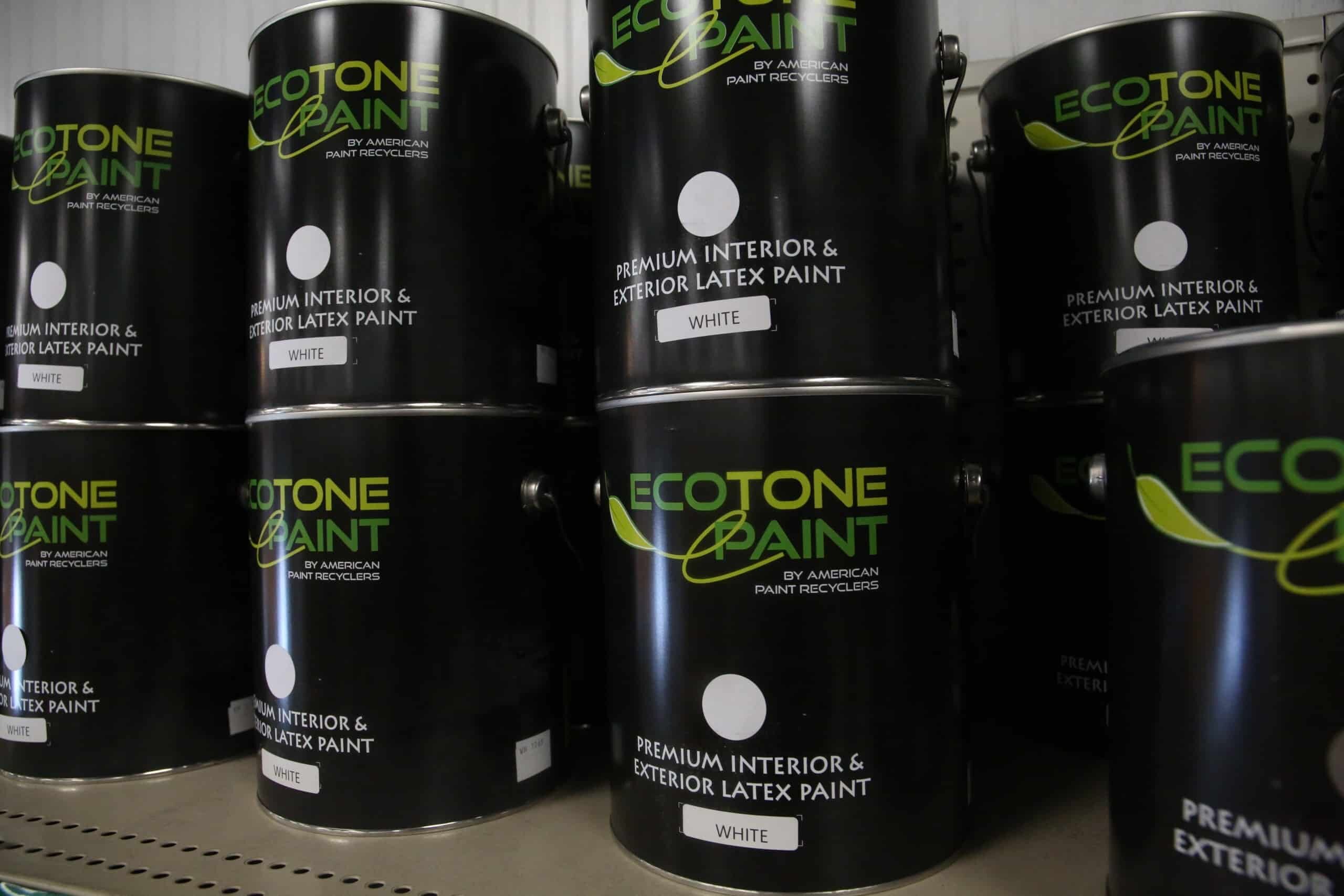
ATHENS COUNTY, Ohio — Household hazardous waste is an unavoidable aspect of daily life but steps can be taken to reduce, reuse or recycle hazardous waste locally.
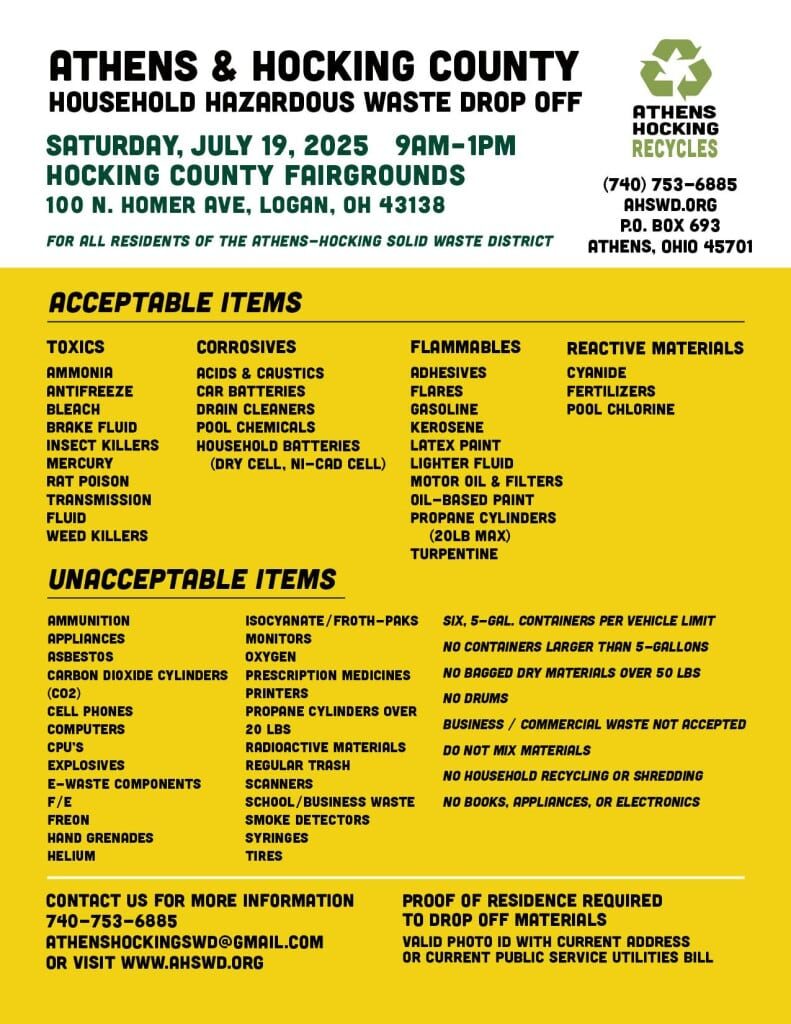
Household hazardous waste, such as paint, cleaning chemicals and batteries, are typically collected at the Athens-Hocking Solid Waste Districts annual household hazardous waste collection day, which is being held this upcoming Saturday, July 19, at the Hocking County Fairgrounds.
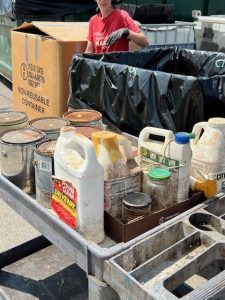
However, a number of programs exist in the county to collect specific types of household hazardous waste year-round. For instance, solid waste district residents can book an appointment with the district’s Sutton Road Recycling Center to drop off waste at any time in the year.
Reducing Use and Storing Waste Properly
Household hazardous waste is dangerous, it contains a number of flammable, corrosive and toxic chemicals. According to the U.S. Environmental Protection Agency, improper storage and disposal of household hazardous waste can lead to environmental damage or harm to sanitation workers.
The first intervention people can take to address household hazardous waste throughout the year is to avoid creating it in the first place.
“I think the main thing is to consider what you’re buying,” said Morton Barlaz, a professor emeritus at North Carolina State University who researches hazardous waste disposal. “Don’t buy more than you need. Try to use it all up. I think that’s really the main thing people can do, is look at ways to generate less.”
Jane Forrest Redfern, the director of the Athens-Hocking Solid Waste District, echoed this idea.
“You should buy the amount [of hazardous products] that you need, not the best price,” Forrest Redfern said. “It’s not flour; Buy the amount you need, and if you need more, then get some more.”
Just as important as buying the right amount of product is storing it correctly. Improperly stored chemicals can break down and lose their effectiveness.
“You want to make sure that you’re storing it as the instructions [specify], because the life cycle for that particular chemical will be different if it’s heated and cooled,” Forrest Redfern said. “You want to make sure that things are stored in a cool, dry place.”
Forrest Redfern noted that there are cases where hazardous products are often used but aren’t actually required, such as when removing paint.
“Instead of using a very toxic paint stripper, you [can] get a sander out or a putty knife, or whatever to chip it off,” Forrest Redfern said. “There are manual ways to do [these] things. So consider the least toxic alternative.”
Paint
Paint is one of the most common types of household hazardous waste. Paint is broadly split into two categories, latex-based and oil-based, and each requires its own disposal method.
For instance, latex-based paint can be easily combined, remixed and sold as a new can of paint. The Habitat for Humanity ReStore at 309 W. Union St. in Athens both serves as a drop off point for used paint and sells newly recycled paint, according to their website.
Another common way to dispose of latex-based paint is to use paint hardener, a chemical mixture which quickly dries out paint and hardens it into a solid block. Once dry, this block of paint can be safely thrown out with regular garbage.
Forrest Redfern told the Independent that instead of buying paint hardener, residents can use kitty litter to absorb small amounts of latex-based paint.
“[Fill the] can up with kitty litter, put it in a cool, dry place that children or pets cannot get into, and let it dry out completely, and then put the lid back on it,” Forrest Redfern said.
Oil-based paints are the exact opposite of latex-based paints in terms of recycling and disposal. There is no way to safely repurpose oil-based paint or dispose of it at home.
“You have to take [oil-based paint] to a household hazardous waste [collection site] because it’s flammable,” Forrest Redfern said. “If you dump it into a garbage truck, it’ll explode. It will contaminate everything. It’s very, very hazardous.”
Forrest Redfern said that the easiest way to tell if your paint is oil- or latex-based is to see if you can wash the paint off with water. If it comes off easily, it is latex-based; If you have to use a paint remover like turpentine, then it is oil-based.
Batteries
Batteries pose a significant risk to sanitation workers, as they can cause fires in garbage trucks when thrown out improperly.
“As soon as a lithium ion battery is crushed, it can ignite,” Rumpke spokesperson Amanda Pratt said.
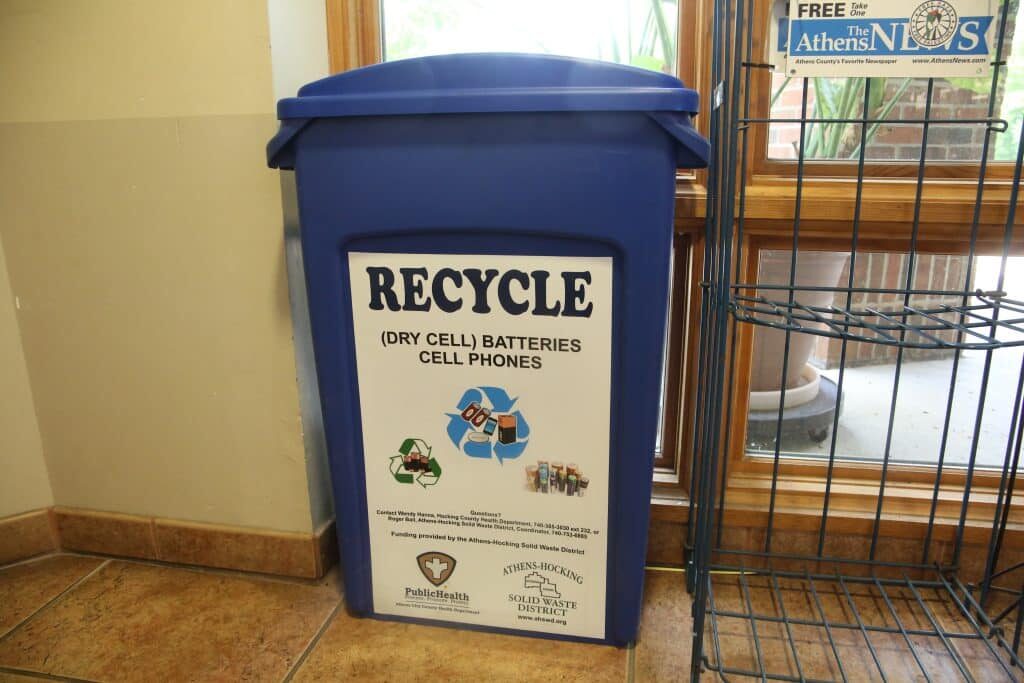
The branches of the Athens County Public Library all have battery collection points. Before being dropped off, the batteries should have their connectors taped over as a safety measure, according to Forrest Redfern.
Appliances
Household appliances such as air conditioners and refrigerators are not considered household hazardous waste, but they do contain chemicals that are bad for the environment. Maria Bonner, director of the Zero Waste program at Rural Action, has been working to create a collection program for household appliances.
“Refrigerants are a big one that people are not always aware of,” Bonner said. “It is one of the most potent greenhouse gasses, and people will sometimes just cut the line and then take it to the scrap yard.”
Bonner told the Independent that Rural Action has partnered with an electronic waste recycler in Columbus to dispose of these appliances. The Southeast Ohio Recycling Terminal, also known as SORT, and the Athens-Hocking Solid Waste district also serve as collection points for electronic waste.
“There is a fee involved. It’s about $20 for a refrigerator and it’s $10 for a small [appliance], like an air conditioning unit,” Bonner said.
Another way to dispose of appliances is to ask for it to be hauled away when buying a new one. For instance, Lowes offers to haul away old appliances for a small fee when making deliveries.
“If you buy something like a refrigerator or a stove or a washer-dryer, ask the people that you’re buying it from [to take your old one],” Forrest Redfern said.
Car Parts
Some car parts, such as car batteries, are considered household hazardous waste, while others, including tires, are not. Regardless of their classification, safe and cheap disposal methods are available throughout the county.
The Athens-Hocking Solid Waste District has developed an “automotive recycling trail” as a resource for recycling or properly disposing of car parts.
“Most automotive materials can be readily recyclable right now at many auto supply stores,” Forrest Redfern said. “[For example], if you go and try to buy a battery, and if you don’t have a battery to trade, then they charge you [a fee.]”
It’s standard practice for mechanics to charge a “core fee” if an old part isn’t traded in when a new one is purchased. This is done to encourage proper disposal of hazardous car parts and provide manufacturers with parts that can be inspected for wear and tear and then rebuilt.
Some mechanics also charge a disposal fee for items such as tires. Forrest Redfern recommends letting mechanics dispose of these items as they are often highly regulated by the Environmental Protection Agency.
“Pay the five bucks per tire,” Forrest Redfern said. “It’s a small price to pay.”
It is illegal to dump or burn tires, according to the Ohio Revised Code.
Medical waste
Medical waste, such as used needles, are not considered a type of household hazardous waste, but they still need to be disposed of safely and responsibly. For example, used needles should be stored in a thick plastic container. Something like a milk jug won’t work.
“A sharps container can be as simple as a laundry detergent bottle with the sharps in it and the cap taped on,” Pratt said. “It should just be labeled ‘sharps,’ and they shouldn’t be put in recycling.”
According to SafeNeedleDisposal.org, a nonprofit which offers guidance on how to dispose of needles, once a sharps container is about three-quarters full, it should be taped, labeled as sharps and thrown out with regular trash.
Some municipalities, including Columbus, have designated needle drop off locations open to the public. The Athens City-County Health Department hosts regular harm reduction clinics offering a needle exchange for up to 30 needles as part of their harm reduction clinic.
Expired medications or prescriptions that are no longer needed can be dropped off year-round at the Athens County Sheriff’s Office Prescription Disposal Box at 13 W. Washington St., or the CVS Pharmacy at 555 E. State St., both in Athens. Additionally, the Athens County Sheriff’s office regularly participates in multiple drug take back days throughout the year.
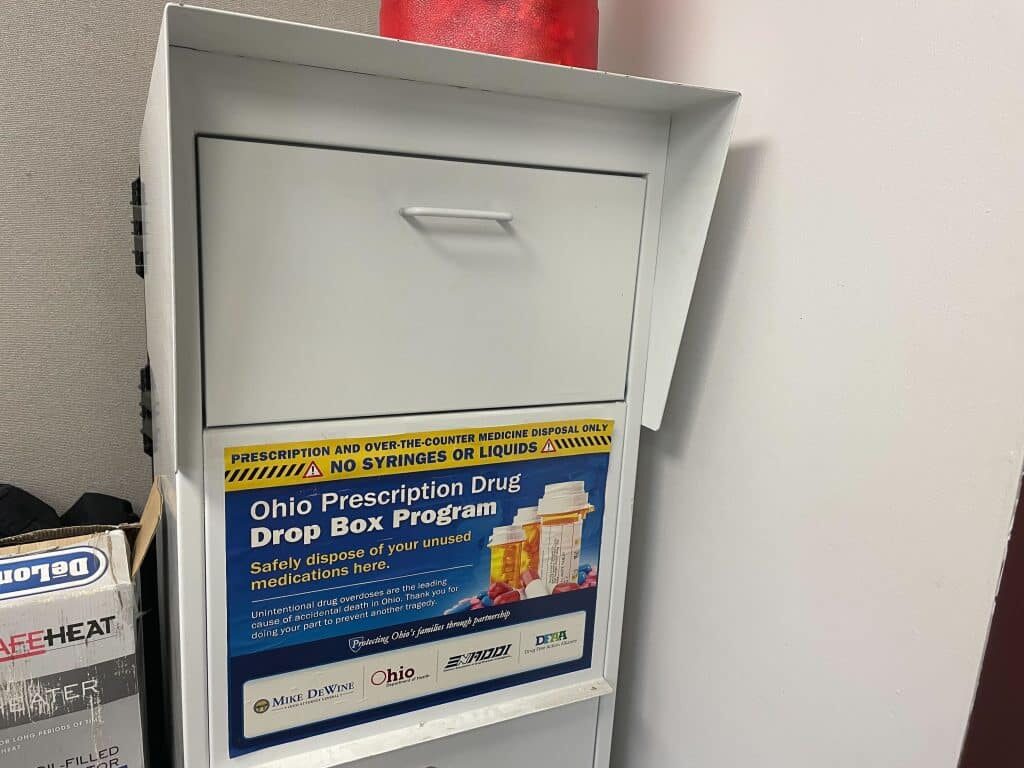
“Medications can get dropped off at the sheriff’s office, they have a special way of disposing of those,” Bonner said.
Miscellaneous waste
Compact fluorescent lightbulbs (CFL), are a common type of lightbulb found in most homes. These bulbs contain small amounts of mercury vapor which is used to give off light when exposed to electricity.
CFLs are considered household hazardous waste because of this mercury. People exposed to mercury experience a range of symptoms such as respiratory problems, issues with walking, and memory loss, according to the Cleveland Clinic.
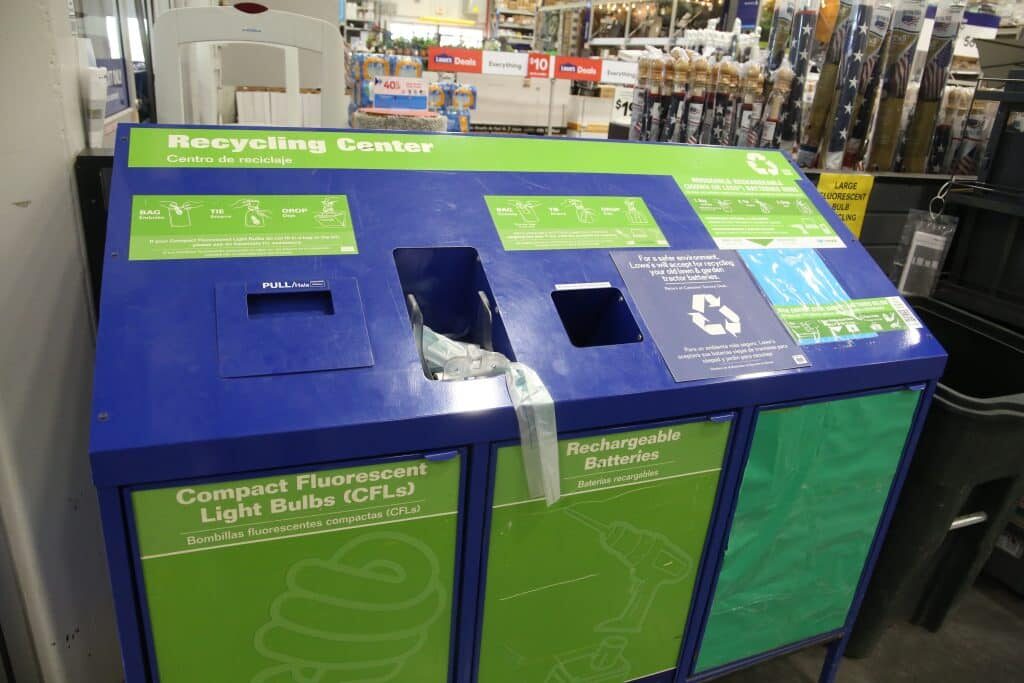
These bulbs can be disposed of for free by bringing them to the Lowe’s Home Improvement at 983 E. State St. in Athens. Lowe’s has bags available at their collection point. Bulbs may be placed in the bag and then dropped into the available container for storage.
Smoke detectors are another common source of household hazardous waste. Some smoke detectors contain a small amount of the radioactive element americium according to the U.S. EPA.
The Ohio EPA recommends contacting your local solid waste district for guidance on disposing smoke detectors, although the Athens-Hocking Solid Waste District doesn’t have a smoke detector disposal program. Alternatively, the Ohio EPA recommends using Curie Environmental Services which offers a prepaid mail-in recycling service for smoke detectors.
Cleaning chemicals aren’t typically recyclable. However, a number of local places will take donations of small quantities of cleaners, according to Bonner.
“A lot of places will take household cleaners for redistribution,” Bonner said. “We have a free section here at [UpCycle Ohio Thrift Store] that we can put those out for people to be able to use.”
Lastly, some companies, such as Canon, operate their own recycling programs for reusable aspects of their products. Forrest Redfern encourages members of the public to do their research and buy products from companies which operate these programs.
“The first thing that people need to do is ask themselves, ‘If I buy this, how am I going to get rid of it?’” Forrest Redfern said. “[For example,] toner cartridges from Canon. I’ll call the company and say, ‘I have 10 cartridges ready.’ They send me a label, they send me a box, they send me a bag. I box them all up, and I ship them back to Canon.”