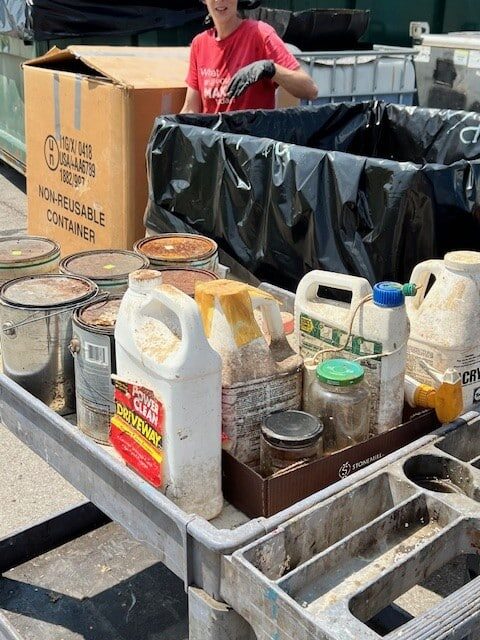
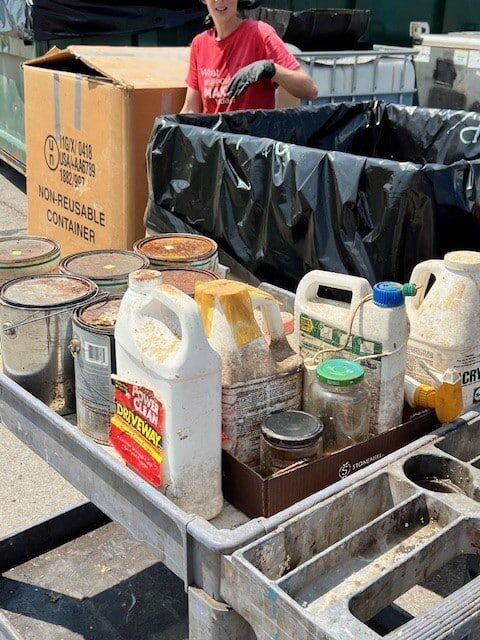
ATHENS COUNTY, Ohio — Every year, the Athens-Hocking Solid Waste District hosts a household hazardous waste collection day, collecting everything from bleach and cyanide to paint and batteries.
Household hazardous waste — various cleaning chemicals, insecticides, herbicides, car parts, batteries, paint — shouldn’t be thrown out with regular garbage due to the danger it poses to the environment, public health or sanitation worker safety.
According to the Ohio Environmental Protection Agency, nearly three-quarters of the state’s solid waste districts offer some form of hazardous waste collection to local residents. The Athens-Hocking Solid Waste District budgets $25,000 a year for its collection days.
In Ohio, the collection of household hazardous waste often falls to local solid waste districts, who partner with companies that specialize in the waste’s safe disposal. Jane Forrest Redfern, director of the local solid waste district, said that in 2024, over 300 county residents dropped off materials for disposal.
Beyond the waste disposal days, there aren’t many options for residents currently.
“[With the] materials that are generated you can’t just put them in the trash, but there’s also not a great outlet for it,” said Maria Bonner, director of the Zero Waste Program at Rural Action.
At the collection days, residents bring their hazardous waste to designated locations. Unfortunately, however, single-day collections may result in more household hazardous waste being thrown out in the regular garbage, at the same time as they divert waste. This has been demonstrated repeatedly, beginning with a 1986 study from the University of Arizona’s Garbology project focused on Marin County, California.
The study indicated that there was nearly twice as much household hazardous waste in regular garbage following a hazardous waste collection day. Researchers hypothesized that public awareness around this waste spiked as a result of this messaging, and when members of the public couldn’t make it to the disposal day, they got rid of the hazardous waste the only way they knew how: their regular trashcan.
These same findings were documented at later studies conducted in Tuscon and Phoenix, Arizona. Despite the march of time, this phenomenon still lives and has been observed locally by Forrest Redfern.
“I’ve experienced that because I do all the PR for these [events],” Forrest Redfern said. “[The event is advertised] on the radio, it’s in the paper. It’s in [the] ‘things to do this weekend’ [article]. It’s blasted on social media. The week after [the collection day], all kinds of people call and say, ‘I have this material. I couldn’t make it.’”
Forrest Redfern has plans to shift the solid waste district from single-day collections to a monthly or year-round model by expanding the center for hard-to-recycle materials in Logan.
These centers for hard-to-recycle materials, known by the acronym CHaRM, divert thousands of pounds of household hazardous waste and hard-to-recycle materials from landfills every year.
For residents who can’t make it to the household hazardous waste collection day, or have waste that needs immediate disposal, Forrest Redfern sometimes uses a voucher system that relies on residents travelling to Columbus.
“If someone’s moving and has to get rid of the stuff quickly, then I’ll write a voucher for them,” Forrest Redfern said. “What they’ll do is take it up to Columbus to our household hazardous waste consulting firm, and then they can drop it off. [The firm] will then bill me for the material.”
Hazardous waste misplaced
The nomadic nature of Hocking and Athens counties tourists and students likely drives up the amount of household hazardous waste generated in the district.
“We have people moving in and out now all the time, especially in Logan, with rentals and stuff like that,” Forrest Redfern said.
Despite public education efforts, household hazardous waste is frequently found in the wrong waste stream, be it municipal trash collection or at recycling centers. This misplaced waste poses a threat to sanitation workers; for example, misplaced lithium ion batteries frequently start fires in collection trucks.
“We see them in our trucks, we see them at our recycling centers,” Rumpke spokesperson Amanda Pratt said. “As soon as a lithium ion battery is crushed, it can ignite.”
Crissa Cummings, the director of Southeast Ohio Recycling Terminal council of governments, said that batteries igniting truck fires has been a problem for SORT as well.
“We have had trucks catch on fire,” Cummings said. “It’s been fairly mild – our driver was able to put it out. [Another time] a fire volunteer fire department was able to put out, but we had a third one that ended up causing extensive damage to a truck. Obviously, it was pretty scary. Anytime anything catches on fire in the trucks, it’s a pretty big deal.”
In part, truck drivers are trained to identify hazardous materials and leave them at the curb. However, if the hazardous waste is mixed up with regular household waste, then sanitation workers have no way of knowing.
“Our drivers are trained — if they see something that is potentially a household hazardous waste item, they have a note pad, and they can tag a trashcan or tag an item,” Pratt said. “There’s a checklist, and it says we did not pick up this item [because] the paint is in a liquid form, this appliance hasn’t had the chlorofluorocarbons (a common pollutant found in refrigerant) removed.”
In addition to damaging property and having a negative impact on the environment, when hazardous waste is thrown out improperly, it can be a safety risk for sanitation workers.
“Our concern is always for the safety of the public and our employees,” Pratt said. “[With] things like liquid paint, [even though] the driver has safety glasses and gloves on, if something can splatter back onto the employee, that puts them at risk.”
Earlier this year, two sanitation workers in Whitehall, Ohio, avoided serious injury when an oxygen tank ruptured in their truck, according to WSYX.
In addition to routine training, waste collection agencies work to inform employees and the public about what to do with seasonal waste. For instance, pool chemicals and charcoal are commonly found in household garbage during the summer months, due to pool use and summer barbecues.
“So, for example, before the Fourth of July, we might be focusing on the hazards associated with fireworks that might be placed in the trash,” Pratt said. “We recommend that people put old fireworks and soak them in water before they put them in their can or their trash can for pickup.”
The sanitation professionals interviewed for this story all promoted two ideas: Buy less hazardous products and find alternatives, and research the materials that are thrown away.
Sanitation professionals recommended that residents search the internet if they are unsure whether waste is hazardous or not. If that doesn’t help, the professionals suggested calling either the solid waste district or garbage collector.
“Check with your local solid waste district,” Pratt said. “Check Rumpke’s website. We try to list all of these things out on our website, under the residential trash section.”
Waste collection oddities
Misplaced waste is also an issue at the hazardous waste collection days themselves, which often result in anecdotes about the unusual items residents try to bring.
For Forrest Redfern, the most memorable item was a cylinder of toxic gas. Forrest Redfern said that the staff for Environmental Entreprises, the contractor that manages household hazardous waste collection for the solid waste district, immediately spotted the unusual item.
“[The contractors] have eagle-eyes on everything that’s coming out [of cars],” Forrest Redfern said. “The [contractors] know what’s suspicious. I would say that the cylinder was like $1,500 [to dispose of safely], and the reason that I said yes to it was because I didn’t want them driving away with it.”
Brian DePeel, Environmental Entreprises’ divisional director of household hazardous waste, said that on more than one occasion, they’ve had to temporarily shut down collection due to people bringing in explosives.
DePeel described an incident in which a woman brought in her husband’s WWII-era aerial bomb.
“That was one of the instances where we put everything on pause, called a bomb squad, and had them come detonate [the bomb] in their little container,” DePeel said.
According to Pratt, Rumpke has also dealt with grenades coming across their sorting line, in addition to a number of live animals.
“Sadly, we’ve had snakes, like pet rat snakes,” Pratt said. “Once, we had a big lizard of some kind that was in the recycling center.”
Thankfully, none of the above incidents harmed the staff sorting through waste. The same can’t be said for SORT, which had its staff exposed to a chemical weapon after it was improperly discarded.
“Several tear gas canisters came through the sorting line, and they still had enough tear gas in them that we actually had to clear the facility and all of the workers were affected by the tear gas,” Cummings said. “That was pretty awful.”
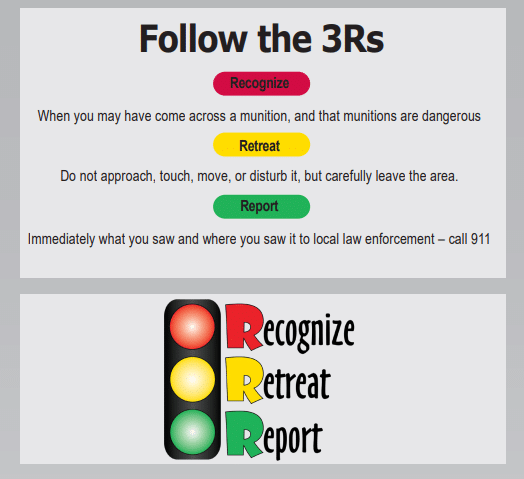
Getting rid of these dangerous items, be it explosives or tear gas, is best left in the hands of trained professionals. The most widely spread guidance for dealing with these materials is to follow the three R’s: recognize the item, retreat from it, and report it.
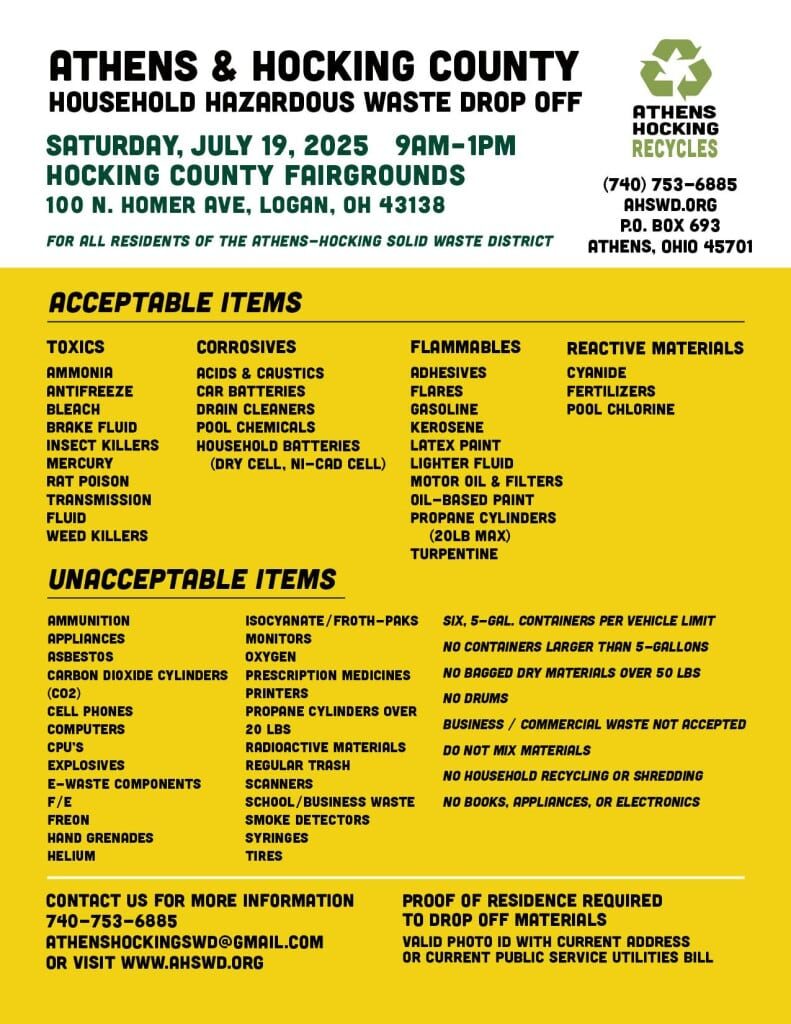
This year’s household hazardous waste collection is 9 a.m. to 1 p.m. Saturday, July 19 at the Hocking County Fairgrounds.