ATHENS COUNTY, Ohio — Each year Americans collectively generate 1.6 million tons of household hazardous waste — most of it ending up in landfills, pouring into sewer systems or recycled by experts.
Household hazardous waste, such as batteries, paint and various chemicals, shouldn’t be thrown out with regular garbage due to harmful effects on public health, the environment and sanitation worker safety. Instead, this type of waste is collected by local solid waste districts, with many hosting annual collection days or collecting year-round at designated drop-off locations.
However, whether or not hazardous waste is disposed of properly, it still has to be dealt with.
When hazardous waste goes where it shouldn’t
If household hazardous waste ends up in a municipal solid waste landfill, there are multiple systems to prevent it from posing risks to public health and the environment – though there are still risks.
According to the U.S. EPA, the first prevention method is multiple layers of plastic and clay liners that protect groundwater from being exposed to leachate.
Leachate is water which has passed through a landfill, picking up a number of toxic properties. Leachate “often consists of high concentrations of organic contaminants, heavy metals, toxic materials, ammonia and inorganic materials,” according to an article in the academic journal Water Reuse.
A series of pumps and pipes transport leachate to a collection pond for storage and testing, according to David Murphy, a senior engineer at Rumpke. The company bought the Athens-Hocking Reclamation Center — which processes 750 to 800 tons of garbage a day, from Kilbarger Construction Inc. — in 2021.
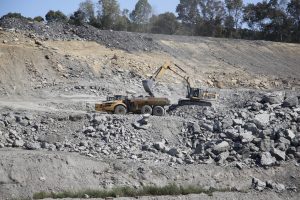
“[Household hazardous waste is] put in the landfill, just like normal [municipal solid waste], and contained like normal MSW,” Murphy said.
The landfill does not accept hazardous waste from industry, Murphy said, and it also tests its leachate “to make sure we don’t have any issues with anything that’s going to leave the landfill” for processing at treatment facilities in Logan and Huntington.
Molly Kennedy, a spokesperson for Rumpke, told the Independent in an email that Rumpke’s leachate test measures “ammonia, total suspended solids (TTS), total dissolved solids (TDS), chemical oxygen demand (COD) and metals.” Kennedy added that if a test shows that there is a problem, Rumpke works with leachate partners to find a solution.

To get a better understanding of how household hazardous waste breaks down in a landfill, the Independent spoke with Morton Barlaz, a professor emeritus at North Carolina State University who researches decomposition in landfills, municipal solid waste and the biological and chemical processes that occur in landfills.
Barlaz said that the most common type of household hazardous waste to end up in the landfill is residual liquid such as “home pesticides, paint thinner or any oil-based paint.”
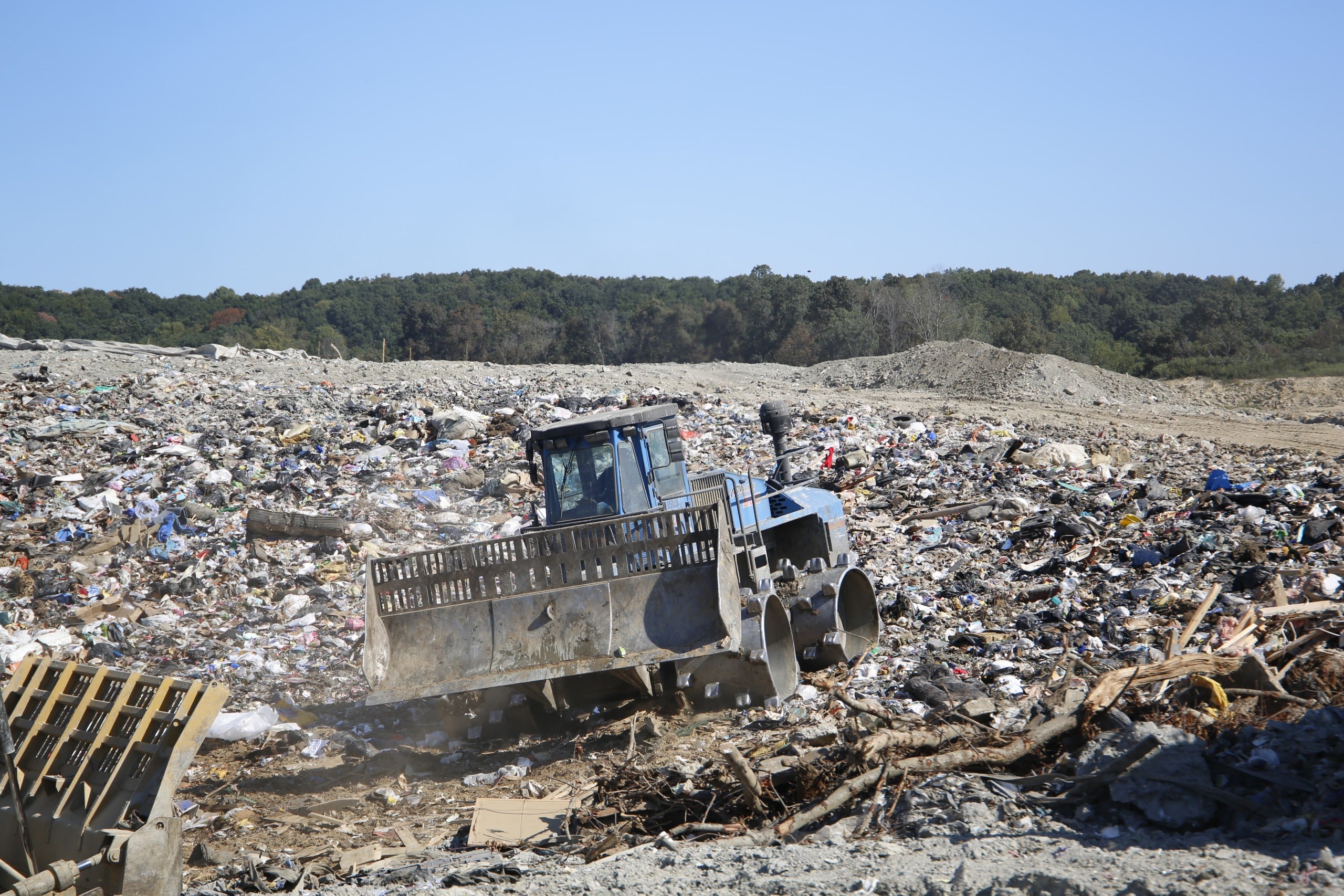
When garbage arrives at a landfill, it is dumped at the working area of the landfill where it is compacted by a bulldozer before being covered with a layer of dirt. Barlaz said that the health risk to landfill workers posed by hazardous waste are relatively small — the real risk comes from processing leachate.
“I think that the major impacts are, number one: The chemicals that are soluble are going to show up in the landfill leachate,” Barlaz said. “There have been a number of studies showing [that] pesticides and old pharmaceuticals are in landfill leachate. The problem is that the leachate collected goes to wastewater treatment plants. The problem is that some of those chemicals are not removed in the wastewater treatment plant [and are] then discharged to surface water.”
A representative for the U.S. EPA noted that this is one of the major consequences of throwing out waste improperly. The rep noted that studies have shown the harm misplaced pharmaceuticals have on aquatic life, for instance; the research on the human impact is still underway.
Rumpke’s leachate test doesn’t measure pharmaceuticals according to Kennedy.
While pharmaceuticals are considered medical waste and not household hazardous waste, improper disposal is just as consequential. Athens County residents can properly dispose of medication at the Athens County Sheriff’s Office Prescription Disposal Box at 13 W. Washington St. or the CVS Pharmacy at 555 E. State St.
“That’s kind of one of the major problems with municipal landfill — is then anything that ends up in the leachate can then get brought to a wastewater treatment unit,” the U.S. EPA representative said. “[Those chemicals] can pass through the wastewater treatment unit and get discharged into surface water, like a river stream.”
Aside from landfills, another improper form of disposal for household hazardous waste, especially residual liquids, is in the sewer system.
Lisa Agriesti, a wastewater treatment plant operator for the City of Athens, said that this waste hopefully dilutes by the sheer volume of water coming through the treatment plant.
Agriesti added that the water treatment plant tests for a wide range of chemical issues. The plant conducts daily tests for acidity, monthly tests for nitrogen, quarterly tests for lead and several more tests.
“We are required to report a certain number of tests to EPA, so if one failed, we would test again and see if we got another hit, or if possibly it was a lab accident,” Agriesti told the Independent in an email. “Those things are not always easy to determine. However, if we continued to get a hit on something we would try to back track and locate where it might be coming into the system and [find out] how or why it is coming in.”
When hazardous waste goes where it should
Environmental Enterprises, a Cincinnati-based company, assists solid waste districts in collecting household hazardous waste, including the Athens-Hocking Solid Waste District.
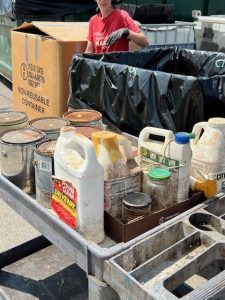
Brian DePeel, divisional director of household hazardous waste for Environmental Enterprises, said that once the company’s employees get their hands on household hazardous waste, the focus shifts to safely storing and transporting the material. DePeel said that this is accomplished in a variety of ways, ranging from buckets to drums, to large cardboard boxes.
“It’s at that particular point it gets logged in by the site manager,” DePeel said. “We will load the truck as we go and write a manifest. [Once the] manifest is signed, we take generator status on the material … and then it gets delivered down to our facility in Cincinnati. That’s where it’s processed.”
The first step in processing is organizing the items into groups: paint goes with paint, flammables with other flammables, and so on.
Some types of hazardous waste, like pesticide containers, are incinerated, as they can’t safely be reused or recycled. But DePeel estimated that 80–90% of the household hazardous waste Environmental Enterprises collects is reused or recycled into other materials.
That can include direct use of the materials by employees.
“If an employee wants something for their own personal use they can take it out,” DePeel said. “But nothing leaves our facility unless it’s for their own personal use. They can’t bring a friend in or anybody else like that. It has to be their own personal use.”
In terms of recycling, DePeel pointed to flammable liquids as a good example, noting that they can be used for fuel in cement kilns.
“A lot of the materials that do get recycled are actually combined with other materials to create a product that can, in fact, help recycle something else,” DePeel said.
Another item which is frequently recycled is latex-based paint. DePeel said that Environmental Entreprises partners with a local church group that remixes and combines the paint for charitable uses.
In the 37 years DePeel has worked for the company, he could only recall two types of hazardous waste that have to be sent on to landfills: asbestos and hardened paint.
“That’s the only option you have with asbestos,” DePeel said. “Because there’s no amount of treatment or chemicals that is gonna take away the hazard of it.”
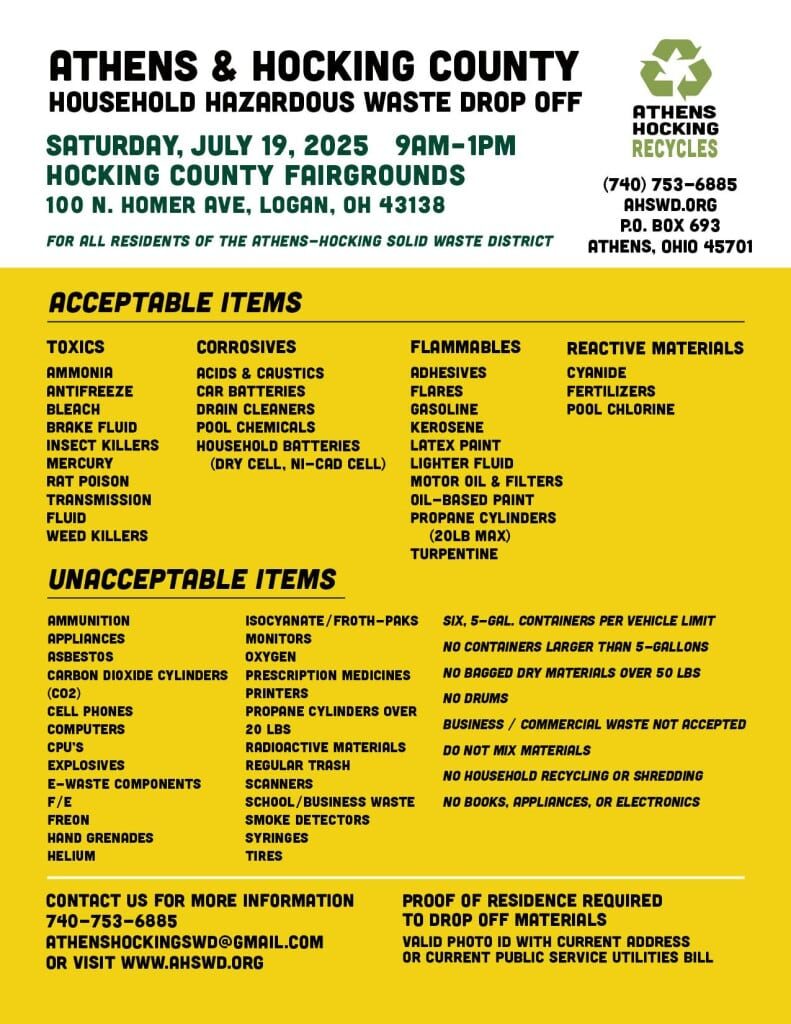
This year’s household hazardous waste collection is 9 a.m. to 1 p.m. Saturday, July 19 at the Hocking County Fairgrounds.