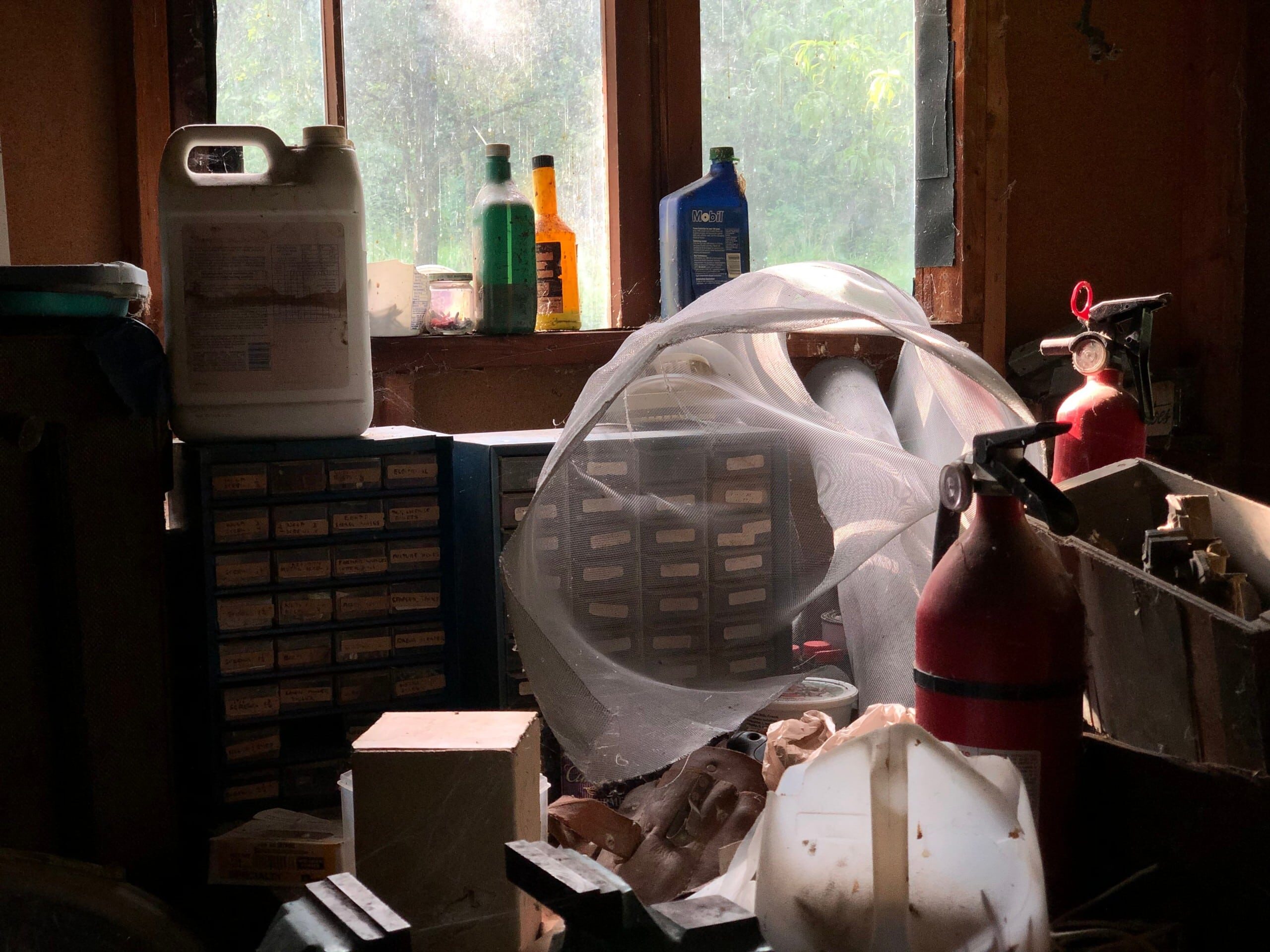
ATHENS COUNTY, Ohio — Current and future projects by local waste collectors aim to streamline the complex process of collecting and disposing household hazardous waste.
Center for Hard to Recycle Materials (CHaRM)
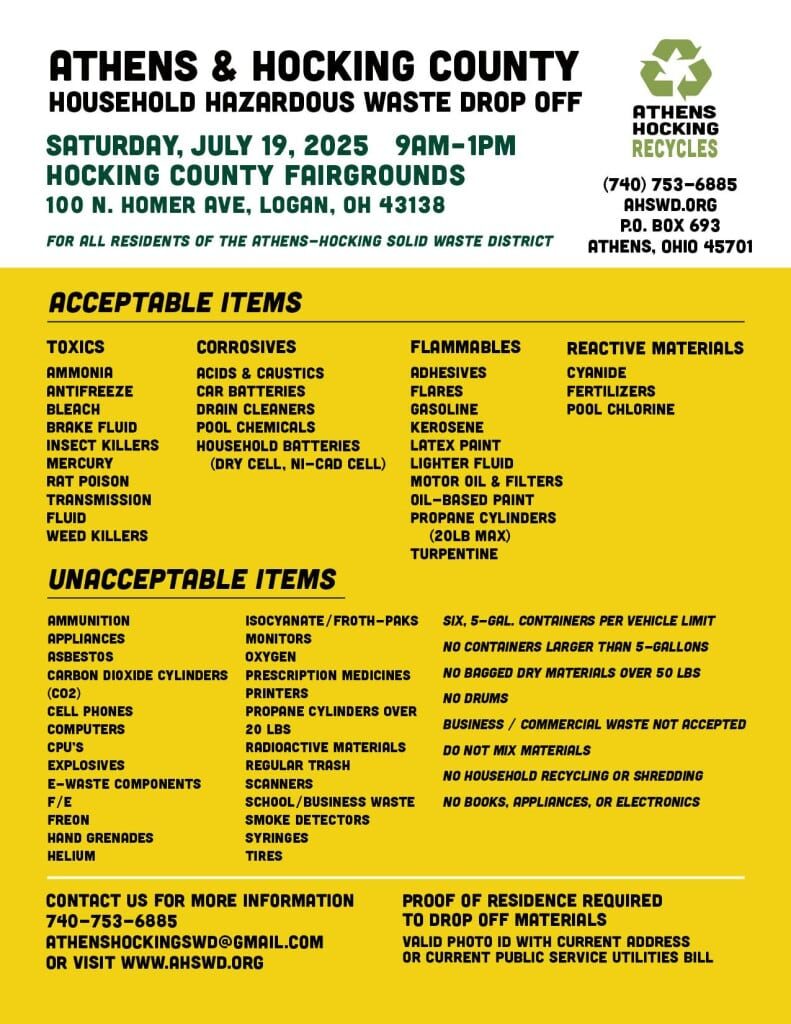
Household hazardous waste, such as paint, cleaning chemicals and batteries, are typically collected at the Athens-Hocking Solid Waste Districts annual household hazardous waste collection day, and other options exist for collection around the county.
But the Athens-Hocking Solid Waste District’s proposal to expand operations for its Center for Hard to Recycle Materials in Logan would create a year-round collection point with regular hours for residents to dispose of household hazardous waste and other hard-to-recycle materials.
Such centers, also known as CHaRMs, have opened up in cities across the country, such as Pittsburgh, Atlanta and Boulder.
“I’m renovating the Sutton Road Recycling Center to be able to have a building that’s heated and cooled and has running water,” Jane Forrest Redfern, the director of the Athens-Hocking Solid Waste District, told the Independent. “Right now, I don’t have any of that up in Logan. Once I get that center set up, then I can be there more often, and be able to have regular hours where people could drop stuff off.”
Currently, the center’s drop-off point is by appointment only.
Forrest Redfern told the Independent that upgrading the center’s heating and cooling system will allow for the safe storage of more materials, paint and other chemicals can decompose if exposed to frequent temperature changes.
Forrest Redfern speculated that she would have Environmental Entreprises, the company the Athens-Hocking Solid Waste District partners with to dispose of household hazardous waste, come every six weeks to collect materials.
The center will also enable the waste district to host special collection events, according to Forrest Redfern.
“Most people want to paint in the spring and summer,” Forrest Redfern said. “In August, you could do a paint drive. From that, if the paint is not that old, school groups or churches or whoever, here’s fresh paint you can use. If not, we’ll send it off for recycling.”
The Athens-Hocking Solid Waste District is currently in the bidding process for the renovations at the Sutton Road Recycling Center and doesn’t have an estimated completion date, according to Forrest Redfern.
Crissa Cummings, the executive director of the Southeast Ohio Recycling Terminal (SORT), told the Independent that SORT also has plans to open a CHaRM in Athens County, estimating that it would cost roughly a million dollars to build their facility.
“Ideally, there would be a place where folks could bring hazardous waste year-round in both Athens and Hocking counties,” Cummings said. “We have the plans drawn up for [a CHaRM] that’s going to also take hazardous waste.”
Cummings told the Independent that SORT’s CHaRM would offer the full spectrum of collection, including lawn waste, mattresses, and textiles, in addition to and household hazardous waste. Cummings said that SORT would work with Rural Action and the Athens-Hocking Solid Waste District to set up collection points.
Shifting to a year round collection model does have its pros and cons.
“Year-round programs are obviously more accessible,” a representative from the U.S. Environmental Protection Agency told the Independent. “They’re more convenient. You can go to them more regularly. … I’ve got a year round program available to me, and it creates a regular habit of dropping off my household hazardous waste.”
However, Brian DePeel, the divisional director of household hazardous waste for Environmental Enterprises, noted that there’s much higher cost involved in operating a program year-round.
“There’s a cost that’s involved when you have a recycling center that people don’t understand,” DePeel said.
Forrest Redfern said that the Athens-Hocking Solid Waste District would continue to run collection events, as they both serve to capture household hazardous waste and educate the public.
“People don’t really think about household [hazardous waste] every day, right?” Forrest Redfern said. “They only think about it when they’re moving or something spilled or they’re concerned about it, or whatever, doing spring cleaning. So you want to have events [to generate awareness].”
Extended Producer Responsibility
Legislation is also an avenue for making it easier to dispose of household hazardous waste. Extended Producer Responsibility, or EPR, has become a way for states to offset costs associated with household hazardous waste by requiring companies and retailers to offer a collection method for hazardous waste.
“There are no federal EPRs, we don’t have the legal authority to do an EPR federally,” the EPA representative told the Independent. “But Vermont has passed one for all household hazardous waste, and they’re working on implementing it statewide.”
According to the Product Stewardship Institute, a group which works to pass EPR legislation, 34 states have passed 146 EPR laws, targeting 21 different types of waste. Ohio currently has no EPR laws.
According to a study published in the Journal of Industrial Ecology, the first EPR laws passed in 1991 in New Jersey and Minnesota, requiring manufacturers to collect and recycle dry cell batteries.
The EPA representative said they haven’t heard of a county level EPR for household hazardous waste, but they noted that medical waste EPRs have been done at the county level before.
Alameda County in California, for example, requires pharmaceutical companies to pay for the collection and disposal of unused medication. Pharmaceutical companies sued to stop the EPR, claiming that it violated a constitutional interstate commerce clause. However, the 9th Circuit Court of Appeals upheld the EPR as legal, and the U.S. Supreme Court refused to hear the case, paving the way for other counties to enact similar laws.
“My expertise is in pharmaceutical disposal, and absolutely the pharmaceutical EPRs started at the local level and then grew from there,” the EPA representative said. “Now there’s a bunch of state ones. So it varies from waste to waste and from state to state.”
Multiple Athens County waste activists and workers told the Independent that they would support an EPR. Maria Bonner, director of the Zero Waste program for Rural Action, was among them.
“The companies that are producing these [items should have to] have a way to accept them for proper material management,” Bonner said.
Forrest Redfern also voiced support for an EPR, describing it as a “social responsibility law.”
“I mean ideally what should happen is that the people responsible for these materials should take them back, instead of making consumers try to figure out where to get rid of materials,” Forrest Redfern said.
The Independent asked several local politicians if they would support the implementation of an EPR in Athens County.
Many of them, such as County Commissioner Chris Chmiel and Athens City Council members Micheal Wood and Solveig Spjeldnes, said they would be interested in learning more about this type of legislation.
Other officials, such as County Commissioner Lenny Eliason, Athens City Council President Sam Crowl and Athens City Council Member Jessica Thomas told the Independent that they would be concerned about the authority of local government to implement such a measure.
“In terms of general EPR policies, while I support attempts to fund and properly dispose of hazardous waste, there are many things to consider in a specific policy,” Crowl told the Independent in an email.
“Such as the impacts of placing the responsibility in the hands of industry producers who may not be the best experts on disposal, the potential reduction of the role of local governmental agencies in effectively managing waste, and many others including the impacts to industries as well as consumers.”
Crowl added that he would support an EPR if a sustainability assessment showed positive benefits to local residents and the environment and that these benefits outweighed the cost of the program.