NELSONVILLE, Ohio — Nelsonville City Council — both of them — held organizational meetings this week.
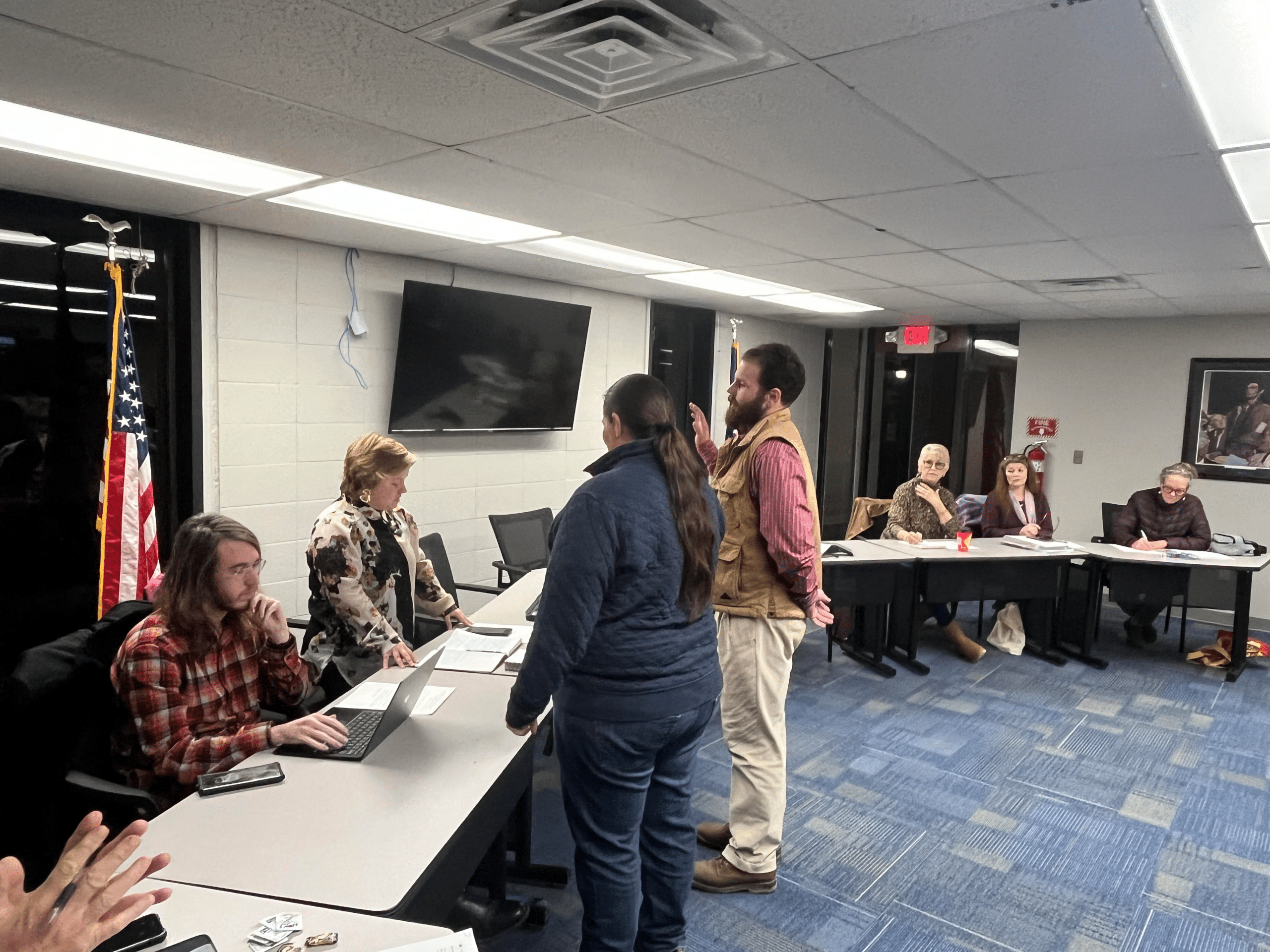
On Monday Jan. 5, candidates who were elected November 2025 met to discuss city business, at a meeting that members of the public attended. Acting as a Nelsonville City Council, the group held a public meeting not at Nelsonville City Hall, but at Hocking College.
That group included Lynn Bishop, Wesley Henderson, Glenn Smith, Sue Powell, Jessica Hollenbaugh and Dan Sherman, all of whom ran for city offices last year.

“If [our council] went to city hall, there’s the chance that the council that’s still performing as council would try to have us arrested; they cannot do that here,” council member-elect Sue Powell said during the Monday meeting at Hocking College.
McCray Powell and Nic Joseph-Saul were not present, though also elected last year; both are members of the city council that existed before Jan. 1. McCray Powell and Joseph-Saul’s council met Jan. 6 at Nelsonville City Hall. The special meeting was announced through the city’s official channels, unlike the one held at Hocking College.
The duplication results from the city’s uncertain legal status. In November 2024, voters overwhelmingly approved Issue 23, which repealed the city charter and mandated a new city government to begin Jan. 1 of this year. But in August 2025, the city council repealed Issue 23 by passing Ordinance 54–25. The Ohio Supreme Court has twice refused to decide which side should prevail.
Jan. 5 meeting
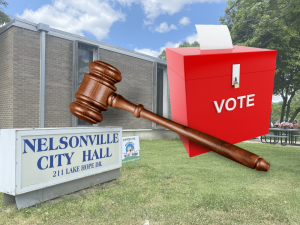
Although it resulted from the 2024 passage of Issue 23, which abolished the city charter, the council that met Jan. 5 proceeded under charter rules. Jonathan Flowers, who was elected mayor in November 2025, was appointed city manager. Councilors appointed Joseph Scherer as clerk of council, Michael Milane as city treasurer and Garry Hunter as law director. Andrea Thompson-Hashman was appointed as city auditor, the position she ran for in the November 2025 election.
The council also adopted rules for council operation. Sue Powell was chosen to serve as council president, with Jessica Hollenbaugh as vice president.
The council at Hocking College also adopted Ordinance 2-26, an ordinance that repeals Ordinance 54-25, and allows the council to operate outside the charter. However, given the city’s case that two opposing bodies are vying for its governorship, it’s unclear if the ordinance is effective.
Sue Powell told the Independent that “in our estimation, we are in control and we’re going to hold council meetings.”
When asked about whether the Issue 23 body has access to city funds and how it plans to operate while another council also is in place, Sue Powell told the Independent to ask Hunter “legal questions.”
Former council member Greg Smith — who spearheaded the petition drive that put Issue 23 on the ballot — said Jan. 5, “I’m not a lawyer. I can’t answer any questions, but I think it puts [the charter council] in a real tough position. I think it says we go in and post these ordinances on the bulletin board, that they’re in effect.”
Sue Powell told the Independent the Issue 23 council plans to meet again Jan. 19.
Jan. 6 meeting
During a special meeting Jan. 6, the council operating under Ordinance 54-25 filled two vacant council seats. Present were council members Gregg Clement, McCray Powell, Nic Joseph-Saul, Nancy Sonick, and Amy Hollenbaugh.
Acting Council President Nic Joseph-Saul made a motion to appoint Charlotte Beach to fill the seat vacated by Cameron Peck, after his one-month term ended Dec. 31, 2025.
Former City Manager Bernie Roell asked Beach if she was aware of the Issue 23 council and about her feelings about Issue 23. She said she attended the Issue 23 candidates’ meeting, but expressed not entirely understanding the circumstances surrounding the two councils.
“I don’t know all of what’s going on, because I’m not in it,” Beach said. “And in order to be part of something, you have to listen more and understand more, and that’s what I want to do. So I’m trying to join something so that I can learn more and do more and do the right thing.”
The council voted unanimously to accept Beach’s appointment.
Joseph-Saul made a motion to appoint Peck to fill the other council seat, vacated by Cory Taylor after his one-month December term ended. The council allowed Peck to comment on the nomination; he said he “spearheaded the effort for 54-25” because “the statute that went to the ballot was flawed and required transitory language.”
He began to talk about his plans for the future of Nelsonville before being interrupted by Roell, who asked, “Do you have a law degree background?”
“Do you?” Peck replied.
Roell said, “I don’t, but—”
“OK, neither do I, so we’re equals,” Peck said.
Peck continued to discuss his plans if he were to rejoin council, saying he wants to “try and shake hands and come together and either institute another ballot initiative that includes transitory language or petition for a charter amendment initiative.”
Dakota Saul — partner of Nic Joseph-Saul — asked if Peck would be willing to ensure a public education campaign on Nelsonville’s current governmental situation. Peck stated he would and that he was open to speaking with anyone.
He then turned to resident John Meeks. “I’ll talk to you, man, we’re neighbors,” Peck said.
“I know,” Meeks said. “And yet you personally attack citizens on Facebook like you have myself.”
That launched a back-and-forth between Peck and Meeks until Joseph-Saul intervened. No other comments were made and Peck was unanimously appointed to the council.
McCray Powell nominated Joseph-Saul for council president, but that nomination was voted down by Clement, Peck, Sonick and Amy Hollenbaugh; McCray Powell and Beach voted yes.
Amy Hollenbaugh then nominated Peck for the position. In public comment, Dakota Saul asked Peck several pointed questions, including “How do you think your behavior as president gives the public any faith to be behind you?” and “Do you feel like your behavior was appropriate when you scream at people?”
The back and forth between Peck and Saul ultimately settled and the council voted to appoint Peck as council president, with Joseph-Saul the only council member to vote no.
The vice presidency was met with a split council with one nomination for Joseph-Saul and another nomination for Amy Hollenbaugh.
The first round of voting ended without a majority vote for either candidate, with some council members taking time to ponder on the vote and other council members abstaining from voting.
A second round of voting ultimately ended with Amy Hollenbaugh being appointed as council vice president, with Amy Hollenbaugh herself abstaining and Joseph-Saul also abstaining.
The council then attempted to go into executive session, to which Roell asked if there was going to be a city attorney present and stated that the council cannot go into executive session without one. Peck asked Clement if Roell’s comment were true, to which Clement said it was true.
That doesn’t appear to be the case, however, according to the Ohio Attorney General. And the city charter doesn’t mention any requirement for an attorney to be present for the council to go into executive session.
The city did not have an attorney during the Jan. 7 meeting because Jonathan Robe resigned from the position Dec. 31, 2025.
The council decided to adjourn without an executive session. After the meeting adjourned and the council chambers were emptying out, Peck removed the other council’s Ordinance 2-26 from the city bulletin board.
During a special meeting Jan. 8, the council passed Ordinance 1-26 to hire Dinsmore, a law firm, as special counsel to the city.
The Ordinance 54-25 council is set for its first regular meeting of the year Jan. 12.
Background
The events leading up to the current situation have been forming for years, but began to brew after 70% of Nelsonville residents voted to pass Issue 23 during the November 2024 general election.
Issue 23 was a citizen-initiative to abolish the form of government since 1996, the Nelsonville City Charter, and return to a mayor-based statutory form of government Jan. 1, 2026.
It took months and a tug-of-war legal battle to even get Issue 23 on the ballot.
2025 was a year intended to prepare for the incoming change of government with the implementation of the Ad-Hoc Advisory Commission, a citizen-led committee that oversaw the city’s transition to a form of government.
Although, issues began to arise early on when the council cited a lack of transition plan in changing the form of government and the commission mulled over the “December problem.”
The ‘December problem’ was the one-month lapse between the end of council members’ terms in December 2025 and the beginning of terms for members of the Issue 23-based council, which were set to take office beginning in 2026.
In response the council made plans to place Issue 4 on the ballot during the May 2025 primary election. Issue 4 would have kept the charter while allowing a mayor-council city government.
The issue ultimately failed with 54% of residents voting against it.
After the failure of Issue 4, it was apparent that residents wanted a change in the form of government, but the council deemed getting to that point was tougher than it seemed, again citing a lack of a transition plan.
Due to that reason, the council voted 6-1 on Aug. 11, 2025, to repeal Issue 23 through Ordinance 54-25, effectively obstructing the path to a statutory government.
In the over four months since the repeal, the results of the repeal festered with multiple court cases and legal battles to achieve a direct resolution on the matter, but ultimately no court ruling gave a final decision on the legality of Ordinance 54-25.
This led to the November 2025 general election having Issue 23-based candidates still on the ballot with Issue 23 repealed. Legal battles continued during the month of December 2025, but a lack of direct oversight led to 2026 starting without an answer on who’s in charge.
The issue at hand was foretold and plainly put in a court filing during the city’s Ohio Supreme Court case in September 2025: “[A] final resolution of the issue is needed to restore the citizenry’s trust in local government. Currently, when the citizens of Nelsonville wake up on January 1, 2026, they will not know which government is in charge,” a second motion for reconsideration filed by the Athens County Board of Elections stated in the case. “It will create further chaos that will likely take years to untangle, and all at taxpayer expense.”
Keri Johnson contributed to this reporting.