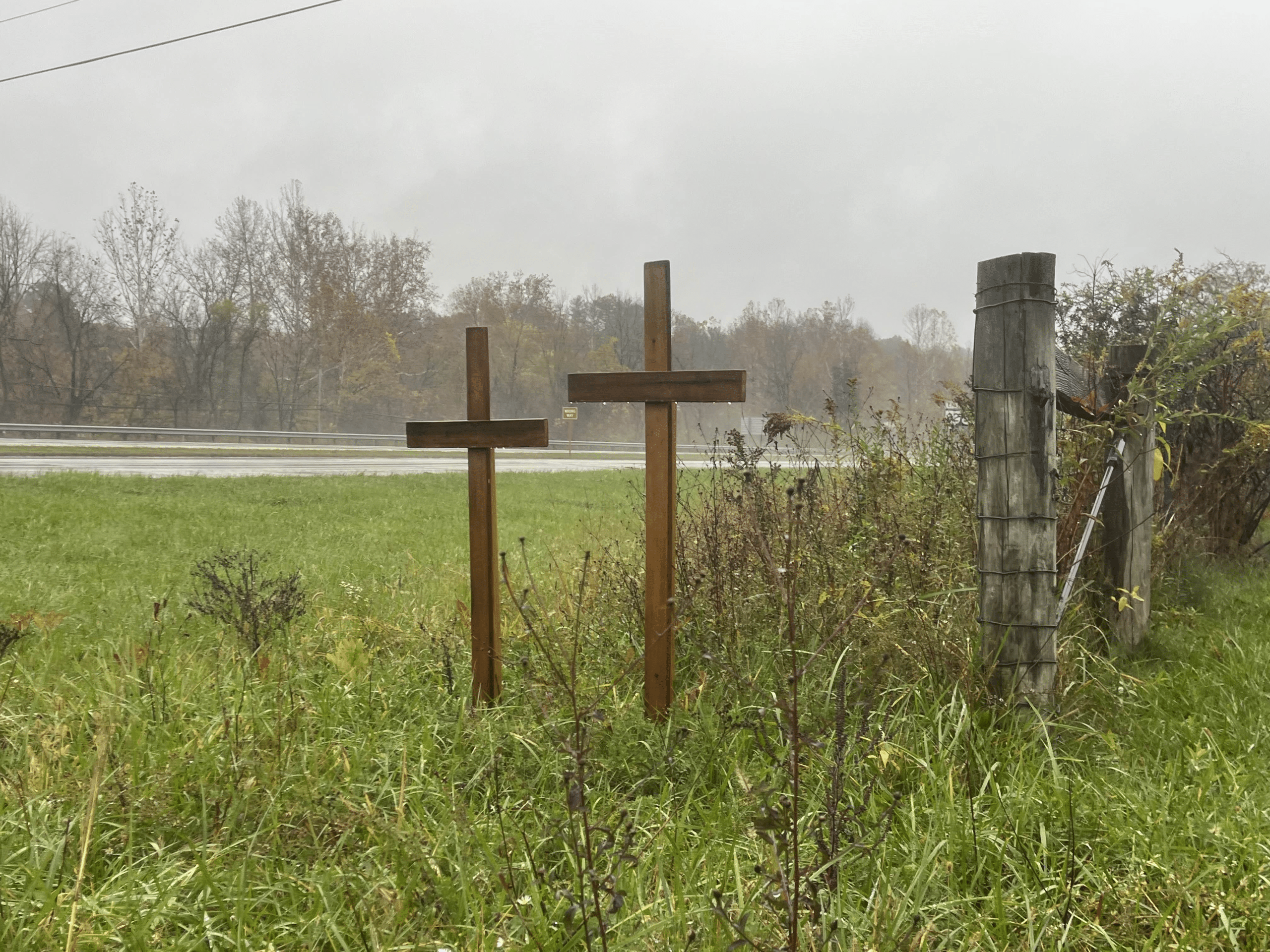
ATHENS, Ohio — An Ohio State Highway Patrol trooper involved in a crash that killed two Albany residents and their dogs in July has since returned to full duty, according to OSHP Sergeant Brice Nihiser.
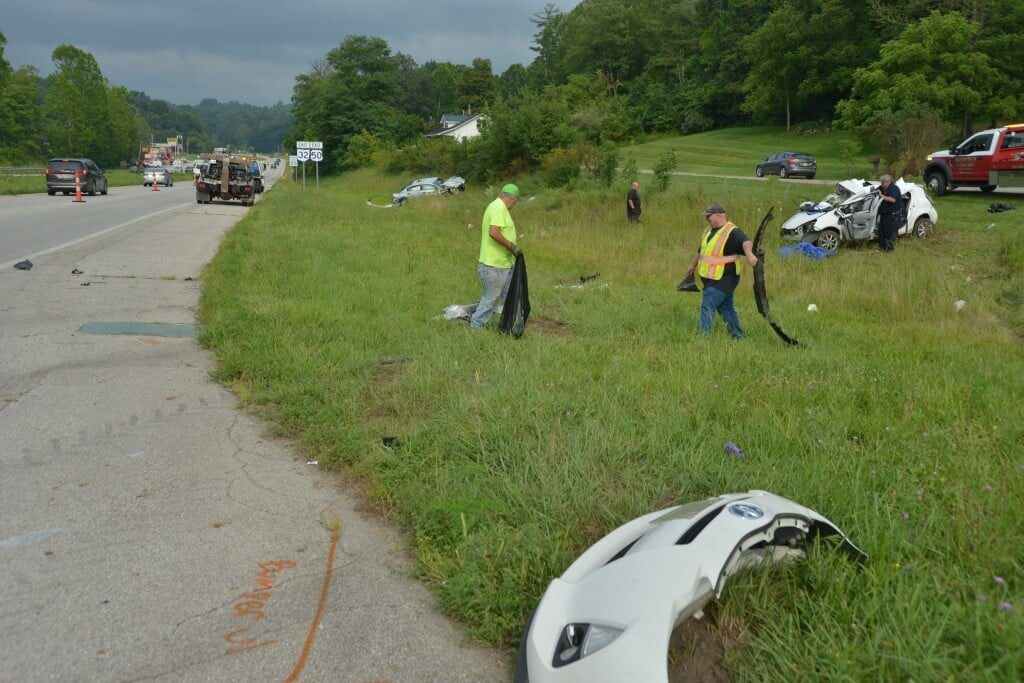
The crash happened on the afternoon of July 31, when John Horton was driving westbound on U.S. 50 in a Toyota Prius with Le-Ann Horton, and the couple’s two dogs. The Hortons were turning left from U.S. 50 across the highway onto Fisher Road when their car was struck by a cruiser driven by OSHP Trooper Zackary Tackett. Tackett was trying to catch up to a motorist who had allegedly committed a traffic violation.
According to an independent review of the body cam footage, Tackett had been travelling over 100 mph at the time of the impact. He had reached over 120 mph in the moments before the collision. The posted speed limit on that section of U.S. 50 eastbound is 55 mph.
Nihiser told the Independent Sept. 22 that Tackett was on administrative duty following the crash and had not returned to duty. In a follow-up interview on Oct. 30, Nihiser told the Independent Tackett was placed on critical incident leave but had since returned to full duty.
Nihiser said OSHP troopers returning to duty from leave depends “on the circumstances” but much of the time it depends on whether the trooper is “able to come back to full duty physically.”
Nihiser also stressed to the Independent that Tackett was not involved in an “active pursuit” at the time of the crash.
“There’s a big difference between a pursuit and just catching up to a vehicle,” Nihiser said. “For a pursuit to be initiated, we have to be behind the car and activate our lights and show that we are trying to stop that vehicle.”
The OSHP has separate policies for troopers operating their cruisers and for troopers engaging in vehicular pursuits. Pursuits are defined as “an active attempt by an officer in an authorized emergency vehicle to apprehend a fleeing suspect(s) who is attempting to avoid apprehension.”
Troopers on patrol are expected to observe the legal speed limit except during specific activities — including “overtaking or intercepting a violator.”
If they’re chasing a fleeing suspect, however, troopers are required to use their lights and sirens “to signal to the suspect and warn other persons using the highways.”
The OSHP could not confirm the speed at which Tackett was travelling, whether the cruiser’s emergency lights were on prior to the crash, or what alleged traffic offense prompted Tackett to accelerate.
OSHP’s crash reconstruction team is still investigating the incident, and those questions would be answered in a final report, Nihiser said.
Speed estimate
Tackett’s dashcam video of the crash obtained by the Independent offered an answer to at least one of those questions.
Peter Thomas, a mathematics professor at Case Western Reserve University, was able to calculate the speed Tackett was travelling at based on the cruiser’s dashcam video.
The Independent has decided to not publish the footage, out of respect for the victim’s families.
“I am not a ballistics expert, but I think anyone can estimate the vehicle’s speed fairly accurately from the video,” Thomas told the Independent in an email.
According to Thomas’s calculations, Tackett’s speed reached as high as 130 mph six to four seconds before impact and “about 116 miles per hour in the two seconds preceding the collision.”
Thomas came to the conclusion by measuring how quickly the cruiser passed the center white lines on the highway.
Thomas cited page 538 of the Federal Highway Administration’s Manual on Uniform Traffic Control Devices which states, “Broken lines should consist of 10-foot line segments and 30-foot gaps, or dimensions in a similar ratio of line segments to gaps as appropriate for traffic speeds and the need for delineation.”
Thomas concluded that based on a 40-foot distance from the beginning of one line to the next and the dashcam video’s 30 frames per second frame-rate, he could precisely calculate the cruiser’s speed.
Thomas specifically looked at the last 10 seconds of the 1 minute and 40 second video, when Tackett is travelling at the fastest speed, leading up to the moment of collision.
From the timestamp of 1:30 to 1:36, Thomas observed that for every two seconds, Tackett was travelling past 9.25 highway line segments, which is about 370 feet. Therefore, Tackett was travelling 185 feet per second, or 126 mph.
“To estimate the velocity at the time of impact, I backed up 60 frames from the last frame in which I could see a white stripe, which was 10 frames before timestamp 1:38. In the 60 frames that followed, the vehicle appeared to move about 8.5 stripe intervals, giving an average speed of about 116 miles per hour in the two seconds preceding the collision,” Thomas wrote in the email.
Thomas wrote that he didn’t know how uniform the 40-foot stripe rule is on U.S. 50, but is “pretty confident” that his estimates are good within a range of plus or minus five mph.
John and Lee-Ann Horton had been married since 1976, and were both active volunteers in the community, according to an obituary published July 31 by Ewing, Hughes & White Funeral Homes.
Tackett “sustained non-life-threatening injuries and was transported to Marietta Memorial Hospital for treatment,” according to a press release about the incident.
In a call log audio recording of the incident obtained by the Independent, a trooper who responded to the scene can be heard telling the dispatcher that Tackett “has minor injuries” and “a minor headcut.”
The Independent also obtained the initial OSHP traffic crash report, which included a written narrative of the incident. The narrative states that after striking the Hortons’ vehicle, Tackett’s cruiser “continued off road right overturning multiple times,” eventually “striking a traffic sign.” The vehicle then “overturned and struck a fence.”
Tackett was selected as trooper of the year at the Athens post of the OSHP in 2022 and 2024, according to a press release from November 2024. The release also noted he won a traffic safety award in 2022 and 2023, and in 2018, won a criminal patrol award.
Unsafe speeds
Prior to the July 31 crash, the Independent had been investigating high speed chases in Athens County.
Throughout the investigation, the Independent conducted interviews with experts who spoke candidly on the dangers of police officers operating their vehicles at high rates of speed.
Geoffery Alpert, a professor of criminology and criminal justice at the University of South Carolina, has researched policing nationally and across the globe for over three decades. Alpert has written and contributed to multiple books and articles about policing, including research on police pursuits.
In an interview with the Independent in May, Alpert said law enforcement agencies should view the risk of high-speed emergency vehicle use as a “balancing test of what’s the [agency’s] interest is in apprehending someone, and then the protection of civil and constitutional rights of everyone, including the suspect, the public and to a certain extent the police officer [involved].”
Officers engaging in high speed emergency vehicle use should only raise “the risk of the public for the most serious offenses,” Alpert said.
“Certainly when there’s no risk known … the question we have to ask is, ‘why raise the risk for the public?’” Alpert said.
In an interview with the Independent in February, Lauren Bonds, executive director of the National Police Accountability Project, echoed similar ideas about suspects who commit traffic violations.
“If it’s a traffic violation, that risk [to the public] isn’t terribly high. You can find [suspects] later,” Bonds said.
Bonds suggested that agencies could cite motorists with a ticket through the mail for traffic violations instead of speeding to catch up to the vehicles.
Referencing the frequency with which OSHP crashes result in death of those uninvolved in a crime or traffic incident, Nihiser said, “I wouldn’t say they are common, but they do happen.”
“We try to take every precaution that we can to mitigate that risk,” Nihiser said.