Disclosure: The Athens County Independent has been a host for AmeriCorps since 2023. Our most recent service member, Al Maloney, was among those whose positions were affected by the program cuts. They are now an employee of the Independent. In addition, three members of the Independent staff — Keri Johnson, Emily Beveridge, and the writer of this story, Eric Boll — are former AmeriCorps service members.
ATHENS COUNTY, Ohio — In the early evening of Friday, April 25, Rural Action received the bad news: The federal government had terminated funding for Volunteers in Service to America positions, also known as VISTA.
Nationwide, more than 32,000 AmeriCorps service members have been suspended, according to America’s Service Commissions, a nonpartisan group that advocates for public service.
Rural Action coordinates the local AmeriCorps program, which includes both VISTA and the State and National programs. The VISTA program is intended to combat poverty by dispatching paid service members to support local nonprofits and public agencies.
“It has a long history, and has done a lot to support local communities, to support local schools, to build up all of the work that supports farmers and local businesses,” said Debbie Phillips, Rural Action’s CEO. “We’ve been able to get a lot more done with supportive programs like that.”
Rural Action itself lost its VISTA member, who applied to another AmeriCorps program and is continuing their service.
“The communication that the service members received is that they can look for another placement,” Philips said. “I know that our team and ServeOhio are trying to support service members who have to make some kind of transition. I don’t know where folks are landing at this point.”
Avery Nelson, a VISTA who was serving at Mount Zion Black Cultural Center, said that Rural Action’s communication about the cuts has been more helpful than what’s coming from the AmeriCorps national office.
“Rural Action has been really good with trying to stay in contact and trying to figure out how they can help me or find a job,” Nelson said. “I just got an email from [the AmeriCorps coordinator] where she’s found some positions that might fit me.”
News of the VISTA program’s cancellation has had emotional and financial consequences for both the VISTA members and host organizations, Nelson said.
“One day it just hit me,” Nelson said. “I’ve been stressed out. I have to pay for [rent, groceries and bills]. I like my job, and I like the people I work with. I wanted to stay [with Mount Zion Black Cultural Center] for my whole three years of service, because I kind of had a vision. I just feel like [the government is] taking that away from me.”
News of the funding cut sent the Mount Zion Black Cultural Center board into “panic mode,” said Trevellya “Tee” Ford-Ahmed, the center’s communications and media director. Nelson was critical to the center’s operations “in terms of marketing, in terms of outreach, in terms of fundraising, in terms of grant writing, even in terms of our film development,” Ford-Ahmed said.
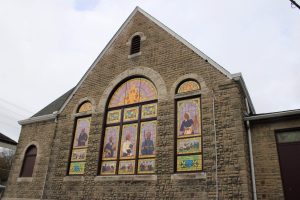
As an example, Ford-Ahmed pointed to Nelson’s role in the creation of Berry Day Week, a citywide holiday that honors Edward and Martha Berry, who ran the former Berry Hotel on Court Street. Nelson reached out to local restaurants, encouraging them to develop berry-themed menu items, Ford-Ahmed said. Funds from the berry-themed menu items were used in 2023 to finance the restoration of the stained glass windows at Mount Zion Baptist Church.
The Tablertown People of Color Museum was set to get its first VISTA member this year. The museum works to preserve and display artifacts demonstrating the cultural history of Appalachia ranging from Indigenous American arrowheads to Civil War medals to artifacts of the coal and railroad industry.
Museum Executive Director David Butcher said the VISTA position would have provided critical labor for museum operations — including digitizing and cataloging the museum’s collection.
“When you’re a small organization getting started, [VISTA] is a big help,” Butcher said.

What comes next
VISTA host sites are still determining next steps, figuring out if they can hire their VISTAs as regular employees or must let them go.
“I think each organization is going to make their own choices about how they respond to this,” Phillips said. “A lot of smaller nonprofits are mainly volunteer-led, and they may decide they’re just going to do the best they can. That’s just going to be a determination based on their own capacity.”
In order to host a VISTA, organizations complete a month-long application process and pay a share of the VISTA cost, “which is like their local buy-in and investment in the program,” Phillips said. Although the investment of time can’t be repaid, Phillips said that Rural Action VISTA hosts should get at least a partial refund of their share.
“We’ll certainly do everything we can to make people whole,” Phillips said.
Meanwhile, the Mount Zion Black Cultural Center hopes to make some lemonade by incorporating the VISTA loss in its upcoming capital campaign.
“It was a member of the board that said ‘Thank God we got a capital campaign coming up,’” Ford-Ahmed said.
Land of confusion
The VISTA program was created in 1965 as part of President Lyndon B. Johnson’s War on Poverty. The program functions as the domestic sibling of the internationally focused Peace Corps. For the past 60 years, VISTA service members have provided millions of labor hours to support public health, environmental education, pollution clean up, food access and more.
President Trump tried to cut funding for AmeriCorps his first term by eliminating funding in his budget proposals, according to the nonpartisan Voices for National Service. The recent cuts were ordered by the Department of Government Efficiency, led by Elon Musk; a coalition of governments and organizations is suing the Trump administration to stop DOGE, on grounds that it is unconstitutional.
The cuts have spurred confusion. Although VISTA funding is controlled by the federal government, not every VISTA program — but some AmeriCorps programs organized by state and nongovernment organizations have been cancelled. That has happened in Ohio, where the Ohio Outdoor Corps, the Northern Ohio Watershed Corps, the Ohio History Service Corps and other programs were closed.
The president’s current proposed 2026 budget would eliminate funding for all AmeriCorps programs.
AmeriCorps hosts and program coordinators think that will cost communities in the long run: For every dollar spent on AmeriCorps, communities get a $17 benefit, according to a study from Voices for National Service. And the investment itself is cheap, with service members paid about $25,000 per year, according to the AmeriCorps website.
“I just think [VISTA] is an incredible return on every dollar invested,” Philips said.
Butcher agreed.
“I think if anybody would stop for 20 minutes and read all the wonderful things that this program has done and accomplished, they would reconsider,” he said. “A lot of these VISTA [members] go on to do marvelous things — they contribute a lot to the country in rural areas, and then they go on to bigger and better jobs.”