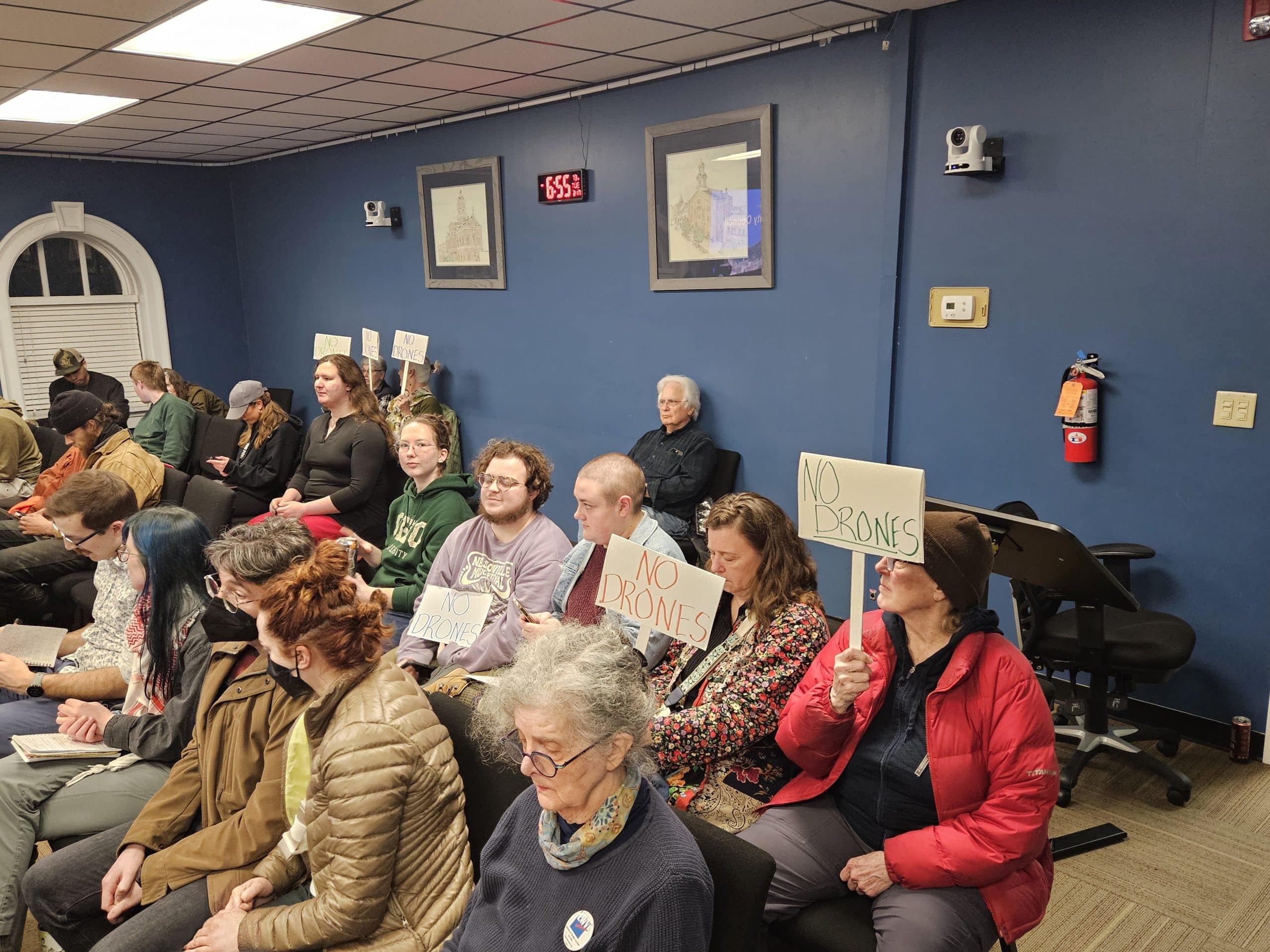
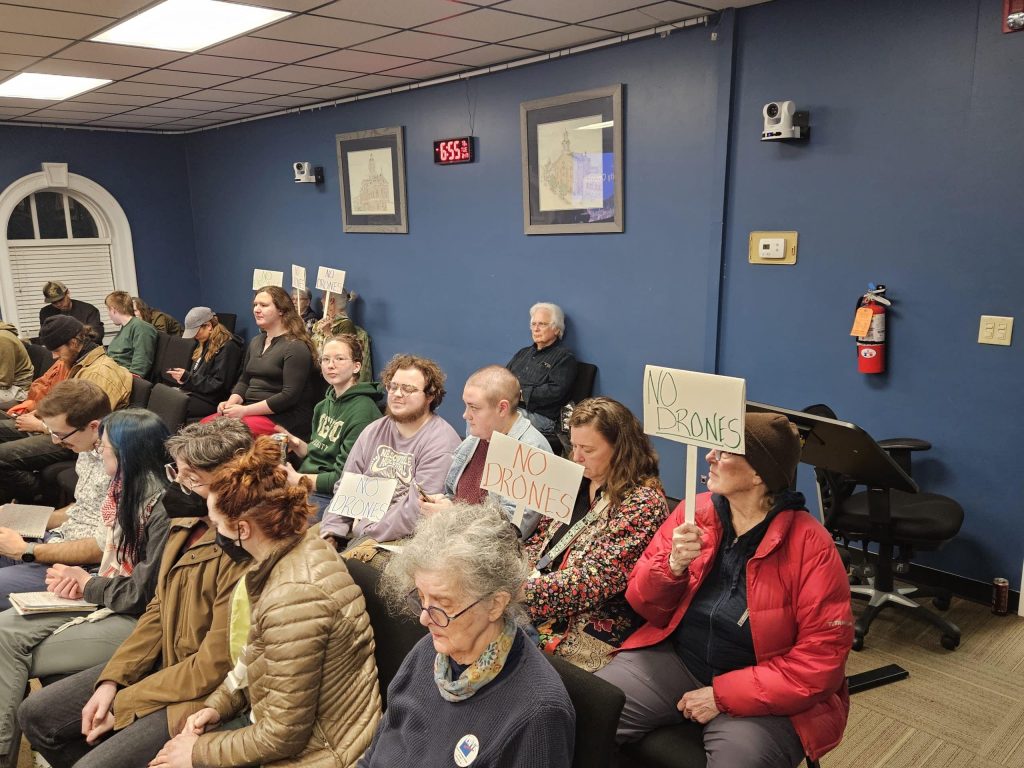
ATHENS, Ohio — Athens residents showed up at Athens City Council Tuesday night to oppose a proposal for the city to participate in Ohio’s Drones for First Responders Pilot Program.
Residents cited concerns that drones directed to scenes by police dispatchers would tread on civil liberties, as well as dismay that the state would not reimburse the city for the $300,000 up-front cost until 2028.
Speakers said they worried about the potential for sensitive data collected by the drones to be shared with other law enforcement agencies and the drone manufacturer. They also said the issue felt rushed, with the state requiring selected agencies to decide about participation in only a couple of weeks.
The issue of participation in the Drones for First Responders Pilot Program was first raised at a meeting of council’s City and Safety Services Committee on Feb. 9. A motion to bring the matter to the full council did not receive a second, so the issue seemed to have been settled.
However, the proposal returned for consideration at Tuesday’s combined committee-regular meeting, which spanned three and-a-half hours. The discussion involved two drone program-related ordinances.
One ordinance would have allowed the city to enter into an agreement with the Ohio Department of Transportation to initiate the program. A related appropriations ordinance would have authorized grant acceptance and placement in the city budget.
The Committee of the Whole voted 5-2 against moving forward with the drone program ordinances.
However, they did move forward on the city’s first policy involving unmanned aerial systems, such as drones. It would also apply to body-worn cameras and automated license plate readers.
The policy offers minimum requirements for warrants, data retention, access controls, and biometrics, with facial recognition software prohibited.
It also covers “Protected Activity” under the First Amendment, stating drones cannot be used “to monitor or record individuals solely for exercising their First Amendment rights, such as peaceful protests or religious gatherings.”
The civil liberties policy would require the city service-safety director and the city’s police chief to develop a much more comprehensive policy for advanced technology.
Public speaks out against drones
Council President Micah McCarey divided public comments and council discussion into three sections: civil liberties, program funding, and the grant agreement. Most of the public comment came during the civil liberties portion of the agenda.
Brenda Searcy, a Westside resident, said the public already has a hard time informing itself about rapidly advancing technology. The guardrails that once appeared to protect the citizenry are no longer followed, she added.
“We don’t live in the world we lived in 15 months ago,” Searcy said. “We just don’t.”
There are people who “are terrified” of how advanced technology can be used, who “do not have the status of U.S. citizen,” she said. “There are a lot of people here on temporary statuses, etc., and they’re terrified. I’m terrified for them.”
Ben Brewster, a Spring Street resident, said drones would directly violate the Fourth Amendment through warrantless fly-overs and recordings made over private property.
The presence of a city police-dispatched drone “would represent a major step in the direction of constant law enforcement surveillance,” Brewster said.
“The best time to defend your privacy is before you lose it,” Brewster said.
Tyler Woodbridge, a Maplewood Drive resident, said his fear is that the federal government could “commandeer” drone data “ for nefarious purposes,” including family separation and deportation of U.S. citizens. Resident Mizan Ali said a drone was seen at two recent non-violent protests, which did not engender public trust. While the city does not yet own or operate drone technology, the Athens County Sheriff’s Office has used its drones to observe protestors.
Jeff Kuhn of May Avenue said the important issue is the contract the city would have with the drone company and how drone data collection would be used and shared. Some companies keep data for 30 days, which is “egregious,” Kuhn said, noting that New Hampshire passed a law that data there must be deleted after three minutes.
A company’s use of its drone data is what it decides, and sharing with outside law enforcement agencies is the issue, Kuhn said. The agency needs only make a request. The drone contract should involve a community control model being used across the country, Kuhn said.
Badger Johnson, of Woodward Avenue, said he visited Minneapolis recently and noted that a woman was filming U.S. Immigration and Customs Enforcement agents “dragging a family out of their car.”
One of the agents addressed her by name, Johnson said — made possible by facial recognition technology in the agent’s body camera. The camera also could have revealed her home address, he said.
“That kind of thing scares the pants off of me,” Johnson said.
Millfield resident Alex Hearne said artificial intelligence companies use legal loopholes to over-promise the community safety aspects of technology, such as license plate readers, while using the same data for other purposes eroding privacy.
A few speakers mentioned Ohio House Bill 26, which would “require state and local authorities to cooperate with the federal government in the enforcement of immigration laws” and allow the state to withhold funds from municipalities that don’t comply.
Sarah Jones, a Nottingham Drive resident who moved to Athens eight years ago, said she never thought invasion of privacy would become an issue here, the city she dreamed of as her permanent home.
“I foolishly thought that a proposal like this would not infiltrate the community that I now call home. Clearly, I was wrong,” she said. “You can’t protect us from the many consequences, so protect us now.”
Some audience members held signs that read “NO DRONES.” About halfway through the meeting, Alan Swank, 4th Ward, tried to stop them.
“You know what, folks, in all seriousness, we have rules here,” Swank said. “Would you please put down the signs? I know you have your rights of first expression, but this is not a football game or supporting teams or whatever.”
McCarey interceded, saying, “If you want to hold your sign, you can hold your sign,” before directing Swank to continue his comments.
Council members’ positions
Council members said they had received numerous emails from residents, all opposing the Drones for First Responders Program.
Council member Beth Clodfelter, At-Large, said some of the 17 emails she received, from “people I really, really respect,” went into several paragraphs of vivid detail about potential abuse of the drones.
“At least a dozen of them referenced a concern that ICE could get hold of this information,” Clodfelter.
Councilor John Staser, 2nd Ward, said he has never heard as many concerns voiced by his constituents as he has about the proposed drone program.
Staser said he was particularly concerned about warrantless surveillance after reading a July 2025 story from WOUB Public Media about area sheriff’s departments — including Athens County’s — using drones “to deter crime, pursue suspects and gather aerial intelligence in high-risk areas.”
Mayor Steve Patterson noted that Athens firefighters could use drone aerial assistance to locate fire victims, or for search and rescue operations along the Baileys Trail System near Chauncey. The possibility of using drones owned by the Athens County Sheriff’s Department for such purposes was discussed during Tuesday’s meeting.
Both Clodfelter and Staser said that drones could be useful to firefighters and other emergency responders, but that potential abuses outweighed the potential good.
Councilor Michael Wood, 1st Ward, said he received 25 emails, all against the drone program.
Trying to “ram through” the related ordinances is not something that demonstrates public trust, Wood emphasized. He noted the loss of local control the city experienced when it tried to ban single-use plastic bags.
Wood said the same loss of local control over drones would happen if and when HB 26 passes. It will supersede whatever council enacts, he said, later adding, “I did not get elected to give up our civil liberties.”
The lone voices in favor of the program came from Swank and Paul Isherwood, At-Large.
Isherwood said the program would allow the city to better respond to emergencies. He also noted the program would be cost-effective during a time of tight budgeting for the city because the $300,000 program grant covers all related costs for two years. The city would pay for expenditures and later be reimbursed by ODOT.
Swank said he had received emailed comments voicing passionate views on the drone program. He added that he had attended a local basketball game recently and there was no opposition expressed to him there.
Swank appeared to blame public opposition to the proposal on the Independent’s story about the Feb. 9 committee meeting. He described the story’s first paragraph as “an inflammatory opening statement” and said the article had “unfortunately done this community a great disservice” by describing the program as “criminal surveillance purposes.”
The Feb. 9 meeting included substantial discussion of drones being first on the scene of possible crimes, such as catching a “peeping Tom” and recording the crime of voyeurism while it takes place. The discussion also involved drones being used to provide aerial surveillance of vehicle break-ins.
Swank said in his view, the use of drones did not involve criminal surveillance, but rather emergency response.
Isherwood and Swank cast the only votes in favor of moving forward with the drone ordinances.
In other matters Monday, the council:
- Adopted Ordinance 02-26, allowing the service-safety director to advertise, accept bids and give the award to the lowest bidder for the city’s annual purchase of water softening salt for the water treatment plant. The city is authorized to spend up to $230,000 on the purchase.
- Adopted Ordinance 01-26, which grants a special right-of-way use permit to a business so that an in-ground sign can be placed in front of the building at 35 Elliott St.
- Adopted Ordinance 03-26, related to interfund transfers, so that $375,000 could be applied as a final payment for the Athens Armory project. The Armory transfers entailed $214,000 taken from General Fund 101, Other Administration and $161,000 taken from the Capital Improvements Fund. The transferred funds were placed into the Athens community improvement corporation fund 906.
- Suspended the rules and adopted Ordinance 04-26, set for second reading, which authorizes the city auditor to reduce 2026 appropriations when anticipated receipts are inadequate, when combined with the carry-forward balance, to approve full appropriation of funds. City Auditor Kathy Hecht said the ordinance simply allows her to adjust city budget line items throughout the year so that revenue covers appropriations during a time of fiscally tight budgeting.
- Suspended the rules and adopted Ordinance 05-26 to make additional interfund transfers, including $73,000 from the general fund to the cemetery fund; $160,000 from the Parking Garage Fund to the Parking Garage Debt Fund; and $400,000 from the Water Fund to the Water Treatment Program Improvement Fund.
- Heard first reading of three ordinances related to temporary street closures for fairs and festivals in the Uptown area between April 11 (International Street Fair) through Oct. 31 (Halloween Block Party). McCarey asked if the council wanted to ask event organizers to pay fees ranging from $500–$1,500 to help cover the city’s costs associated with placing barricades during events, offering electric hookups and other services. Transportation Committee Chair Beth Clodfelter said that should not happen this year because event organizers applied for permits on specific dates before the city considered fees. The matter may be discussed next year, she said.
- Suspended the rules and adopted Resolution R-04-26, designating banks as public depositories for city funds that are currently not in use and can thereby be invested to acquire the highest rates of interest possible for city gain. Three local banks applied and were accepted as public depositories. The resolution authorizes to place up to $25 million as public depositories with J.P. Morgan Chase Bank, Athens; up to $15 million with Hocking Valley Bank, of Athens; and up to $15 million with Peoples Bank of Athens.
Athens City Council’s next meeting will be at 7 p.m. Monday, Feb. 23, at Athens City Hall, Council Chambers, third floor, 8 E. Washington St. Meetings are also streamed online. Regular sessions are on the first and third Mondays of the month; committee meetings are on the second and fourth Mondays.