ATHENS, Ohio — Athens Mayor Steve Patterson’s administration wants to increase the city’s income tax by 0.3 percentage points.
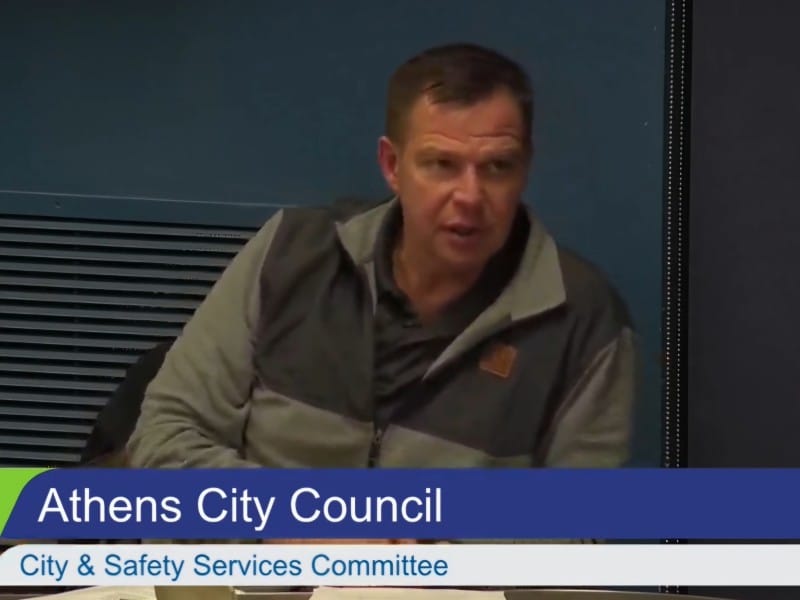
Service-Safety Director Andrew Stone presented the proposal to Athens City Council at its Tuesday night committee meeting. The increase would raise the city’s income tax to 2.25% and generate an estimated $2.6 million annually, Stone said.
If the council decides to pursue the increase, it must pass an ordinance to put the issue before voters — most likely on the May 2025 ballot.
Stone said the increase is needed to cover rising costs such as healthcare for city employees, which has jumped by 58% since 2009. The city has 263 employees, of whom 189 are full time, Auditor Kathy Hecht said in an interview Tuesday.
The tax increase would boost the general fund, which supports the city’s police and fire departments, courts, code enforcement and more. That fund has been hit by a decrease in overall income tax revenue from Ohio University personnel, Council President Sam Crowl said.
Stone attributed the drop to a change in state law during the COVID-19 pandemic that allowed employees who work from home to base some of their income taxes on where they live, rather than their employer’s location.
“The biggest issue is that we receive much less money from Ohio University in 2024 than we have in the past,” council President Sam Crowl said.
According inflation-adjusted figures Stone shared at the meeting, the city’s annual income tax revenues trended generally upward from 2008 to 2021, when collections peaked at $18.7 million. Total income tax revenue dropped in 2022 and again in 2023, when the city’s income tax brought in $16.8 million.
Total inflation-adjusted withholdings from Ohio University employees as a percentage of total income tax revenue have fallen from 42% in 2008 to 29% in 2023. Actual dollar amounts rose from 2008 to 2017, when they began to fall; 2023’s total OU withholding was about 28% lower than in 2017.
In addition to the erosion of OU withholding revenue, the city’s budget is burdened by increasing numbers of fire calls to the university, Crowl said.
“As we all know, about 45% of our fire runs are going to the Ohio University campus,” Crowl said.
Stone said other reasons to consider a tax hike are possible increases in contributions to the Ohio Police and Fire Pension Fund and the potential addition of three firefighters. In addition, he said, the state may cap municipal tax increases in the future.
Stone recognized that “it’s a fairly significant decision to pass on a tax increase to the voters.”
The city’s voters have twice approved hikes in income taxes. In 2023, the income tax went up by 0.1 percentage points to repay bonds for construction of the new fire station headquarters on Stimson Avenue. In 2017, voters approved increasing the tax from 1.6% to 1.85%.
According to Stone’s materials, Athens municipal income tax of 1.95% is lower than many other cities’, including Lancaster, Circleville, Oxford and Bowling Green, among other cities. Only Marietta’s is lower, at 1.85%.

Councilman Alan Swank, 4th Ward, asked if the city could instead get more revenue by increasing the city’s “inside millage” or combine a smaller income tax increase with a higher inside millage rate.
State law allows taxing districts to levy up to 10 mills of property tax without seeking voter approval. The city currently uses 3 inside mills.
Stone said he would take the matter under consideration.
Swank also noted that placing the issue on the May 2025 ballot issue would mean the city would have very few OU students available to help it pass. Swank suggested the city consider placing the matter on the November 2025 ballot.
Councilor Beth Clodfelter, At Large, said the city should examine creative “alternatives” to perpetual tax increases. Many city residents are on fixed incomes, such as seniors, she said.
Swank noted that the city income tax is not applied to Social Security Income recipients or to pensions.
The U.S. Census Bureau estimates that about 5% of city residents in 2022 were 65 or older. Over 90% of them met federal poverty guidelines.
The census bureau estimated the city’s 2022 median household income at $34,493. However, families and married couples had median incomes that were five times higher than those of nonfamily households — mostly students. Nearly two-thirds of the city’s housing units are rentals.
Other business
The Finance and Personnel Committee heard a report from Mollie Fitzgerald, executive director of the Athens County Economic Development Council. The committee expressed its intention to continue the city’s share of ACEDC funding, which is $60,000 per year from the general fund. Other members at that level are Athens County, OU, and the Athens County Port Authority. ACEDC provides administrative services for the port authority.
The council’s Planning and Development Committee discussed continuing its $120,000 annual contract with consulting firm Sunday Creek Horizons. The firm has taken a regional approach akin to “a rising tide that lifts all boats,” Stone said. The consulting firm has pulled in millions of dollars for the city, he added.

The Planning and Development Committee also had a brief discussion on political signs following the recent Nov. 5 election.
Swank noted concerns that some political yard signs did not comply with the city’s code, which limits such signs to no more than 350 square inches. That means that a 24 x 18 inch sign would be too large.
Committee member Michael Wood, 3rd Ward, said the city should be able to regulate obscene signs. Swank said city Law Director Lisa Eliason had informed him months ago that yard signs constitute free speech, and therefore, “I couldn’t do a thing about it.”
Wood disagreed, saying that the U.S. Supreme Court has ruled that obscenity can be removed.
Jeff Risner, 2nd Ward, made a presentation on Solar Renewable Energy Credits, which offer a way for municipalities that have solar arrays to sell or lease credits from energy generated to other entities.
Risner said SRECs are an incentive for municipalities to increase green energy production. Even if the entity they sell or lease credits to does not have or plan to develop solar arrays of its own, the selling municipality is incentivized to move toward renewable sources.
With its solar arrays near the city pool and Athens Community Center carport, the city could sell SRECs totaling from $86,000 to $92,000 in annual value, Risner said. Ohio entities can sell SRECs to adjacent states; in Pennsylvania, one SREC is worth $31.25.
Stone said the city would need to find a broker that specializes in SRECs. He noted that the city could allow its SRECs to accumulate value for six years before selling them. Proceeds of the sales could go into a city fund to buy out existing solar arrays the city has through power purchasing agreements.
Let us know what's happening in your neck of the woods!
Get in touch and share a story!