ATHENS COUNTY, Ohio — While the relationship between Ohio University and the surrounding communities is sometimes strained, “Athens would not be Athens” without OU, local photographer Rich-Joseph Facun told the Independent.
Facun is a former photojournalist whose work has been published by the New York Times, Atlantic, NPR, Wall Street Journal, and more. He has previously published two photo books, “Black Diamonds” and “Little Cities.”
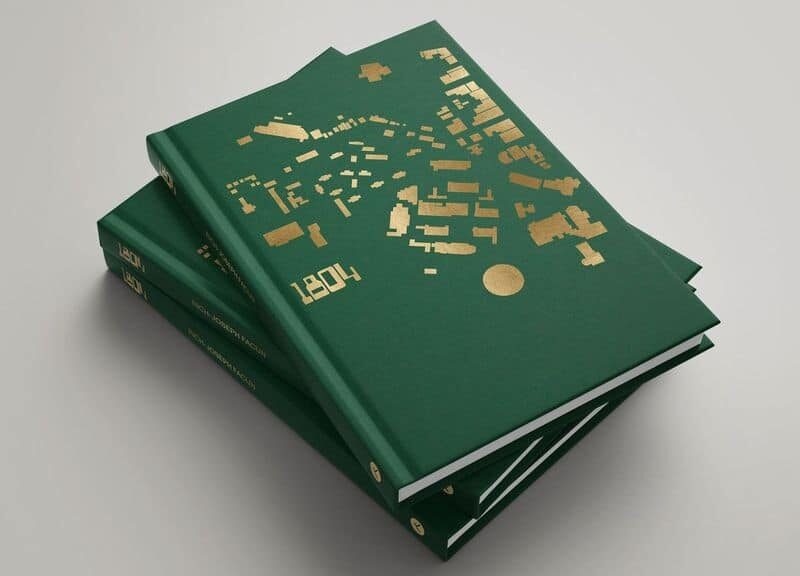
Facun’s third book, “1804,” is a new release looking at that relationship, beginning at the university’s founding and through to the present.
It is the first book published by Liars Corner, a new publishing company Facun launched. It focuses “on uplifting and giving an outlet for underrepresented and marginalized communities and artists,” said Facun, who is of Otomi and Pinoy descent.
Set for November release, “1804” features 62 photographs and an essay. Facun began the project during the early days of the COVID-19 pandemic, in 2020.
“That was a really difficult time for myself, and also for other people in the community,” he said. “Just walking around and streets were empty and businesses were closing. I just needed to get out and start taking some photographs.”
The context of the pandemic led Facun in a new artistic direction.
“Normally, the majority of what I shoot is people,” Facun said. But, when Facun began taking the photographs that would become “1804,” “there weren’t very many people out.”
“I just started photographing the social landscape of Athens,” he said. “And while doing that, it really started to hit home that Athens was a modern iteration of a company town.”
Many company towns in Athens County and the Appalachian region sprung up around extractive industries in the mid-19th and 20th centuries. Company towns, like the former Eclipse Company Town in the present-day community of The Plains, featured housing for workers and a store all owned by the coal company.
“1804” explores a similar company town dynamic between Ohio University and Athens, through Facun’s camera lens across time. With each picture, Facun tells the story of how OU, as the dominant employer in the town, also became a driving cultural force.
Athens was established in 1803, but the chartering of OU the following year was instrumental in shaping the town.
“Certainly, Athens would not be Athens had the University not been established there,” Facun said. “I’m positive that it would mirror more of the economic status of many smaller towns in this region, like Shawnee and Nelsonville.”
Meanwhile, the vibrant community of Athens offers a big draw for prospective college students.
“I’ve lived in so many places, and I’ve never lived anywhere that had the community that’s available in Athens,” Facun said. “There’s just a certain, unique kind of community that’s very supportive, and it … feels smaller than [it is].”
However, Facun noted that the symbiotic relationship between Athens and OU could pose problems for both in the future.
“Are we witnessing a shift from boom to bust?” he asks in a press release for the book. The book explores this question, delving into problems now facing the university that could affect its future.
“You’ve got Senate Bill 1 [Ohio’s higher education overhaul], you’ve got executive orders, you’ve got a decline in the amount of students pursuing higher education,” Facun said. “That’s a whole new can of worms.”

“I think only time will allow us to determine how that will directly affect the community of Athens, and how it all directly affects the university, and then, in turn, affect[s] the relationship between those two entities,” Facun said.
Facun sees the images in his book as telling the story of that relationship just as effectively as writing.
“Each image is intended to be structured in the sense of like a traditional written story. So there is a narrative there,” Facun said.
“When you create a written story, there’s a lead graf, and you build on that, and there’s transitional sentences to lead you to each new paragraph, and it builds to climax, and so forth. So in that way, it’s constructed in the same way you traditionally build a written story.”