
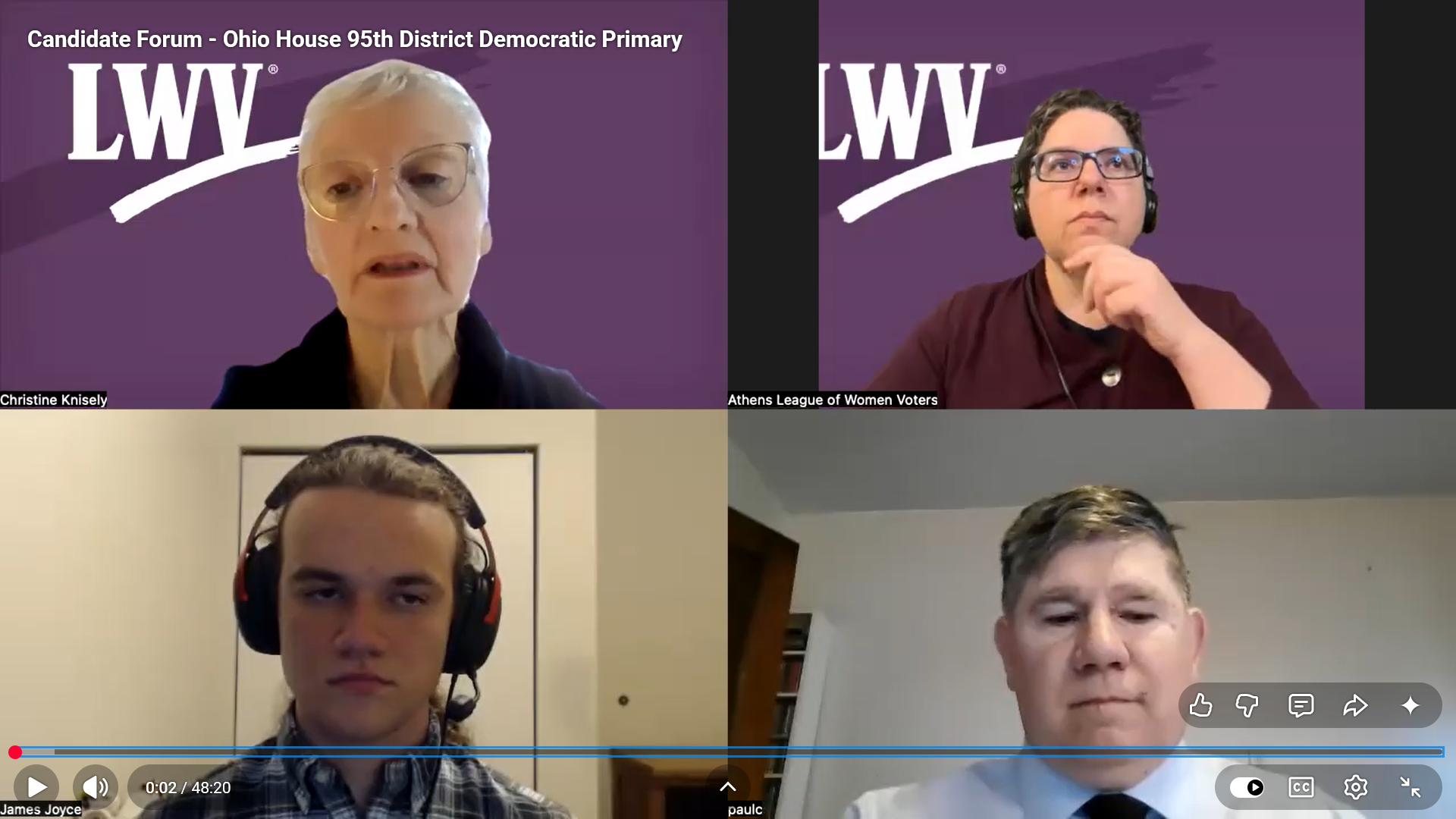
ATHENS, Ohio — The League of Women Voters of Athens County hosted a virtual candidate forum Monday night featuring Ohio House District 95 Democratic candidates Paul Cameron and James Joyce.
The district comprises the city of Athens, rural swaths of Athens, Belmont and Guernsey counties, and all of Harrison, Morgan and Noble counties.
Incumbent Rep. Ty Moore (R-Caldwell) is running unopposed in the Republican primary.
The questions, asked by League of Women Voters of Athens County member Chris Knisely, below have been paraphrased for clarity.
Introductions
Joyce, of Athens, is a 20-year-old Ohio University junior studying computer science and artificial intelligence. He said he grew up the second-youngest of five children and is from the greater Cleveland area.
“I’m running for state representative because I believe that our district deserves a representative who understands the challenges that face young people, working families and our small communities,” Joyce said.
The child of small business owners, Joyce said he saw “the long hours and determination that they put into building that business and the values that [it] takes to be successful and to achieve your dreams.” Those values are what he brings to his campaign, he said.
Joyce said he is focused on utilities affordability, renewable energy, and education.

Cameron, of St. Clairsville, described himself as “an activist and organizer from Belmont County.”
Cameron said he is a member of the Ohio Progressive Democratic Caucus and works with Ohio Valley Mutual Aid and Belmont County Unify, National Association for the Advancement of Colored People, and American Civil Liberties Union.
Cameron said he’s also a scout leader with Scouting America, formerly the Boy Scouts of America, retired from the U.S. Army after 24 years of service.
“As a mail carrier, census worker, field surveyor and construction project manager, I’ve spent the last 20 years traveling and working throughout District 95,” Cameron said.
Speaking to the district’s issues he said, “I know firsthand the failure of industry.”
“I grew up in a steel town in the 1970s and 1980s and watched the mill that was the economic center of my hometown fail, the coal towns were soon to follow,” Cameron said. “Residents of small towns that once had ready access to grocery stores, doctors, small businesses and other essential services now must travel significant distances to find what once was local.”
Cameron’s platform is centered on community revitalization, including “restoring the downtown areas of our small towns, and helping to establish small, locally owned businesses within those spaces.”
“Re-centering our communities will give us the foundation to address the other problems facing Southeast Ohio,” he said.
Why are you running for office?
Cameron described himself as a longtime “avid follower” of national and international politics in particular, “having worked as a military intelligence specialist within my active duty time in the army.”
Cameron said he’s been involved in his local activist communities for the past decade in pursuit of more “progressive ideology pushed within our society.”
He is “tired of seeing the status quo,” he said. “This seemed to be the right year [to run for office].”
Joyce said that he was inspired to run, in part, by his grandparents’ immigration to the U.S. from Poland.
“Those stories of the accomplishments of my grandparents and my parents living out the American dream, starting with nothing and going somewhere, were quickly becoming less and less possible,” Joyce said.
What are your policy priorities?
Joyce said his first priority is lowering the cost of utilities by implementing solar energy and making solar energy more accessible to individuals.
He said his experiences as a student makes education another top priority.
“As a 20-year-old, I’ve recently gone through the United States education system,” he said. “I’m currently in it — in college — and it has a lot of improving to do. I want to focus on lowering our reliance on standardized testing to ensure that teachers can focus on actually teaching our students instead of teaching to [pass] a test.”
Cameron said the district has a “poverty problem” — a lack of jobs and other resources. Among other revitalization efforts, he wants to promote abatement of abandoned properties, support small businesses and create local jobs.
How will you learn about and represent your constituents?
Cameron said he plans to “regularly get out into the community, to get out to the local organizations, the parties, the town and county meetings, the commissioner meetings, the board meetings of the villages, and to get out and to talk to the local leaders, regardless of party, and to to address the issues that are on the ground.”
Joyce said he would meet with “anybody that is willing to talk to me, to hear about anyone’s problems,” and open lines of communication through social media and other formats.
“As a representative, [it would be] my responsibility to go out and to learn what the problems are,” he said.
How are you qualified to address your district’s pressing needs?
Joyce said he believes that his ability to listen and inquire about constituent needs qualify him for the office.
“Sometimes it becomes our job to put aside our own personal beliefs, to vote for what the public wants or what the public thinks that it needs, because it’s what a democracy is,” Joyce said. “Our job is to listen and then report back what the people want, not necessarily what we want.”
Cameron said that over the past two decades, he has worked in every county in the district and traveled throughout each one.
“I have a background where I can speak with and connect with the local people,” Cameron said.
Cameron said he may hold different values from some constituents in the area, but feels that he can “reach across the divide to speak in a language that we can both understand and find common values, common cause, in order to address issues and to avoid the partisanship that would normally be expected or that would normally come in this modern day.”
What is your experience with budget and fiscal policy?
Cameron said he manages projects and their budgets as a construction project manager for a Parkersburg, West Virginia, glass and glazing company. He said he also has experience as a church treasurer.
Joyce said he does not yet have direct experience managing budgets.
“I’ve spent a lot of time talking with people and figuring out what is necessary for the state government to spend money on and what is less necessary for the state government to spend money on,” Joyce said. “And I think that is a very important aspect of creating a well rounded budget, is ensuring that money is going where it needs to go, when it needs to go.”
How should our state support and sustain quality rural health care?
Joyce said funding to local hospitals is important to keeping them open.
“To ensure that there is a hospital within less than 30 minutes or an hour of anybody is a feasible thing that the state government can help ensure, as well as creating a network to help move people quickly when they need specialized treatment,” Joyce said.
Cameron pointed to recent myriad healthcare funding changes and cuts coming from the second Trump administration.
“We have an administration of setting policies to raise insurance costs and to make the availability of small rural hospitals and community medical centers less viable,” Cameron said. “My feeling is that if the federal government will not pursue an actual policy of universal health care, then let’s pursue that at the state level.”
What steps should be taken to curb gun violence in our state?
According to the U.S. Centers for Disease Control and Prevention, Ohio has a firearm injury death rate of 15 per 100,000 population. Around 1,800 people died from firearms in Ohio in 2024.
Cameron said he feels that within the U.S. “there is a culture of gun violence that many within [the] government fail to recognize as a concern.” He recognized the Second Amendment as a “foundational principle of this nation,” but that it “does not necessarily mean that every single person needs to have the access to an assault rifle.”
Cameron pointed to the implementation of red flag laws and other measures “that can be taken in order to make sure that people who are particularly a threat, who are concerned to the community, can be denied access to a firearm.”
As a trained range safety officer with the National Rifle Association, Cameron believes “if you want to have access to a firearm, then you need to have training,” he said.
As a recent high school graduate, Joyce said has experienced “commonplace” lockdown school shooting drills — and actual threat lockdowns.
“Those are very stressful times that should not be happening in the United States,” Joyce said.
Joyce said one way to deter gun violence is for the “media not making it [attractive] for people to commit gun violence, to create attention.” Focusing on mental health issues, he said, will help curb gun violence.
Joyce echoed Cameron’s comments about training, adding, “You should have to prove competence and understanding of how a firearm works to own and use a firearm.”
What policies will you pursue to promote social and racial justice?
Joyce referenced Senate Bill 1, the Advance Ohio Higher Education Act, which banned diversity, equity, and inclusion, aka DEI, programing and initiatives at Ohio colleges and universities, among other changes.
“The state legislature currently has a target on anybody that doesn’t look like me, which is not OK,” Joyce said. “I am a believer that we are all humans and that we are all equal, and our society should reflect that.”
Joyce said something he wants to focus on in office is local history and Ohio’s role in history as a site of the Underground Railroad, and the fight for civil rights.
“We should celebrate that, and we should make that well known,” Joyce said. “…That people from those communities know about that history is very important to me, as well as pushing through policies to make sure that students that are in the LGBTQ community feel safe here in Athens.”
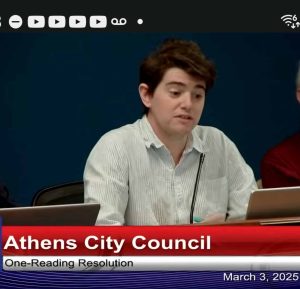
Joyce voiced support for the safe haven resolution that Athens City Council adopted in March 2025, declaring the city “safe haven for transgender and non-binary individuals seeking gender-affirming healthcare.”
Cameron said, ”I have a mixed-race family, I have many members within my family who are LGBTQ,” so for him, social and racial justice are significant priorities.
“We need to focus on getting back to making … racism unacceptable again,” Cameron said. “We also have to protect the LGBTQ community as well.”
“Everyone deserves equal rights under laws,” Cameron said. “Everyone deserves to be respected for who they are. We need to especially focus on protecting the immigrant community and making sure that they have due process rights that are protected as they deal with immigration statuses also.”
How can the state address threats Ohio faces due to climate change?
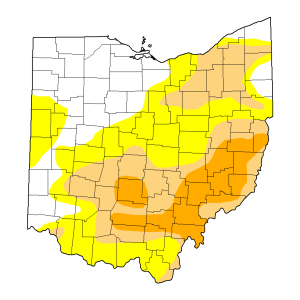
“We’re definitely looking at a climate change issue here in Ohio,” Cameron said, mentioning the historic drought Southeast Ohio experienced in 2024.
“We need to address the issues where we can,” Cameron said. “We have a lot of opportunity in District 95, a lot of open land. Within this rural area, we have the opportunity to create green energy initiatives. We have areas that would be very conducive to wind farms, wind turbines; areas that would be very conducive to solar farms.”
Cameron said that if green energy initiatives are pursued, it must be done so in a way that reduces “the dependence upon dirty fossil fuels.” At the same time, he said, “We need to make sure that we keep data centers out of our area, because when you start having an increase in electric production, data centers want to show up to utilize that and pollute the area.”
Joyce said renewable energy sources are “pivotal in shifting the state away from fossil fuels. But it also goes further than that. We also have to tackle the problem of no public infrastructure for public transportation.”
Carbon emissions could be reduced by increased public transportation and more walkable and bikeable cities, Joyce said.
“One of the largest producers of emissions is our agricultural sector, and Ohio is a farming state, so creating techniques that produce less [carbon dioxide] through our farming are extremely important,” Joyce added. “This is a large issue that we have the solutions to, but it requires the political will and drive to implement those solutions to bring the shift that is necessary in our society to move away from fossil fuels to renewables and a less of a climate threat that we are facing.”
What should the state government do to provide equitable, quality public education, pre-K–12?
Joyce said he doesn’t agree with how the state currently funds public education.
“My first step would be to increase funding for our public schools,” Joyce said. Also important to him is “providing free school lunches, so that regardless of where you are, you don’t have to worry about where your next meal is coming [from].”
Cameron agreed with Joyce regarding funding.
“We need to make sure that all the schools are funded properly and correctly,” Cameron said. “We need to stop the diverting of public education funds to private charter schools.”
Cameron also said that schools need “to focus on getting better teacher quality and attracting teachers,” especially in rural areas. The state should focus on supporting trade education, as well as universal pre-K and daycare to support struggling parents, he said.
How will you work to increase job opportunities in the 95th District?
Cameron said creating local jobs is among his priorities, and can be done through revitalization efforts, supporting downtowns and small businesses.
“We need to establish those as basic services — you need restaurants, you need grocery stores, you need community centers, libraries, medical clinics, daycares,” Cameron said. “We need to make sure that these are available. We do this, we create communities that people want to live in, people want to stay in.”
Joyce said that the state could support thousands of jobs and facilitate economic growth by investing in its “crumpling public infrastructure.”
“Using infrastructure as the backbone to bring in the initial investment, to create those initial jobs, to then begin turning the wheels to then bring in local businesses and other businesses, is my plan,” Joyce said.
What is your stance on access to reproductive healthcare?
Joyce said he is “a firm believer that a woman gets to choose what to do with her body.” He said he also supports access to contraception, in vitro fertilization and robust sex education.
Cameron echoed Joyce’s comments. “[Women] absolutely have every right to choose how their body is under their control, and that their decision should be between them and a doctor, and not between the government,” he said.
Cameron said he feels “that reproductive health is an essential function for women to have a full and realized set of rights within this country. There is absolutely no instance in which their rights should be restricted.”
Closing remarks
Both Joyce and Cameron spoke of Southeast Ohio’s history in their closing statements.
“Here in Appalachia, we have a history of extraction-based resources coming in, taking our wealth and leaving,” Joyce said. “We don’t want the next generation to go through the same cycle that we have and to deal with the problems that we are dealing with. The buck stops with us.”
Cameron also mentioned the region’s history of extractive industry, noting the growing data center and tourism industries in the region.
Cameron also mentioned ongoing statewide proposals to eliminate property taxes, which “would primarily benefit absentee landowners who maintain property as rentals, while driving up sales tax to unsustainable levels for families already struggling with lower wages and higher prices,” he said.
“We must not support programs which further support the wealthy at the expense of the poor,” Cameron said. “You want someone who will fight for the residents of Southeast Ohio against the wealthy outsiders who extract resources from our region and provide little in return.”
Election information
The deadline to register to vote in the May 5 primary election has passed. Early voting is underway. Find more voting information from the Athens County Board of Elections.
