
ATHENS COUNTY, Ohio — The Ohio Department of Natural Resources will test well water for possible contamination after determining toxic waste from four fracking waste injection wells in eastern Athens County spread underground.
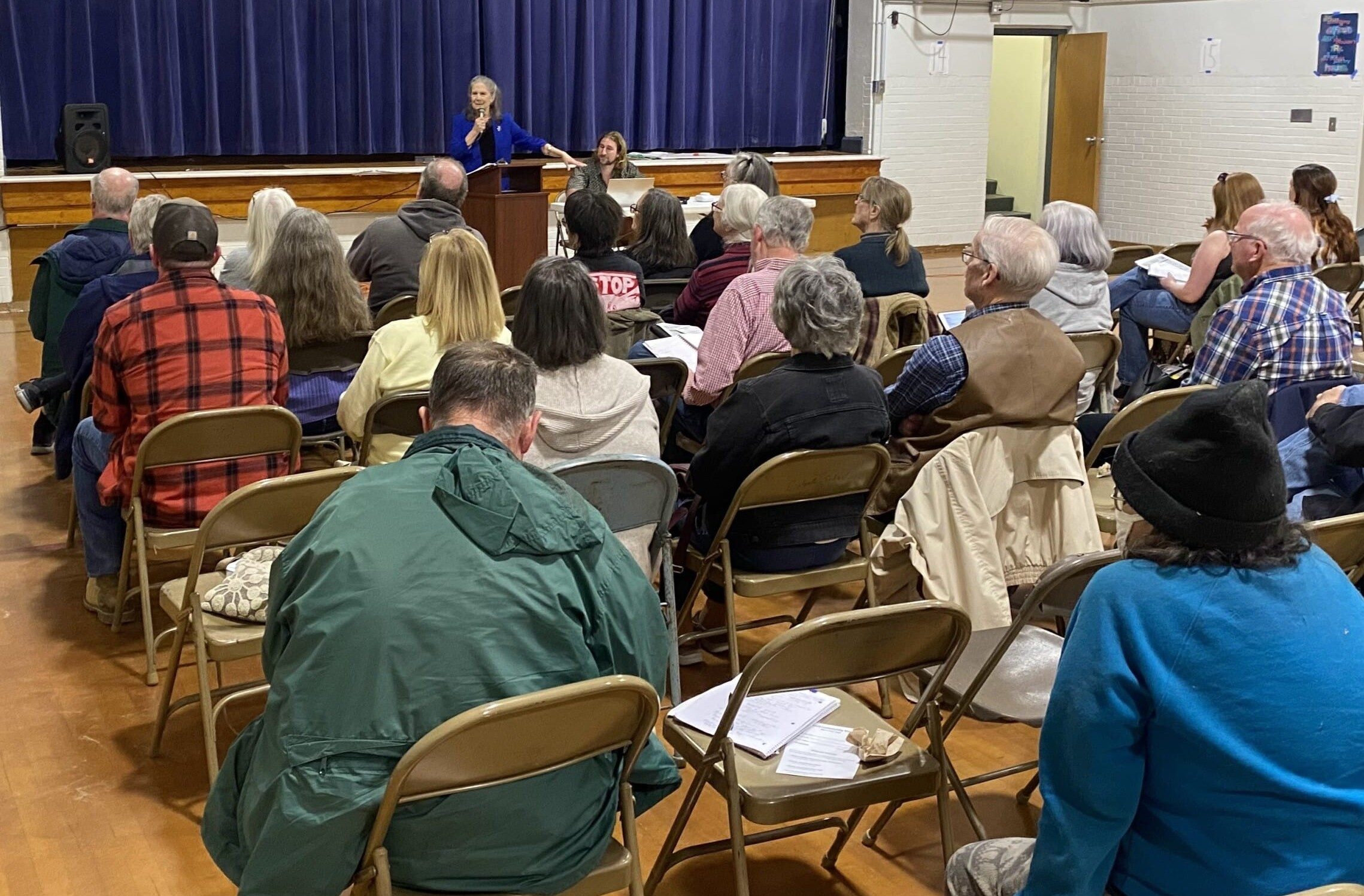
On March 27, about 50 people heard updates on the ODNR’s water testing plan and related issues at a town hall in Coolville organized by community members. The discussion at the town hall was lively, with community members frequently raising hands to ask questions and voice concerns.
“It makes me want to cry,” said Coolville resident Dawn Harman, who learned about possible contamination at the town hall. Harman told the Independent she moved to the area “to not have all that pollution and live in my 40 acres of woods.”
The ODNR Division of Oil and Gas Resources Management found last year that toxic fracking waste from four injection wells poses an “imminent danger” to health and the environment.
“While the division has received no reports of adverse effects to human health or safety associated with the implicated injection wells,” the division will hire a consultant to “conduct a groundwater study to ensure no evidence of adverse impacts to ground water can be found,” according to the division’s request for proposals.
“It’s not a good place to be … but it’s a better place to be than not having the investment in testing,” said Ohio University professor and groundwater expert Natalie Kruse Daniels at the Coolville town hall.
The division is evaluating bids from two consultants and “hopes to award a contract in the near future,” according to a March 26 statement Division Chief Eric Vendel shared with town hall organizer Roxanne Groff.
One of the four injection wells at issue is a Rome Township well operated by Reliable Enterprises that the division suspended in May 2023. The next month, the division suspended the other three injection wells, operated by K&H Partners in nearby Torch.
While the Rome Township well permanently ceased operation after the ODNR’s suspension order, K&H fought its suspension vigorously. K&H appealed the division’s order both to the Franklin County Court of Common Pleas and the quasi-judicial Ohio Oil and Gas Commission, which specifically hears these types of cases.
The Franklin County case was dismissed for lack of jurisdiction, while the Ohio Oil and Gas Commission heard arguments in the case in December 2023. Four months later, the commission has yet to issue a final decision.
The K&H wells have operated continuously without modification since October, when the commission allowed the company to continue operations throughout the appeal process.
Related reading from the Athens County Independent:
In a January post-hearing brief the division warned, “If K&H is allowed to continue operating the K&H Wells without modifications, critical freshwater in … Athens County could be irreparably destroyed.”
According to its water sample analysis plan, the division will test water from wells within a half mile of the four implicated injection wells and seven oil and gas production wells.

The division previously concluded the seven production wells were impacted by underground migration of toxic fracking waste, known as brine.
Data released by the Pennsylvania-based watchdog group FracTracker shows that at least two of the three K&H wells in question have been injected with waste containing polyfluoroalkyl substances, or PFAS. PFAs are linked to birth defects and increased risk of cancer.
Related reading from the Athens County Independent:
ODNR data published by FracTracker shows fracking waste in Ohio contains radioactive waste as well. The radioactive compounds that ODNR found in fracking waste can remain in the environment for thousands of years and cause bone, liver and breast cancer.
The division’s consultant will test water from 33 water wells in Athens and Washington counties.
Kruse Daniels presented on the division’s water sample analysis plan at the Coolville town hall and said the database the division used to identify water wells “is a little hit or miss, but it’s a good starting point.”
Meanwhile, Groff, an environmental activist and former Athens County commissioner who presented at the townhall, said the division’s proposed area of review “doesn’t go far enough.” That’s because the division has found that brine spread further than a half mile from injection wells, she said.
The division found that brine from the Reliable Enterprises well impacted oil and gas production wells as far as 2 miles away, while brine from the K&H wells impacted production wells as far as 1.5 miles away. In a separate instance of brine migration in Washington County, the division found that brine spread even farther.
The division will primarily evaluate impacts to water supplies by testing for chloride concentrations and measurable bromide. If chloride concentrations and the ratio of chloride and bromide in the water surpass given thresholds, the division will recommend additional testing.
Groff told the Independent she doesn’t think the division’s proposed set of parameters for water sampling are sufficient.
Kruse Daniels, however, said at the town hall, “I can always say ‘sample for more’ — but I think actually what they laid out does make pretty good sense.”
ODNR media representatives did not respond to a request for comment.
Kruse Daniels said “the proof will be in the pudding in a lot of ways,” regarding the sufficiency of the division’s water testing.
“This is a single sample at a single time point, but what we understand is that how contaminants move in the environment is very time-based,” Kruse Daniels said. “When we look at how these things could move, we’re talking about — is it thousands of years, is it hundreds of years, is it tens of years? And a lot of those things we don’t know.”
Kruse Daniels said it will be important for the division to compare water parameters in the area over time.
The Division’s bidding process closed on March 15.
Once the division awards a contract, the consultant will have 90 days to conduct water testing and an additional 30 days to issue a final report, per the RFP.
In addition to discussing the division’s water testing plan, speakers at the town hall also discussed a petition to revoke Ohio’s regulatory authority over its underground injection program and Ohio’s history of underground injection well incidents.
Groff encouraged community members to contact their elected representatives in the Ohio Statehouse to share disapproval with Ohio’s current rules regulating injection wells.
“We have voices; we need to use them,” Groff said.
Elevating the voices of the people was part of why Groff and other activists organized the town hall, she said.
“They don’t offer themselves to people,” Groff said, referring to the ODNR. “So the people have to organize themselves to have these meetings.”
The town hall was hosted by Torch Can Do, the Buckeye Environmental Network, the Ohio Brine Task Force and Athens County Future Action Network.