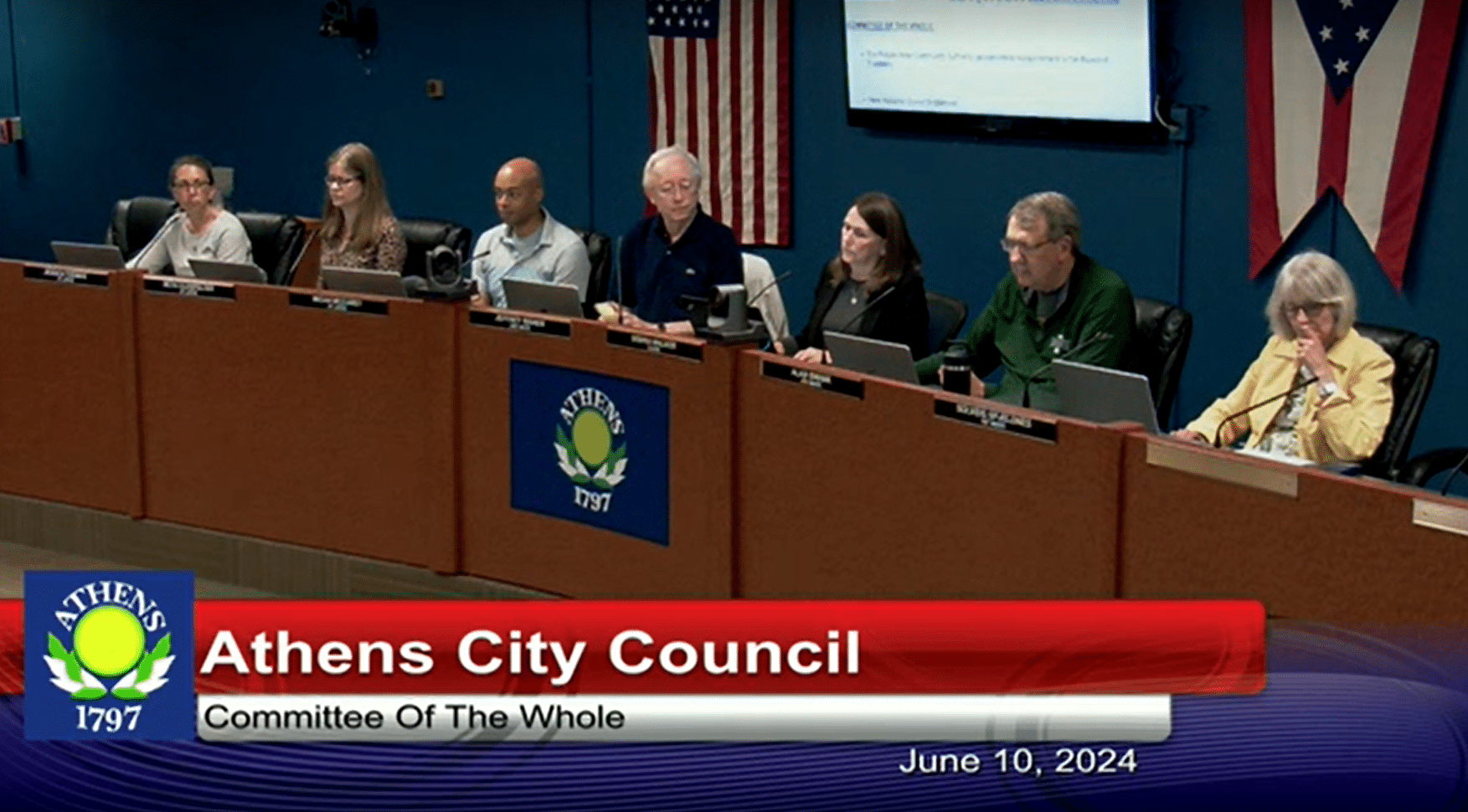
ATHENS, Ohio – At its Committee meeting June 10, the Athens City Planning and Development Committee considered a recommendation for tobacco and cannabis zoning to prepare for recreational marijuana sales, which may begin by mid-June in Ohio.
Deputy Service-Safety Director Andrew Chiki said that though recreational cannabis use is now legal in Ohio, with sales set to begin imminently, “there are still home rule items that can be regulated by cities — specifically, where and how cannabis-specific businesses would be set up.”
Chiki said community members have expressed concern to the Athens City Planning Commission about an “overrun” of places selling cannabis throughout different zones within the city of Athens.
“A number of recommendations have been made [to the city planning commission] in order to create a process that does not overrun the city with multiple businesses of the same [kind],” Chiki said.
Drafted by the Athens City Planning Commission, recommended changes to Athens City Code Title 23, the city’s current law regulating tobacco use, include requiring licensed cigarette, vapor product and other tobacco product retail dealers, as well as cannabis establishments, to operate at least 500 feet from schools, public libraries, public playgrounds and parks. The proposed changes to Title 23 would also limit the number of cannabis establishments that can operate within different zones in the city.Council member Jessica Thomas, At-Large, noted that existing tobacco retailers will not immediately begin to sell marijuana, too — but that they theoretically could down the road..
“If you are an existing tobacco retailer and you … were granted a permit – because they still have to go through state permitting and applications, which seems like it’s going to be competitive – you could combine it in the same space,” Thomas said. “But you would have to abide by the 500 feet.”
Swank added that those retailers would still need an entirely new license to distribute marijuana.
Council member Sam Crowl, who served as acting mayor at the meeting, said there are various state imposed restrictions on how stores can sell cannabis, including in regards to storefront appearance. He also asked whether the principle use of stores would change if they began to sell cannabis, which could affect applicable restrictions for a given business.
“A gas station is principally a gas station, yes, they sell tobacco,” Crowl said. ”But if you are a tobacco or vape store and you also sell cannabis, at what point does the principle use change?”
Chiki said that there are currently 33 businesses in Athens that have a tobacco license and a number of those are convenience stores that primarily sell gas and groceries, so if they were to sell cannabis products, their principle use would remain the same.
Chiki did not definitively address Swank’s question regarding the principle use for vape and tobacco-specific stores, but Swank said it would probably be similar to restaurants that sell food and alcohol, as their principle use depends on what percentage of their stock is food and what percentage is alcohol.
Crowl told the Independent that city council is seeking advice on whether the ordinance will have to go back to the planning commission “if we made certain changes to it.” It’s not yet clear when an ordinance regarding the planning commission’s recommendations will be formally introduced to the full city council.
Also on Monday night, the city council’s finance and personnel committee read a request submitted as a draft ordinance by the municipal court to change the payment structure of two employees. The draft ordinance would see the employees paid half of their wages from the city’s general fund, instead of entirely from the general fund. The other 50% of their payment would come from grants recently obtained by the court.
Crowl said moving these expenditures away from the general fund would be a positive development for the city.
This is because the city’s general fund currently has a balance below the statutory minimum threshold of 7.5% of annual expenditures. The fund balance was at 6% in late May, Athens City Auditor Kathy Hecht said at a previous council meeting. Its goal is to reach a comfortable 9%.
“We’ve had discussion of court expenses and how the city council is able to work with the court systems with our budget,” Crowl said.
Council member Beth Clodfelter, At-Large, said she is happy that the court will be able to take care of its employees without “dipping” into the general fund.
Jeffrey Risner, acting as council president pro tempore, asked Athens City Treasurer Josh Thomas if this would help the city to reach the 9% goal.
“We’re saving $55,000 here, the way I look at it,” Risner added.
Thomas said it would put the city slightly closer toward its goal for the general fund.
“But you need to keep in mind, the auditor actually mentioned this the other day, [the city’s percentage of annual expenditures] is a fluid thing. It comes and goes,” Thomas said. “Sure, we save money in one area, but then an expense comes up in another area. It’s just not a hard number.”
Crowl told the Independent that this draft ordinance will be introduced as an appropriations ordinance to council, but it may not be able to move toward passage by council until August due to the council’s July break.
Athens City Council’s next regular meeting will be at 7 p.m. Monday June 17, in Athens City Hall, Council Chambers, third floor, 8 E. Washington St. Meetings are also available online. Regular sessions are on the first and third Mondays of the month; committee meetings are on the second and fourth Mondays.