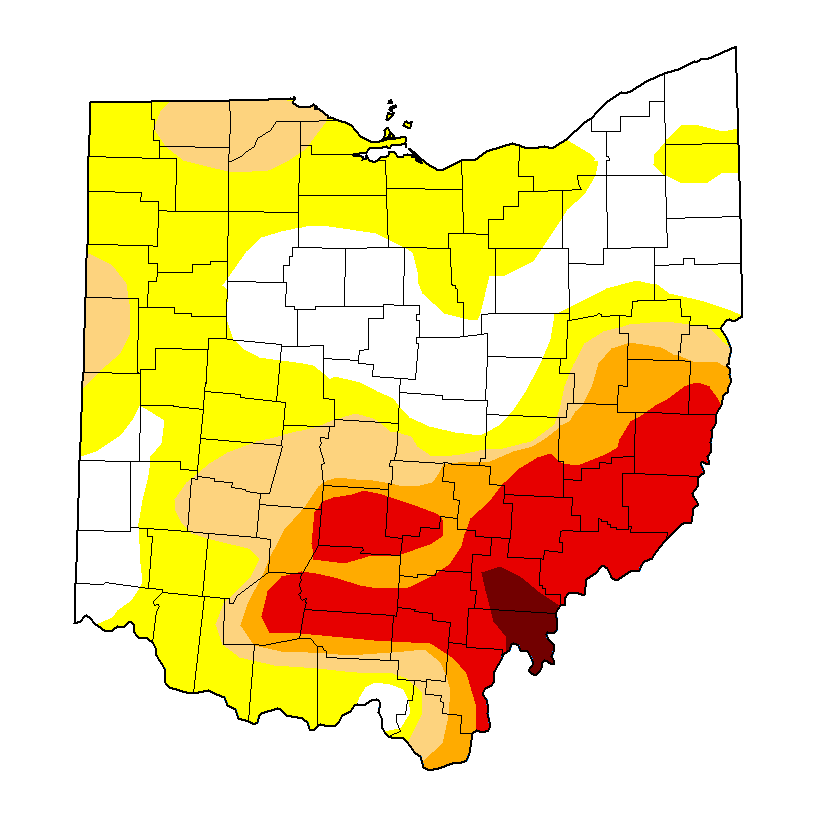
ATHENS COUNTY, Ohio — As Athens County swelters in a return of extreme heat without significant rain, the regional drought that began in June has become even worse.
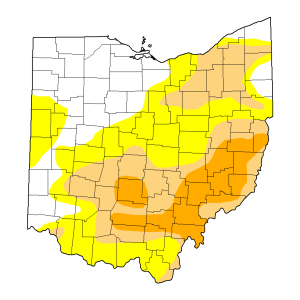
In its Aug. 29 weekly report, U.S. Drought Monitor upgraded much of Athens County to “exceptional drought,” the most severe classification used by the service.
The lack of rain is reaching near record-breaking status. The Scalia Lab for Atmospheric Analysis at Ohio University didn’t record a single inch of rain in August, when two to three inches is the norm.
Despite areas of Athens County receiving some precipitation Thursday night, this summer’s rain loss has reached a point where it may be unrecoverable, according to lab director Ryan Fogt.
“We’re just so far below normal right now, that any rain that does happen won’t provide enough relief,” Fogt said.
Meanwhile, the return of extreme heat led to the open of cooling stations at the Athens Community Center (701 E. State St.) and Hocking Athens Perry Community Action’s Glouster office (3 Cardaras Drive).
“We offer our lobby areas at the community center during open hours, typically the hottest part of the day,” Deputy Service Safety Director for the City of Athens Andrew Chiki said. “We make those available for anyone from the public to use as a cooling area, charge their devices and get a drink of water”
The cooling center isn’t just for people, Chiki said — pets are welcome as well “as long as [owners] have control over their animal.”
“We know that it’s important for animals, people’s pets, need to stay cool just as much as people do,” Chiki said.

Heatwave and drought explained
Temperatures near 100 degrees are unusual even for late August weather in Athens County; the return of extreme heat is primarily due to a unique weather pattern, according to Fogt.
“It’s set up by a strong high pressure system which is just over the Appalachian mountains to our south and east,” Fogt said. “There is a weaker pressure system to our north and west. Those two are bringing a strong southerly flow into the Ohio region. So we are having air come all the way up from the Gulf of Mexico to Ohio. That is surging temperatures even more than what they were.”
The high pressure system also cleared out much of the cloud cover, leading to very sunny conditions. Winds blowing from the Gulf of Mexico are also bringing up a fair bit of moisture, exacerbating the heat by added humidity.
This humidity, however, may offer some momentary relief from drought conditions as a cold front coming through Friday and Saturday may turn the moisture into rain.
Like most recent severe weather events, the drought can be linked back to global warming, although Fogt attributes the majority of the drought to changes in the jet stream.
“It was relatively unexpected how strong the jet stream pattern would be in the West,” Fogt said. “In July we saw this relief, heavier rains in the Central U.S. extending out to Indiana and Western Ohio. That was projected to progress eastward and hit Southern Ohio and West Virginia. That pattern didn’t really shift significantly in August, so storms have largely been going north or west of us and we haven’t had a lot of rain.”
Drought dries up creeks, causes algal blooms
The Watersheds team at Rural Action has been keenly aware of the lack of rain. According to Nate Schlater, the senior director of ecological restoration at Rural Action, areas of the Federal Creek Watershed that haven’t been dry for a decade are now without water.
“Some of the smaller streams which are typically ephemeral have dried up,” Schlater said. “Some of the larger streams that are typically perennial, that very very rarely dry up, may actually dry up.”
The drying of the local watersheds has radically altered the behavior of local wildlife, both aquatic and terrestrial. Because animals are drawn to more limited water sources they are more likely to come into contact with each other, which could spread disease more easily, Schlater said.
The dry conditions also have contributed to algal blooms along the Hocking River. If these blooms grow in intensity, it is theoretically possible they could consume all the oxygen in an area of the river, leading to a mass organism die-off.
Acid mine drainage also has become more potent as a result of the drought. Typically, rainwater helps dilute the drainage resulting in less acidic water. However, no rain means that many tons of mine drainage is flowing into the watershed undiluted, according to Schlater.
Even the man-made additions to the watershed intended to combat mine drainage — such as lime dosers, which mix in basic chemicals to neutralize acidity — are struggling to function with the lack of rain.
“We’re seeing some highly concentrated mine drainage right now,” Schlater said. “We know that the (Monkey Hollow doser) in the Monday Creek watershed is not able to function currently due to the flow being too low.”
Monday Creek’s waters haven’t become overly acidic, Schlater said: “We’d rather have it a hair higher, but it’s still pretty good.”
Water district unaffected
Drinking water pulled from underground aquifers has not worsened in quality, according to John Simpson, general manager of Le-Ax Water District. Simpson said the water district’s observation wells were checked recently, so the district should know more about the overall health of the aquifer soon.
The issue of dry ground cracking and putting pressure on pipe infrastructure persists, but Simpson can’t tell just how many breakages can be attributed to the drought. What has been a major concern for the water district is the impact these conditions are having on their staff.
“We’ve been taking extra care to make sure staff stay hydrated and don’t over do it,” Simpson.
Farmers continue to make do
With drought conditions continuing to worsen, many local farmers are having to take unprecedented steps. CJ Morgan of MoSo Farm said they only have a few acres left of grazeable pasture and that their hay supplier warned that extra hay may not be available anytime soon.
“We’ve been scrounging for any green grass anywhere,” Morgan said. “I’ve been putting them on the edges of woods, anywhere there’s shade … I’ve been building a temporary fence and letting them graze that, even if it’s only for six hours.”
The herd’s overall food intake decreased after Morgan butchered six of his heaviest cattle in the past month, but the need for feed remains. Morgan is considering an unusual step: felling trees so cows can eat the leaves, which he said contain quite a bit of nutrition. Morgan, who has a background in forestry, said he was already planning to thin out the undergrowth on his land.
Unfortunately, the persistent drought conditions have introduced a new problem: Trees they planted in the pasture to provide shade are starting to die.
“We planted about 1,400 hazelnuts in late April,” Morgan said. “Our plan wasn’t really to manage them much, they are pretty hardy, just let them do their thing and whatever makes it, makes it. We’ve probably started losing 10- or 20% of them, so we started watering them.”