ATHENS, Ohio — Preparing for a general election is a tremendous amount of work — just ask Athens County Board of Elections Deputy Director Tony Brooks and Clerk Shantelle McLaughlin. They’ll tell you: Election Day isn’t the beginning — nor the end.
Election Day is Tuesday, Nov. 5. This year’s presidential election promises high voter turnout nationwide; Ohio voters will also decide upon Issue 1, regarding changes to the state’s election commission.
Election prep begins months in advance — and requires a tremendous amount of labor and coordination, including in Athens County.
Meet the BOE
The Athens County Board of Elections has only six full-time employees — a deliberate mix of registered Democrats and Republicans. A copy of its 2024 budget shows that staffing is its highest expense, with its full-time staff costing $367,000 this year. It also designated $80,000 to part-time staff and a slightly greater amount to poll workers. A group of 10 temporary employees will help run early voting at the office.
Deputy Director Brooks said the county is lucky to have six staff, which is double that of neighboring counties. “We’re different because we have the college and the university, so that makes it a lot harder for us,” Brooks said. “It keeps us busy all year round.”
Many of the local board of elections staff have worked at the office for “many, many, many years”as public servants, Brooks said.
The newest staff member has worked there for over three years. Brooks himself has been involved at the board of elections since young adulthood, and his mother worked as deputy director for over 30 years. He has served as deputy director for the past four years.
Preparing for Election Day
Making the ballots
Preparation for Election Day begins months in advance at the board of elections. According to the Ohio Secretary of State, the board’s election administration plans for Nov. 5 were due to the state in July, 120 days before the election.
“We start getting our issues filed: the tax levies, liquor option questions, those all start getting filed months and months beforehand,” Brooks said. “We take that paperwork in, we draft the language for the ballot based upon the paperwork that’s turned in.… The Secretary of State reviews it, approves it, makes sure that it’s looking right.”
It’s not always so straightforward, though. This year, the board has scrambled amid a legal battle over a Nelsonville ballot initiative intended to abolish the city’s charter and return it to a statutory form of government.
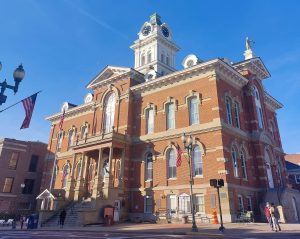
The board of elections also reviews candidate petitions, which must include a certain number of valid voters’ signatures (usually a certain percentage of previous voter turnout). The board of elections verifies or declines petitions based upon standards set by the state. After the staff verifies petitions, the board of directors approves the candidate to appear on the ballot
The secretary of state approves candidates for statewide, congressional and national races; the local board of elections handles only candidates for offices within Athens County. The secretary of state also approves language for local tax levies.
Once the secretary of state has approved candidates and issues, the Athens County Board of Elections drafts precinct ballots — which takes about a week to tweak and proofread.
“We have three bipartisan teams that go over every single piece of that ballot, word for word,” Brooks said.
Each precinct has its own ballot. This year, the county prepared 61 ballots for its 56 precincts. The county has more ballots than precincts due to “house splits,” Brooks said – Ohio House districts that are split across the county.
After proofing, the board of elections goes into “final programming,” adjusting ballots in their voting software for any changes flagged during the drafting process. With the ballot language squared away, the board turns to testing any and all equipment that is used for voting, Brooks said.
Testing was done on Sept. 28, McLaughlin said. It’s open to the public, which helps ensure transparency. The testing uses pre-marked ballots to ensure the machines read ballots accurately.
“After we’re done, we clear out [the machines],” McLaughlin said. However, the staff preserve the test results for the record, Brooks said.
After testing, it’s time to train poll workers.
Poll workers
Athens County’s poll workers are experienced and passionate; many return year after year to help run the polls.
“Some people are 80 years old, and they’ve been in it forever,” McLaughlin said.
“We have a good, solid base of very seasoned, very good poll workers that know what they’re doing,” Brooks said. “We got a lot of good temporary workers that come in and help us with things … and that’s one of our keys to success — having really good temporary workers that come in and help us, really good poll workers too.”
The county has to staff 20 polling locations across its 56 precincts. That calls for 200+ poll workers.
“We’re required to have 224 poll workers for that day, but we’re required now by the state to have [an additional] 15% on call,” McLaughlin said.
The board of elections has secured its 250+ poll workers needed for this year’s election. However, she said that anyone interested in becoming a poll worker is welcome to contact the board of elections office any time.
“We’re always looking for poll workers,” Brooks said.
Poll workers’ duties vary, from greeting voters to setting up equipment. There are four different poll worker duties at each polling location, as well as “rovers” who run errands across the county on Election Day.
Additionally, each poll worker receives an assigned role and “a specialized training for each job that they’re stationed to do,” Brooks said.
Voting methods
Registration needs and requirements
The voter registration deadline is Oct. 7. The board of elections will be open until 9 p.m. on that day to register voters, and the online voter registration will be open until 11:59 p.m. Identification requirements to register to vote can be found here. See the full 2024 election calendar here.
Absentee
The original purpose of an absentee ballot, Brooks said, “was if you were going to be absent from your area on election day, that was the original source of what became absentee.” Absentee ballots are used more often now; early in-person voting is technically absentee voting, Brooks pointed out. The deadline to request an absentee mailing ballot this year is Oct. 25.
“Basically, you can absentee vote for any reason: if you just don’t want to go to the polls on Election Day and you want to come up here and vote early, or you want to request a ballot by mail,” Brooks said. “Some people really like to get their ballot by mail and actually be able to sit down and research things and research candidates and names.”
The board of elections also offers curbside voting by request both at its office on Court Street in Athens or at the polls on Election Day.
“One [worker] of each party would go out, we’d have them fill out a form — the absentee application form — we’d bring it back in to the office, we’d get their ballot, and then both [workers] take it back out to them, with a clipboard, let them vote it, and then we both bring it back in in the folder, and then we run it through the machine.”
Dropbox
Early-voting ballots can be deposited in the dropbox outside the board of elections office. Secretary of State Frank LaRose recently issued new rules about who can drop off ballots for others, Brooks noted.
“If you’re dropping off for a family member or a disabled voter….. You want to come in and drop it off in our office, and we have to sign what’s called an attestation form — that they are the relative or a person designated by a disabled voter to drop off that ballot,” he said.
Provisional
Provisional voting is for people who have moved but not updated their address in time for the election, McLaughlin said. Those seeking a provisional vote must be a registered voter somewhere in the state of Ohio.
Provisional ballots aren’t counted until the voter’s registration is verified. Additionally, “that provisional envelope acts as a voter registration form and will change your [voting] address.”
“When people say, ‘Well, those don’t count’ — they do. They do count,” McLaughlin said. “It’s just there’s a process to go along with.”
Brooks noted the county has a large number of provisional ballots because of the large university student population.
Provisional ballots may also be used if an individual changed their name after the voter registration deadline or did not have the chance to update their voter registration information. Provisional ballots also work for individuals who requested an absentee ballot, but show up to vote in person on Election Day.
After the election
Unofficial vs. official results
Unofficial election results are reported on the night of Election Day, using raw vote numbers from the polls. Official results come out two weeks after Election Day.
“That’s where we go and we add in any provisional ballots that need to be counted,” Brooks said. Election staff have four days after Election Day to process provisional votes and any “problem absentees” to produce official results.
Problem absentees “are ones that have some sort of issue that needs corrected,” Brooks explained in an email. “These are normally where the left a required fields blank on the return ID Envelope or did not sign the ID envelope.”
Voters have until the Saturday following Election Day (Nov. 9) to make corrections. “We normally send them a letter or call them and tell them to come in [and] correct the problem,” Brooks stated.
“We take our original results from election night, the unofficial results, we add in any absentees that have not been processed yet. Then we add in any provisionals that [the board] … has to vote to approve those,” Brooks said.
How unofficial results are calculated
After a voter casts their ballot, it is tabulated by machine, which stores data on a flash drive, Brooks said. “So that’s kind of how it comes to us,” he said.
The paper ballots are then stored in a can in a tote at the polling location until voting closes.
“At the end of the night, a dual-partisan team that’s at the polling location will open, unlock that can at the bottom, pull out that tote, organize those ballots, and then they will put them into a bag,” Brooks said. “They bring those ballots back to us that night.”
Once the ballots arrive at the board of elections office, they are transported to a “ballot room” which sorts them by precinct. Some rooms at the elections office require a bipartisan team for anyone to enter — quite literally, a person registered to each political party must scan their badges for the door to unlock.
While not always required, in all its ventures, the board of elections is mindful of bipartisanship.
“We always have a bipartisan team working on stuff,” Brooks said. “You have to make sure that you’re balancing it out while you’re doing it.”
The ballots are locked in the ballot room and remain untouched, unless they need to be examined for special circumstances or an audit. “Everybody’s paper ballot is stored at our storage location,” Brooks said.
Audit
After each election, boards of elections are required to conduct an audit. “Basically, we look to see if our voting equipment is accurate,” Brooks said. “There’s a requirement by the secretary of state that we have to do at least 5% of our voter turnout.”
To perform the audit, board staff randomly selects ballots from across the county’s precincts, Brooks said. The state also requires the auditing of specific races — in this year’s case, the presidential election results.
“We’ll hand-count the ballots, make sure that it matches our official results,” Brooks said. “That audit is completely done in the view of the board. We have two people again, from one of each party.” The “counters” report their physical ballot results to the directors, who know what the ballots should say.
“We don’t know what the [official] results are,” said McLaughlin, who usually serves as a counter during the audits.
The audit is also open to the public, Brooks and McLaughlin said. Some people also work as election observers.
To learn more
Brooks said the board of elections is open to the public, and the public is welcome any time to learn more about its operations.
“A lot of our processes — if somebody wants to come in and see how they work — please feel free to,” Brooks said. “Because if we can get people educated on our processes and how we work, it combats that disinformation that’s out there.”
The board of elections also keeps up-to-date information on polling hours and precincts on its website. Explore sample ballots, previous election results and even update voter registration online; or stop in at 15 S. Court St., #130, call 740-592-3201 or email athens@ohiosos.gov for more information.
Early voting begins Oct. 8. View the board of elections’ special early voting hours here.