
To the editor:
I recently filled out my Ohio mail-in ballot and, as part of being an informed voter, I read over the fairly lengthy Issue 1 information. The more I read, however, the more I felt I was reading the “against” argument section, rather than the information section. While the points made were not actually untrue, they were misleading: Point 1 would “repeal constitutional protections against gerrymandering approved . . . in statewide elections in 2015 and 2018,” while Point 2 would “establish a new tax-payer funded commission of appointees required to gerrymander the boundaries of state legislative and congressional districts to favor either of the two largest political parties in the state of Ohio . . . .” without explaining that a definition of “gerrymander” is the drawing of district boundaries for political reasons, one of which is fairness (a sidenote: A previous draft of Point 2 used the phrase “required to manipulate the boundaries,” but when Don McTigue, an attorney with the ballot campaign, requested this phrase be replaced by “redraw the map” because of the negative connotation of the word manipulate, Sen. Theresa Gavarone, R-Bowling Green, Secretary of State Frank LaRose, and citizen member William Morgan voted instead to replace the word “manipulate” with “gerrymander,” according to the Columbus Dispatch). Point 3 would “require that a majority of the partisan commission members belong to the state’s two largest political parties” which is an equivocal way of saying “evenly divided between Republicans, Democrats, and Independents.” The remaining points are verbose to the point of obfuscation. Even the Issue’s title ends on a suspicious slant: To create an appointed redistricting commission not elected by or subject to removal by the voters of the state.
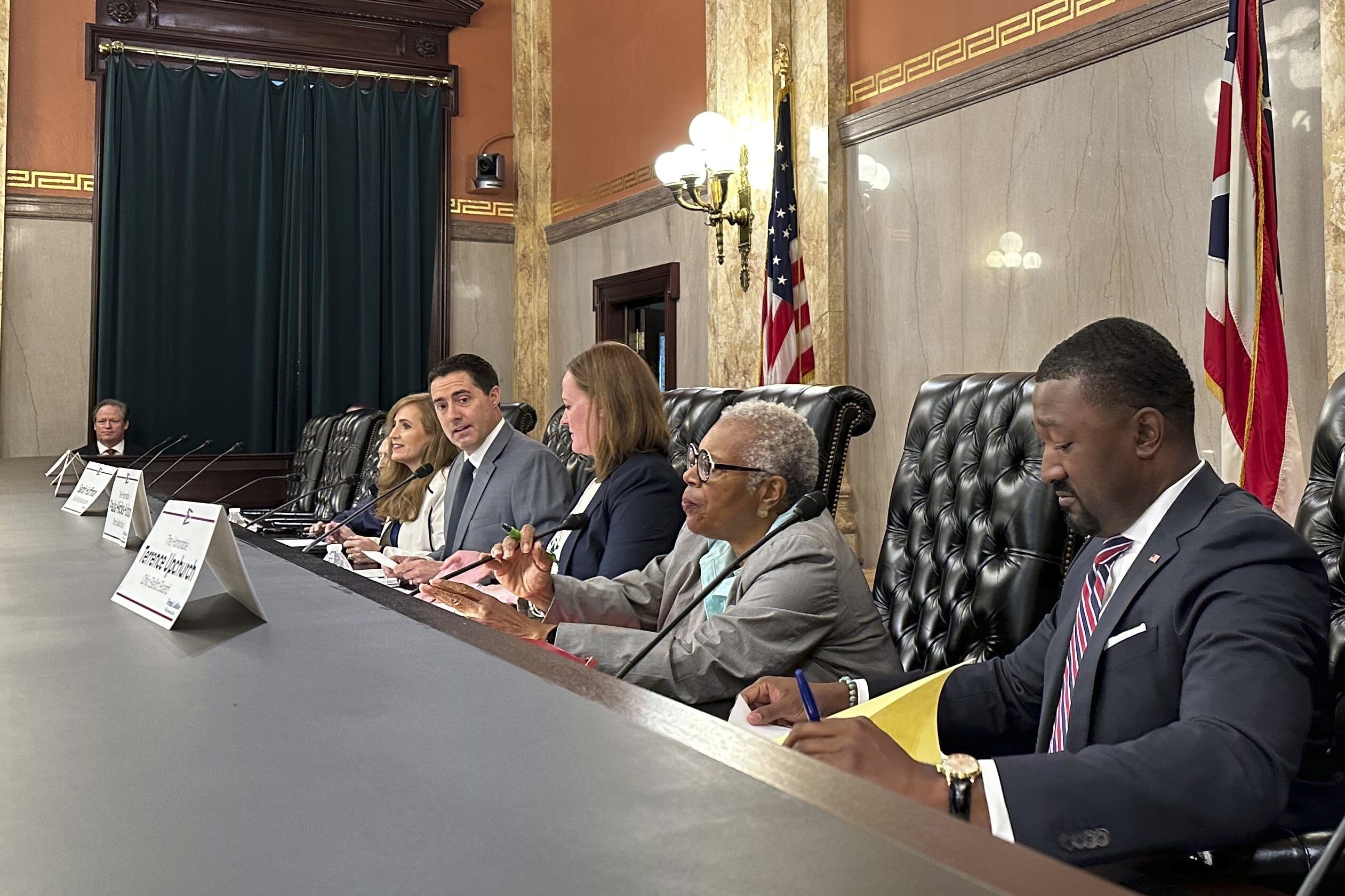
The Ohio Ballot Board — composed of three Republicans and two Democrats — crafted the ballot language of Issue 1, knowing that if an issue appears too lengthy or too complex, voters tend to reject it. And if a “yes” vote on Issue 1 is made to sound repellent, a “no” vote would ensure that the make-up of the redistricting committee remain five Republican and only two Democrats, that current district maps — which favor the Republican party — remain firmly ensconced, and that the Ohio Republican Party retain an unfair advantage in future elections (to be fair, the Ohio Supreme Court found Issue 1’s ballot language acceptable, striking only two sections — which really makes me wonder: If they found these ten points acceptable, how more dubious those two stricken sections must have been: perhaps an allowance for strictly Democratic-leaning districts to be drawn . . . and quartered).
To say that Issue 1 will “require gerrymandering” without defining it as simply redrawing district maps is as disingenuous as saying a person died of natural causes when his heart stopped beating, without mentioning the knife sticking out of his chest. It’s Orwellian double-speak. If Issue 1 is defeated, will that mean that gerrymandering will not be “required”? And does this imply it is not now required, that Republicans only gerrymander because they can . . . or because they must? After this election will the powers-that-be suddenly begin to draw fair and representational maps? We would do well to remember that seven of their previous attempts at redrawing districts (subsequent to those afore-mentioned statewide elections of 2015 and 2018) weren’t rejected by Ohio’s Supreme Court because of poor penmanship, but for reasons of unconstitutionality.
Simply put, the proposed constitutional amendment penned by Citizens Not Politicians calls for a 15-person redistricting commission made up of citizens, rather than the Ohio Redistricting Commission that is currently made up entirely of elected officials.
One would think that if 731,306 Ohians petitioned to put an issue on the ballot, those same citizens should have a say in the issue’s language on the ballot, not those who are desperate to protect the current system that only benefits themselves; however, it appears that many Republicans feel their vision of Ohio should overrule the populace’s vision of Ohio, and that in this struggle, all is fair. According to the Ohio Capital Journal, the current redistricting committee has disregarded a) hours of testimony from hundreds of Ohio citizens, b) citizen and group-proposed maps, and c) the authority of the Ohio Supreme Court’s deadlines for redrawing maps, which led to imposing a map deemed unconstitutional on this election. Moreover, throughout Ohio are campaign signs by “People Not Politics,” which read “Ban Gerrymandering, Vote NO on Issue 1.”
Politicians of both parties not only rig maps, but also rig language in order to rig elections. Perhaps we don’t need Citizens Not Politicians, but rather Citizens to Write Ballot Measures . . . or, better yet, Politicians Out Of Politics.
Chris Hager
Albany, Ohio