ATHENS, Ohio — The Ohio Ethics Commission operates in near total secrecy. Its investigations are so confidential that even the person who registered a complaint against a public official doesn’t know the status of the case.
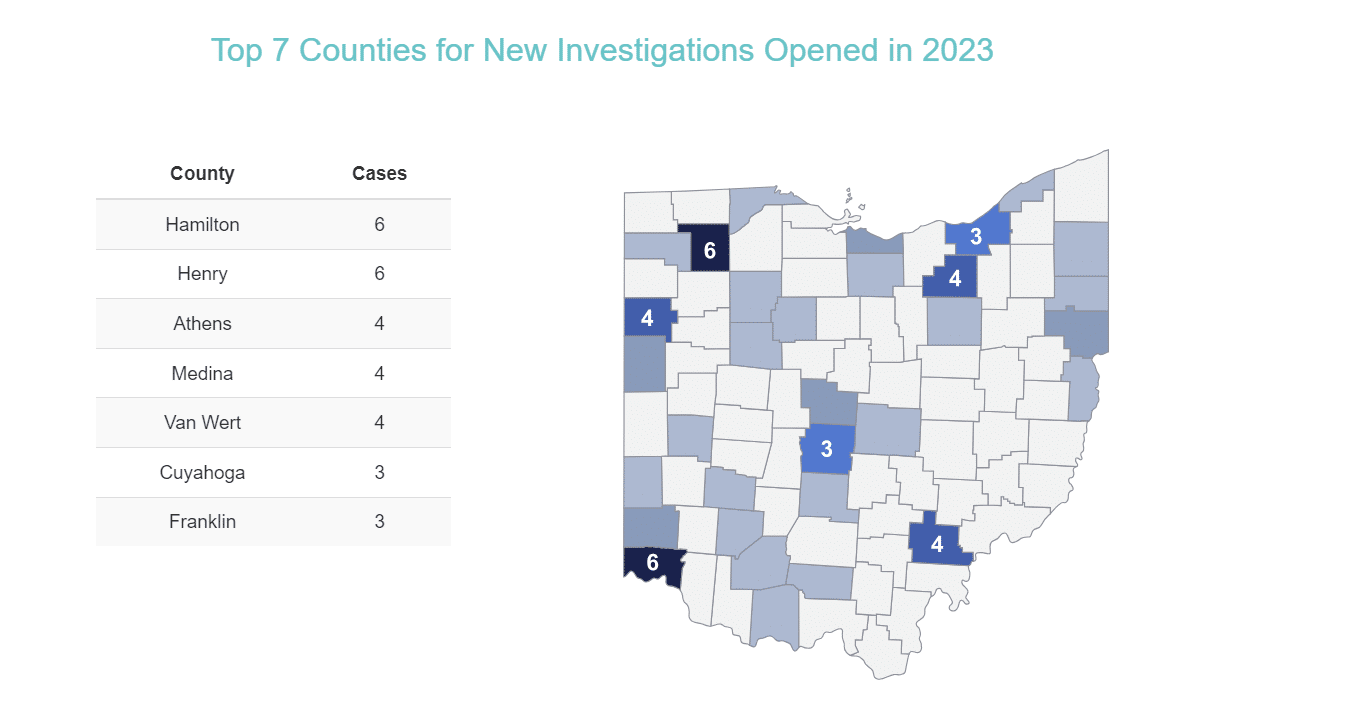
The Athens County Independent began looking into OEC complaints after the county was listed as one of the “top 10 counties for active investigations at the end of 2023” in the commission’s annual report. The county had four active investigations at that time, according to the report.

The OEC upholds and enforces ethical standards for public officials and employees. If someone submits a formal allegation claiming that a public official or employee may have violated one of these standards, the OEC will determine if the allegation is valid through a confidential investigation.
“All of our investigative files are confidential and exempt from the Public Records Law,” OEC Education & Communications Manager Susan Willeke said in an email.
This makes it nearly impossible for the public, and the press, to determine if an investigation remains active or if an investigation was opened in the first place. An OEC spokesperson confirmed on Nov. 27 that Athens County had one active case, but it’s unclear whether it was one of the four cases active at the end of 2023 or a new case.
The targets and nature of the OEC’s open and closed cases are largely unknown. There’s one exception to this: settlement agreements reached in OEC cases, when the OEC finds that a complaint had merit. Those agreements are public record.
Through a records request, the Independent learned that the OEC settled one case in Athens County over the past five years.
Board of election case concludes with settlement
The Independent requested any OEC settlement agreements over the past five years; the only record that the OEC shared was a March 11, 2022, settlement agreement “in the matter of Director of the Athens County Board of Elections Debra Quivey.”
The agreement states in its summary that “the Commission received a referral from the Auditor of State (AOS) regarding potential public contract and conflict of interest violations by Debra Quivey, the Director of the Athens County Board of Elections. Specifically, it was reported that she hired her husband and awarded him excess overtime.”
The OEC’s investigation also found that Quivey hired her brother as a BOE employee and supervised both him and her husband.
The commission found that Quivey violated Ohio Revised Code 2921.42 (A) (1) and 102.03 D, which forbid public officials or employees from employing, promoting or contracting with people and organizations with whom they have personal relationships.
Quivey’s husband worked as a part-time clerk, receiving $32,545 between 2016 and 2018, according to the settlement. Quivey told the OEC that she hired her husband to perform “small jobs or projects like office painting, when no others could be found to perform those tasks,” according to the settlement agreement.
Quivey’s brother worked for the board during early voting and as a rover on Election Day, according to Quivey’s statements in the settlement. The BOE paid him $20,161 between the years 2014–2018.
Quivey told the OEC that before the state audit, her office did not keep files on individual members of the board staff, according to the settlement. However, as a result of the OEC investigation, the board created new personnel files and implemented new internal policies to “better resolve and prevent issues in the office,” according to the settlement agreement.
“In mitigation of any violation, Quivey paid [$1,603] to the County as a result of an AOS finding for recovery due to a payroll error,” the agreement states
Quivey acknowledged that she violated the public contract provisions in ORC 2921.42(A)(1) and the conflict of interest provisions of ORC 102.03(D), according to the agreement.
Under the settlement, Quivey also “agrees she will not make any public argument in defense of the acknowledgement contained in this settlement agreement by stating that she did not do anything wrong, that the facts do not support a violation of the Ohio Ethics Law, or that the resolution of this matter is legally or factually deficient for any reason due to the investigation or processes of the Ethics Commission.”
Quivey did not respond to the Independent’s request for comment for this story.
Per the terms of the settlement, the OEC closed the investigation of Quivey.
Outcome of Patterson complaint unknown
The Independent’s records request shed no light on a 2022 complaint made against Athens Mayor Steve Patterson by local housing activist Damon Krane. Krane made his allegations about Patterson part of his unsuccessful 2023 campaign to unseat the mayor.
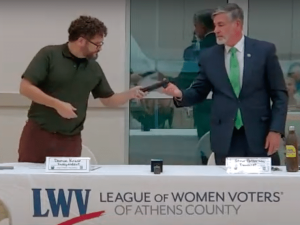
Krane said that he contacted the OEC in November 2021 and submitted a complaint in June 2022. He later shared the complaint and other materials with the Independent.
Krane’s complaint alleged that Patterson violated conflict of interest laws when he arranged a $91,654 contract with the National League of Cities to provide racial equity training to city employees. Athens City Council introduced and approved an ordinance authorizing the contract in a single meeting, on Aug. 2, 2021.
In his complaint, which he shared with the Independent, Krane alleges that Patterson was named to the league’s Race, Equity and Leadership Council in March 2021 after he contacted the league about the council’s training.
A spokesperson for the National League of Cities said that since the city of Athens has been a member since 1978, Patterson would have started receiving member benefits when he joined Athens City Council in 2012. He has held leadership positions within the organization since at least 2019.
The complaint notes that while numerous organizations offer racial equity training, “there is no indication of the mayor or Council considering purchasing training from any organization to which the mayor did not belong.”
Patterson requested that council declare an emergency — thus bypassing the need for three separate readings — even though the measure’s listing on the meeting agenda did not declare an emergency.
In December 2022, the OEC informed Krane it had determined that Athens City Council, Eliason and the National League of Cities had not violated ethics laws, because he had hadn’t alleged individual conflicts of interest for them. However, the OEC stated that because Krane alleged that Patterson potentially had a conflict of interest in this situation, “the Commission staff [will] continue to evaluate this allegation.”
In a narrative of the case he sent to the Independent, Krane wrote that an OEC investigator told him on a phone call in 2023 that “if we stop looking at Patterson we’ll let you know.”
In May, the OEC notified Krane that the commission had decided to close its investigation of Patterson, having determined that Patterson had no fiduciary duty to the league in 2021 because he was not at that time a member of its board of directors.
“The Commission determined that there was insufficient evidence to support a violation of any of the Ethics Laws or related statutes,” the letter states.
The OEC provided no records or other information in response to inquiries and records requests regarding the Krane-Patterson case.
“There is no pending or ongoing OEC conflict of interest case,” Patterson said in a Nov. 21 email. He referred other questions to the OEC.
If you suspect that a public official or employee has violated ethics rules, contact an Ohio Ethics Commission investigator at 614-466-7090.
Keri Johnson contributed to this reporting.
This story was updated at 4:30 p.m. on Dec. 4, 2024, to correct information about the OEC’s correspondence with Damon Krane about the outcome of its investigation. We regret the error.