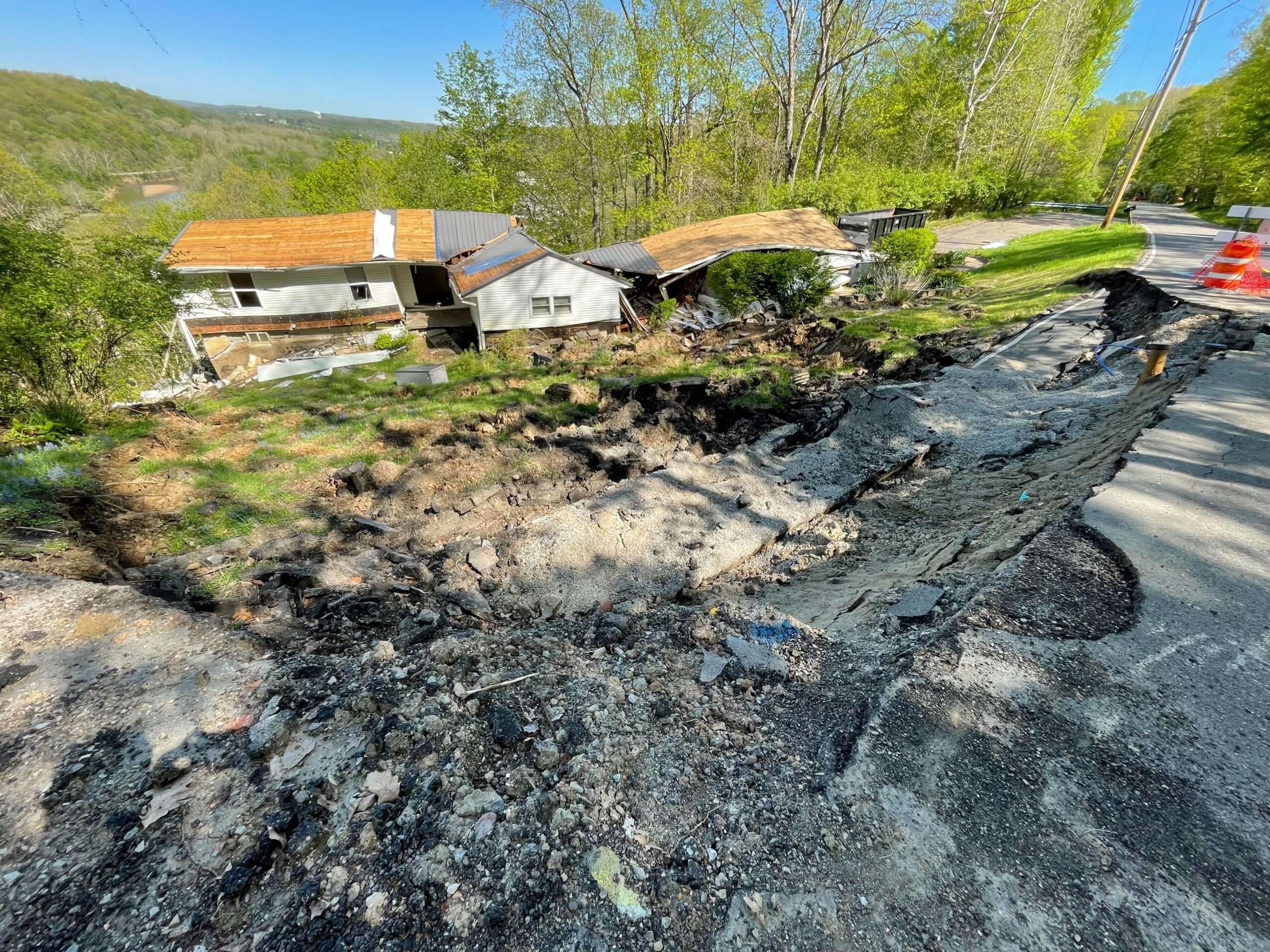
ATHENS, Ohio — As the landslide at Joneswood Drive continues to make its way down the hill, an earth science researcher says it’s impossible to predict when it will stop.
Daniel Sturmer, an associate professor of geosciences at the University of Cincinnati, spoke with the Independent last Wednesday, April 23, about landslide triggers and solutions as well as warning signs for homeowners.
The interview has been edited for clarity and brevity.
What are the types of landslides?
[Geoscientists] call them all mass movements as a generalized term. Within that, you can break it down into a bunch of different subcategories. We break landslides down based on the type of material that moves and how it moves. If it’s rock that’s moving debris, then we use unconsolidated, meaning it’s not packed in like a rock, or it’s fine grain material. We either use earth if it’s relatively dry, or mud if it’s wet.
We then further break them out based on type of motion. That can be a fall, where you have a big piece of rock that falls off of a cliff. We have slides, where material moves fairly coherently along a well-defined surface. We have flows, where material kind of moves down a slope almost like a fluid, and then an avalanche, which is like what you think of for a snow avalanche, but with rock material.
Falls and avalanches tend to move relatively fast. Slides can move at a variety of speeds. They can either be either really, really slow, or fast. Flows are generally relatively fast.
The slowest kind is a creep, where you might have slopes that are moving like a couple of inches per year. If you see places where, like there’s fences that are starting to lean over, or trees that look like they’re leaning over a lot of times. That’s indicative that the slope is creeping.
Are Appalachian slides typically on the slower side?
Not necessarily. I’d say that we aren’t precluded, especially as you get farther up into the higher country back in eastern Kentucky, West Virginia, western Virginia and western North Carolina. We saw really catastrophic landslides, mass movement and debris flows following Hurricane Helene last year in North Carolina and Tennessee. So you can certainly get mass movements that are moving very fast.
But I think overall, we tend to see more of these slower types of hill slope failures [in Appalachia]. If you don’t have infrastructure there — like if you don’t have a road that’s being destroyed, or you don’t have a house that’s built on top of it — you might not even notice things happening.
Geoscientists who work on this kind of thing, we get our eyes attuned to what features to look for. But even for us it’s really hard [spot sometimes], especially in Appalachia, because there’s so much vegetative cover.
Is rainfall linked to triggering these events?
Yes. That’s part of the challenge here in Ohio. In Appalachia more broadly, that is not as big of an issue. We just get so much more precipitation here — really intense rainstorms. We will see landslide activity pick up in spring frequently.
I’m guessing the winter in Athens was about like it was [in Cincinnati] — colder than it’s been the last few years. When the water in the ground freezes, it expands, and then when it starts to melt, all you’re left with is more space than was there before. So usually, I think if we’ve had a particularly cold winter, you might see an uptick in landslides when everything really starts to thaw out, especially if that’s happening in concert with a big rainfall event.
That’s basically what happened here. We had a whole bunch of landslides that happened in the Cincinnati area with the couple of big rainfall events that we’ve had from the last few weeks.
This hillside — not just this specific property — has been an ongoing problem. Every few years, there’s another landslide. Once one area starts to have landslides, is it more likely to trigger another?
In your area, that southeastern part of Ohio, most of the landslides are happening in these clay rich, weak layers within the bedrock. They have these beds of red shale that are super clay-rich. If those beds get lots of water in them, it basically makes the clay slip and effectively lose cohesion, because the water is acting like a kind of lubricant.
Mass movement events are being triggered by [a large amount of rainfall] within a month. You know, if you get six inches or ten inches of rain, then that [hillside] is going to move. And then once it de-waters or gets to an intermediate equilibrium state, it’ll stop moving until the next big rainfall event, then maybe it’ll fail again.
All along that hillside, there are various retaining walls made from wood and steel. Is that an effective method of prevention?
Yes, retaining walls do a lot of work. It’s a matter of balancing the forces. If the retaining wall is not holding up enough of the hillside, or isn’t strong enough to hold up enough of the hillside, then it’s not going to really matter.
But from there, there are a bunch of other methods you can do: You could put piping in the hillside to help prevent water from infiltrating into the hillside, to get it out of the ground so that it doesn’t help trigger the next landslide.
In some places they shotcrete over hills — it’s concrete that you shoot out of a truck — and concrete over the hillside.
There’s something called rock bolts — this is more for bedrock slides — but they are giant bolts that you put in the ground. It’s basically clamping the hillside down.
There’s some fencing. There’s some other things that you can do to try and prevent the hillside from failing further.
Should homeowners contact engineers and get their homes’ foundations checked, or should they not be worried about it?
I would encourage people [to contact an engineer] if they are concerned. It is worth getting a professional out to check, but I know that costs money and is expensive. There are things you can look out for on your property or in your house that are signs that homeowners need to bring a professional out.
One of the things that we see because our landslides are driven by clay that swells up when it rains [is changes to entryways]. So the doors of your home might not close correctly, and then when the clay dries up all the doors will close again.
If they notice new springs popping up on their property, find cracks that are forming on your property just uphill or downhill of it, that’s all indicative that you might be having some movement.
Again, if you’re noticing fences, power lines or something on the property that are starting to tilt over, if you’re noticing new cracks forming in the street or in your driveway, those are also indicative of movement.
I think a little awareness of that will go a long way to maybe giving people a little bit of peace of mind without having to call out a structural engineer. Now you get to the point where you see those signs, then there are a lot of companies that employ a combination of geologic and civil engineers who do this kind of work.
As of today, the landslide has been going on for about 16 days. Is that typical? Or is the duration just too unpredictable?
It depends on all the conditions: How much water is in there? Are we going to get more heavy rain events? Maybe [the slippage has moved enough] to deal with the water that’s already infiltrated it. If we get another big set of thunderstorms, another six inches of rain, it starts the process all over again.
The city’s plan is to let things take their course, and that the foliage on the back of the hillside will stop it. Can you tell if that’s a safe approach?

Well, I feel like I can’t tell just from the photo. Vegetation does act to stabilize hillsides; it does have that role. Now, there’s probably factors at play that I can’t assess from [a photo], and I’m not really an expert in on-site conditions, like a geologic or civil engineer would be.
The question I would be asking is: Where’s the failure plane? How deep is the landslide? And then, how does that compare to the depths of the roots of all the trees?
I imagine there are calculations that you could do to figure out how much that the trees will be able to stabilize. There’s a lot of factors at play here.
I guess, the other question is: Is it different bedrock? Is it more stable bedrock that these trees are really rooted into, relative to what’s failing? Is it that thin layer of the clay that’s failing?
If these trees are all sitting in sandstone or limestone, something that’s stronger, they’re not going to continue falling down the slope. Whereas, if this were just a big collection of clay material, then you know that you could potentially have a case where the rest of the hillside goes. That’s something that you’d have to kind of assess on the ground, and kind of based on how other landslides in the area have gone.
Would we know ahead of time if the hillside is going to fail?
We see this a lot more farther south, down in North Carolina and Tennessee along the I-40 corridor. It seems like that road gets shut down in the canyon between Asheville and Knoxville once every couple of years, because they have a big landslide that comes down those hills. They’re monitoring it, it’s usually not a surprise. They usually already have the road closed, and then it comes down.
So it sounds like [the Joneswood Drive slip] is being watched. I should say I haven’t been there, but I would think that you would see movement. You would see evidence that it was continuing to move before the entire thing failed, if the entire thing was going to fail.