ATHENS, Ohio — Ohio University filed an appeal on Thursday of a State Employee Relations Board decision that had certified a union for its faculty, continuing to fight for an outcome that could hinder labor organizing across the state.
“This is very disappointing,” said United Academics of Ohio University organizer Julie White. “All the way along, I think many of us have tried to approach university administration with good faith, and I think at this point we can justifiably say that another delay leads us to doubt their willingness to work in good faith with us.”
OU had a 15-day window to submit a notice of appeal; it filed on the final day. White said OU has an established pattern of waiting until a deadline to submit filings for the union election, and argued this has been “a way of drawing out this process.”
Over 70% of participating faculty voted in favor of unionization in an election held earlier this year.

OU argues, however, that United Academic of Ohio University violated state administrative law by holding members-only meetings during the course of its election campaign. OU said in its initial objection that by excluding faculty “who may have expressed opposing viewpoints” from its members-only meetings, UAOU garnered an “unfair advantage” in the election process.
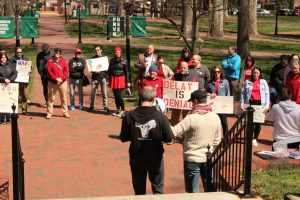
The university maintains in its appeal that UAOU’s members-only meetings deprived faculty of a “free and fair election.” It says SERB did not fully investigate its claims.
“The record reveals a number of discrepancies and unresolved issues of fact that compel reconciliation through the presentation of additional evidence,” OU wrote. The university did not specify what those discrepancies are.
White, a political science professor and Women’s Gender and Sexuality Studies core faculty member, bemoaned the additional delay that she said the appeal represents.
“We’re talking about really significant delays in a campaign that has already gone on for five years,” White said. She noted that the university will be spending a considerable amount of money to continue contesting the union victory and called the additional delay “unjustifiable.”
OU media representative Dan Pittman indicated that the appeal would not necessarily draw out the negotiating process, referencing the notice to negotiate the union submitted to SERB on May 15.
“Both parties are currently working to identify mutually agreeable dates and times to begin engaging in the process of negotiating on matters subject to collective bargaining as outlined in Ohio Revised Code Section 4117.08 while the University’s appeal moves forward,” Pittman said in an email.
Pittman declined to comment further on the university’s appeal.


In its initial response to OU, the union called OU’s argument about members-only meetings “absurd.” UAOU wrote that preventing members from meeting during the course of a campaign could severely hamper employees’ ability to organize at all.
White said, “I think it would make it really impossible to organize a union if any group conversation about outreach and priorities that had more than two people was counted as in some way exclusionary.”
The union also said in its initial filing that a victory for OU could represent a violation of First Amendment rights.
SERB did not weigh in on the constitutional question, but found “insufficient evidence” to justify setting aside the union election results.

Ray Geis, the administrative judge who investigated OU’s objection for SERB, appeared to agree with union organizers that a decision in OU’s favor “would likely prohibit union members and employers from meeting exclusively during the period from the petition for representation through the election at all.”
He wrote that the provisions of the Ohio Administrative Code cited by OU “must not be read to conflict” with Ohio Revised Code, which guarantees the right for public employees to unionize. A ruling in OU’s favor would apparently conflict with that right, in Geis’s view
In its appeal, however, OU argues that SERB should not overlook the plain language of the OAC rule that states in part, “During organizational or campaign activity, the employer or employee organization(s) may hold meetings to discuss representation or election issues, but attendance must be voluntary and available to all employees in the proposed or determined unit.”
“Where agencies like SERB fail to apply the clear, unambiguous language of their own regulations, courts set aside the agency’s findings and direct that the agency administer their regulations as written,” OU wrote in its appeal.
White, however, said SERB knows the regulations surrounding union elections better than OU.
“SERB are the respected experts on this, and they have had their opportunity to make a finding, and they did that,” White said.
The Franklin County Court of Common Pleas will hear OU’s appeal.
Note: This story has been updated since its initial publication to reflect comment from OU.