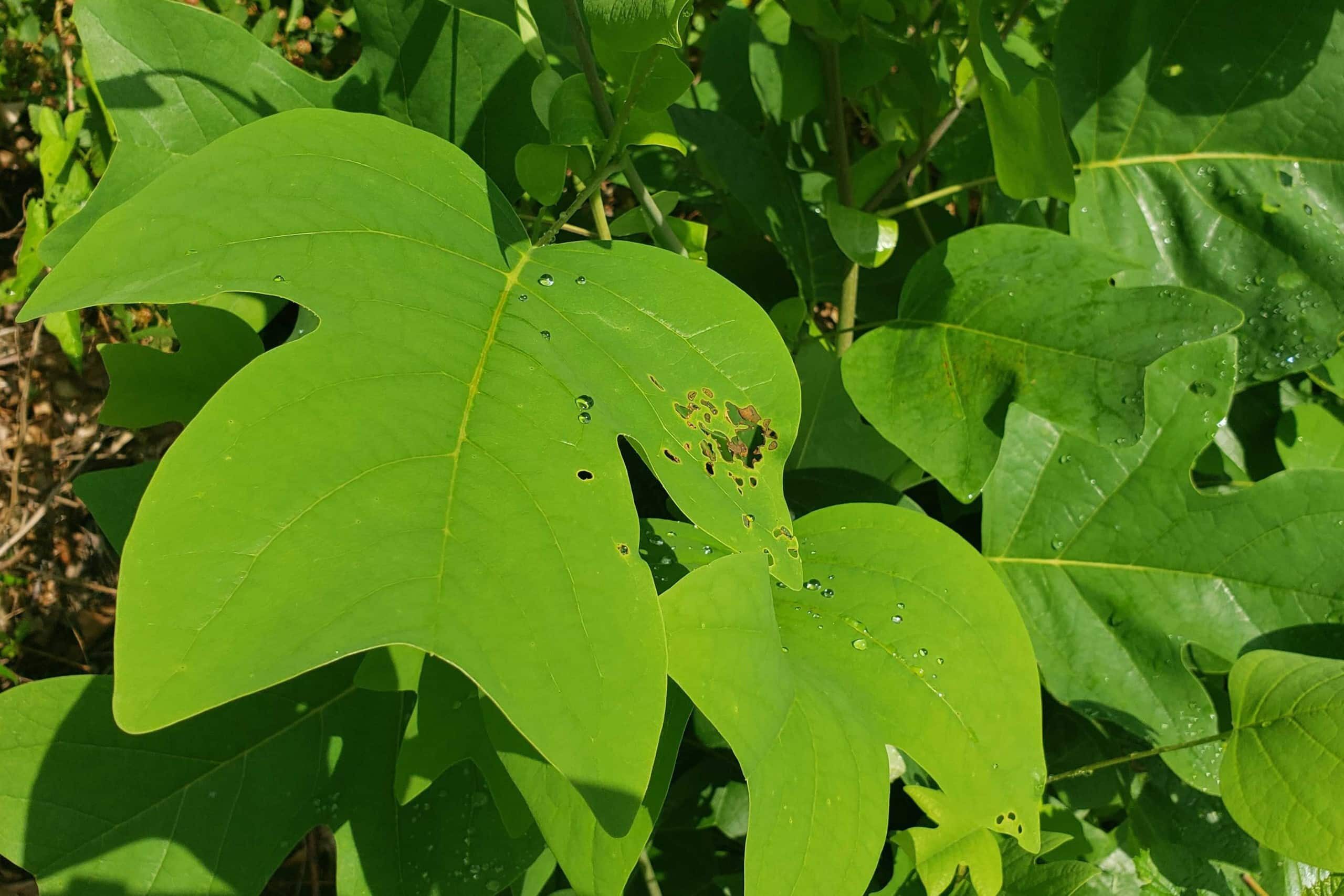

ATHENS COUNTY, Ohio —If your tulip trees are looking a little sad this year, you’re not alone.
Thomas Macy, forest health program manager for the Ohio Department of Natural Resources, started getting reports about tulip trees — sometimes called yellow poplars — with fewer leaves “probably about the second week of May.”
In addition to its own staff observations, Macy said, the agency received between 50 and 100 reports from the public and other environmental professionals.
Around southeast Ohio, Washington County appears to have been hit hardest, Macy said. Wayne National Forest Public Affairs Officer Anna Owens confirmed that the forest’s Marietta unit has seen the most impact.
Jared Deforest, chair of the Department of Environmental and Plant Biology at Ohio University, said fewer tulip trees in Athens County were affected than those in his field sites in Zaleski State Forest and Waterloo Wildlife Area.
On June 10, ODNR conducted an aerial survey flight survey, which gave a better picture of the severity of defoliation.
“The thinned and, in some cases, bare crowns of yellow poplars were apparent from the plane,” Macy said. “The damage was patchy in nature, and not consistent across the landscape, but was consistent with the reports we’ve been receiving, and what we’ve been observing on the ground.”
These results are similar to last year’s aerial survey, when Macy and his team noticed “a lot of this discoloration” and mapped it.
“Then, as we all know, we had an extreme historic drought that further stressed the yellow poplar trees late summer into the fall,” Macy said.
Tulip trees are fast-growing canopy trees that tend to drop their leaves when their environment gets dry, making them a good drought indicator.
Deforest said other drought indicators like yellow buckeye and flowering dogwood were also stressed by the drought.
Last year, he was surprised to see beech trees losing leaves, because they are usually more drought tolerant. It’s possible, he said, that the dry, cracked soil severed the beech trees from their mycorrhizal fungi network.
“This is pure speculation,” he said.
The long-term effects of the 2024 drought remain to be seen, Deforest said, because it may continue to affect how trees grow this season.
“I anticipate this is the year that we’re going to see a decline in growth,” Deforest said about the drought’s effects. He will be performing inventories with his students in the winter.
Pests add to the problem
Compounding the effects of last year’s drought are pests such as yellow poplar weevils, tulip scale, and signet lady beetles.
Yellow poplar weevils spend the winter on the ground as fully grown adults, then lay their eggs during the spring and early summer. These weevils feed on tulip trees, as well as magnolias, sassafras, and sweet bay.
The weevils damage the trees by eating the leaves and laying their eggs in the leaves’ midrib. Once the larvae hatch, they eat out the inside of the leaves, making what are called leaf mines.

Weevils certainly aren’t good for tulip trees, but because both weevils and the yellow poplars are native, weevils are unlikely to kill a tree on their own, said Joe Boggs, an assistant professor in the OSU Extension.
Boggs believes that another pest — tulip tree scales — may be stressing tulip trees even more than the weevils are.
Tulip tree scales are convex, oval insects that can grow to 7 millimeters in diameter. They can be grayish-green or orange. An infested tree looks like its twigs are covered in bumps.
“They have piercing, sucking mouth parts like a soda straw stuck into the tree,” Boggs said.
Scales drain the tree of liquid and nutrients much faster than weevils do, Boggs said.
While Ohio’s tulip poplars are suffering, Macy said the trees are not in danger of disappearing.
“We’re not ready to declare to these people that their trees are definitely going to be dead, so we’re just going to kind of wait and see, the rest of this growing season, what ends up happening with these trees,” Macy said.
Renae Hefty is a junior at Ohio University. Hefty is a summer 2025 intern at Athens County Independent, with support from the Nonprofit Newsroom Internship Program created by the Scripps Howard Fund and the Institute for Nonprofit News.