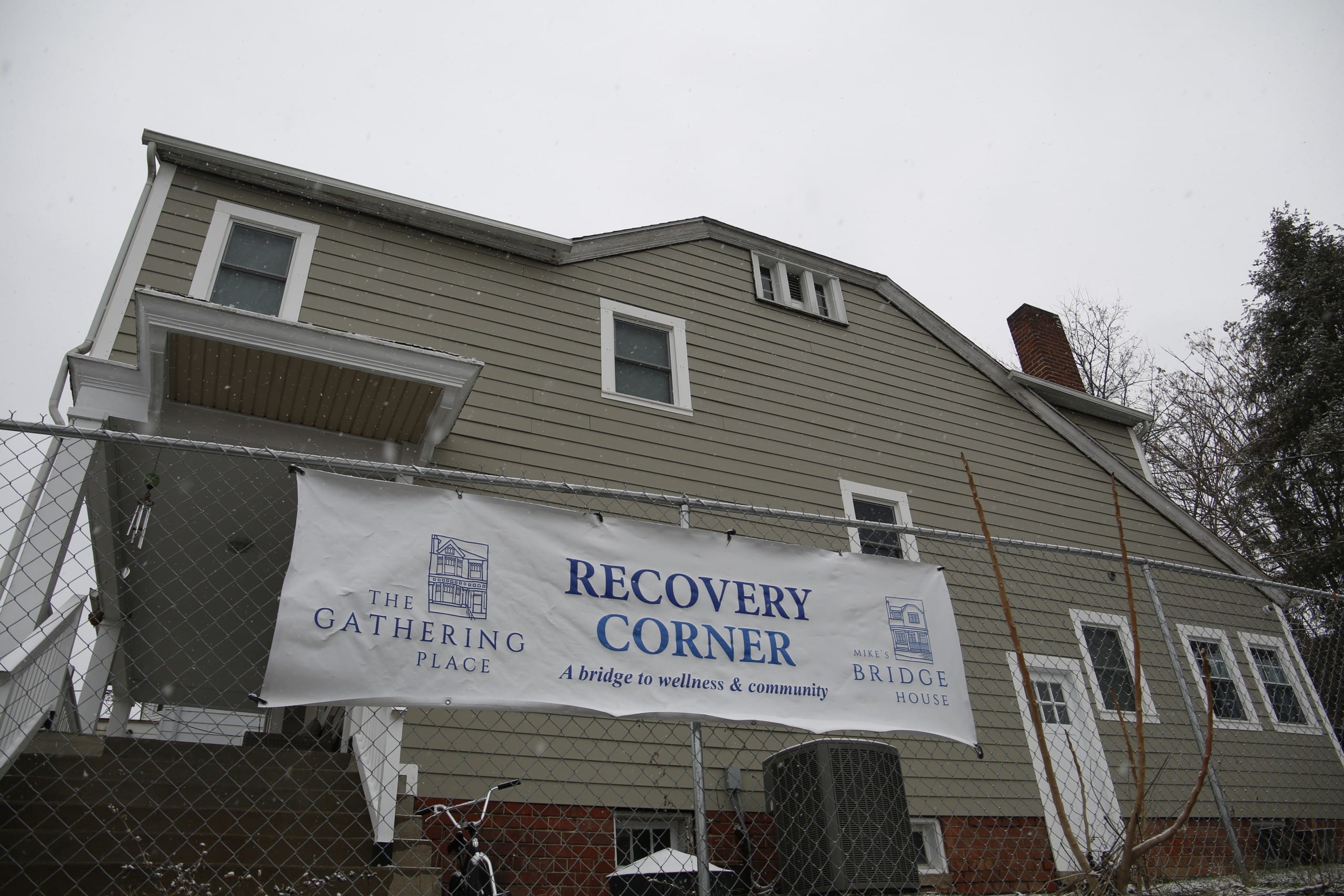

This is the first entry in a new column that highlights the work of local nonprofit organizations serving Athens County.
It’s a typical Wednesday afternoon at The Gathering Place at 7 N. Congress St. in uptown Athens: The living room table is piled with musical instruments, board games are stacked nearby, homemade art adorns the walls, a basket labeled “free stuff” sits by the front door. A TV is on in the other room and at the dining room table people are casually filling out two sheets of paper; one is a word-search game, and another is a worksheet about how to improve time management.
There is one main difference between The Gathering Place and other social drop-in sites, though: TGP is a member-operated peer recovery organization that serves adults with lived experience of a mental health issue or a co-occurring mental health and substance use disorder.
“We empower peers to take charge of their lives,” says Ginger Schmalenberg, sitting in her office upstairs at TGP. “A lot of it is modeling. You’re modeling healthy behaviors. What does it mean to live in a community? Hygiene is part of that. What’s healthy living? Eating well. Cooking has always been a part of that. Sleep hygiene. Exercise.”
To that end, TGP is open seven days a week and serves a meal every day. Programming is practically nonstop and includes things like music therapy, chair yoga, art, creative writing and bingo. And, of course, there are support groups for mental illness and substance use disorder. All told, TGP serves 40 to 50 people per day, and nearly 400 per year.
“Mental illness does not define a person,” Schmalenberg continues. “It’s all about having a meaningful, joyful, productive life. The Gathering Place is a pathway to treatment. It’s not treatment, we’re not clinical.”

But TGP is sometimes what is needed to get people into treatment. In addition to mental health education and peer support, TGP provides critical linkage services for health care, including mental health care, plus housing, food and employment.
“When I started coming to The Gathering Place, I was homeless, I lived in Timothy House. This is a place where you can come and do your laundry, you can take a shower, you can get something to eat,” says Tammy Exline, who has been coming to TGP since 2020 and attends most days. She is currently on the board of directors. ADHD and bipolar disorder have made life difficult for her at times, and TGP has been a great help.
“It’s a safe place to come and (has) people you would want to hang out with,” Exline explains, “They’re positive people and they’re trying to help you stay positive. They don’t judge you here.”
The peer-to-peer component is a big part of what TGP offers. Out of six employees, four are certified peer recovery supporters, meaning they have lived experience with mental illness or substance use disorder.
“Peers can, if you’re having a bad day, can take that bad day and throw it in the trash and make it a good day,” says Richard Otto, a TGP member who at one time served as a peer recovery supporter himself. Since suffering a traumatic brain injury at age 12, Otto has consistently heard voices — in other words, has auditory hallucinations. He didn’t get a proper diagnosis, much less support, until he was well into his 20s. Like so many others with mental health issues, he experienced episodes of being unhoused until his life stabilized.
Otto has been a TGP member since 1997 and now serves on the board of directors. He’s a member of The Gatherers, a gigging band formed from TGP members. He has “nothing but respect” for the peers on staff and TGP as a whole. “I realized that instead of isolating or getting into trouble or hanging out in a bar, I could come to The Gathering Place.”
Housing needs come to the forefront
Schmalenberg recalls that going back 10 years, her organization would help one or two members a year experiencing homelessness.
“It was easy to find them housing, get them vouchers,” she recalls. “Fast forward to 2019 and I was like, man, this is really becoming a problem.”
It was at that time she and others started talking about tiny homes. She found that a modular temporary shelter shaped like an old-fashioned Conestoga hut could be built by volunteers in one weekend for only $2,500.
Then the pandemic happened, TGP had to temporarily close its doors, and homelessness in Athens grew noticeably.
“It’s not that ‘We’re serving the unhoused population,’ but it’s that people who happen to identify with our mission happen to be unhoused,” Schmalenberg says. She got permission from the city to erect a Conestoga hut in TGP’s parking lot, but it is not zoned to allow anyone to sleep in it.
Flash forward again to January 2024 and Schmalenberg joined the Housing Security Co-Create Group facilitated by the Athens County Foundation. The Co-Create group is a collection of some 60 nonprofits and individuals with different interests and expertise in housing and homelessness issues.
“I do remember that the Athens County Foundation saw my struggle. Because of Co-Create, I started feeling that people were listening,” Schmalenberg says. An Interim Solutions Committee alighted on Conestoga huts as a likely best short-term solution while a long-term solution — turning the former Sunset Motel into a shelter, on track to open in 2026 — is being realized.
But there have been bumps in the road. The Job and Family Services site in Chauncey was considered, but in addition to flood risk, Schmalenberg was concerned that the site was too out of the way.
“We should not hide our homeless. They are our community members. This is their home. They are part of our community,” she says.
Then the Ohio Means Jobs site on West Union Street looked possible. Some neighbors supported the site, but others opposed it and now the Athens County Commissioners plan to sell the property.
TGP has been working with the city to update code to allow the Conestoga hut on site to be occupied. On May 21, the Athens Planning Commission voted to update the code to allow for three micro shelters to be allowed at TGP. The issue will go to Athens City Council for a first reading on Monday, Aug. 11, at 7 p.m. in council chambers.
“This effort sends a clear message to our unhoused neighbors: Our community cares,” said Schmalenberg, “I really hope that our community members and stakeholders who support this initiative can attend the meeting when it is introduced to City Council and allotted time for public comment.”
TGP has experienced an uptick in overall crisis needs in and around Athens, from housing to food to basic items. In response to this growing need, TGP recently launched the Community Cares Fund to respond to these urgent needs without delay or red tape. In addition, The Gathering Place Endowment Fund was created to build an endowment to help this organization, which will turn 50 in 2026, grow more stable for another 50 years.
“The real healing or treatment is not in the hospital, it is not going to your psychiatrist you see twice a year,” Schmalenberg says, “The real recovery happens in community.”