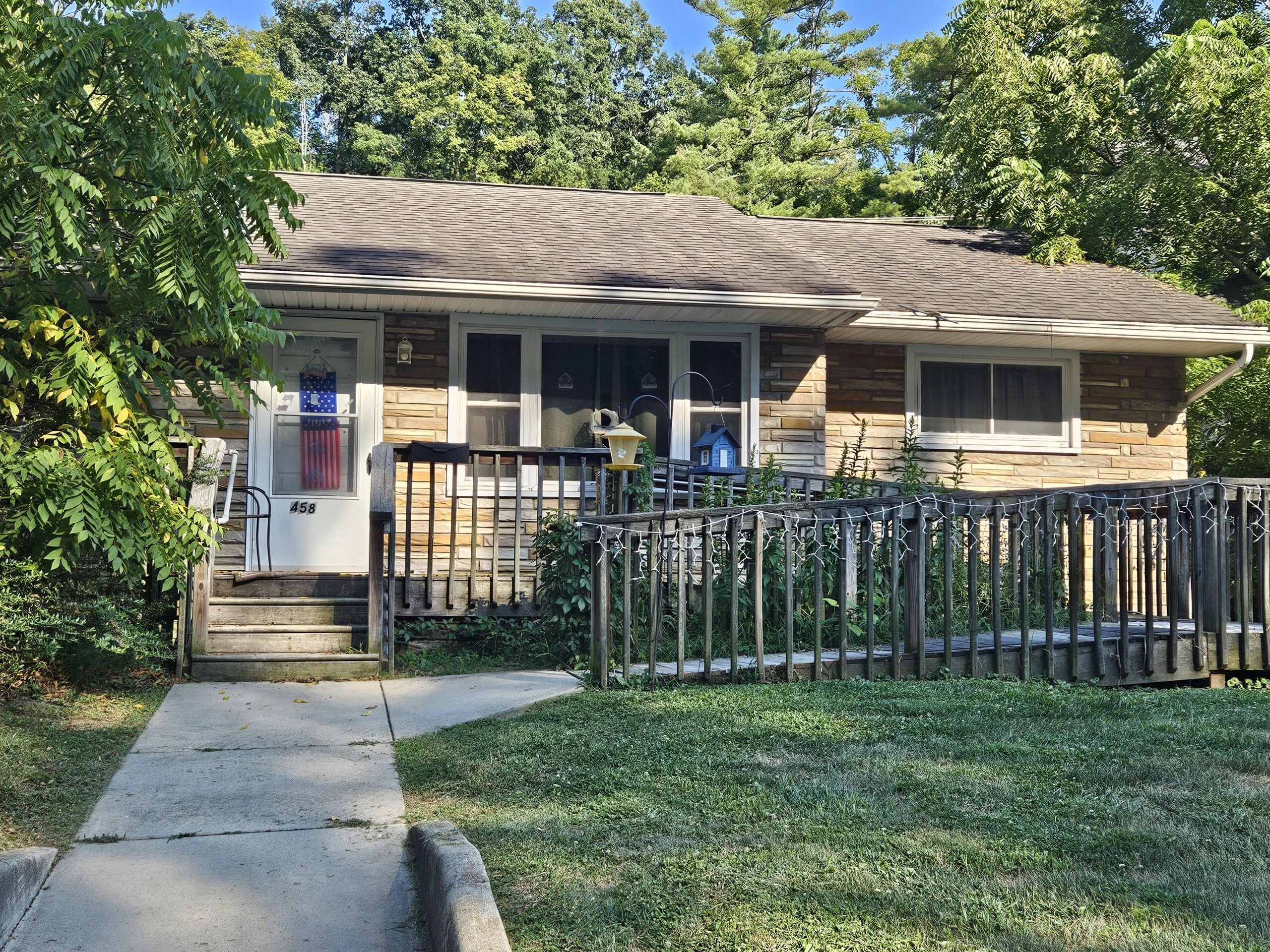
ATHENS, Ohio — First reading of an ordinance that would sell two single-family homes to the Athens Metropolitan Housing Authority, which already manages the homes for clients with disabilities, produced ample debate during Monday’s Athens City Council meeting.
One council member said the homes — at 458 Richland Ave. and 25 Central Ave. — are being proposed for sale to AMHA at about $57,000 under their market values, with tax implications that would remove just over $5,000 from local property tax revenue, should AMHA receive tax-exempt status.
Three other council members, however, said the clients living in the homes are exemplary of affordable housing that works in Athens, and that the sale of the homes on the open market would likely boost rental costs — and potentially result in the clients having to move.
Mayor Steve Patterson, absent Monday, said last week that the home occupants are disabled and receive public assistance vouchers.
In other matters, the council adopted several ordinances on their second readings, including final construction cost of the new fire station headquarters, a pre-fabricated restroom facility on West State Street, and a small adjustment in city income tax allocations to give slightly more to a street fund, and a bit less to a recreation fund.
The council also heard first reading of an ordinance to adjust city fees and, as requested by the city law director, filed a brief in support of North Canton’s case against a rental company that is fighting the city’s attempt to enforce rental property inspections — and administrative warrants when ordered.
Law Director Lisa Eliason said the case may make its way to the Ohio Supreme Court and has major implications for cities such as Athens.
Debate over two homes heats up


Ordinance 80-25 would authorize Patterson to sell the single-family homes at 25 Central Ave. and 458 Richland Ave. The city purchased the homes to increase affordable housing in Athens but now are “no longer needed for a municipal purpose,” the ordinance states.
The proposed sale price of $282,520 for the two homes raised concerns from council member Alan Swank, 4th Ward.
The Athens County Auditor’s website has the Central Avenue home valued at just over $121,000 and the Richland home at $144,000, or about $265,000 for both. Zillow, however, places their respective fair market values at $138,200 and $198,200.
“Yes, we need housing for everybody,” Swank said.
Swank said the two properties generate around $5,000 in yearly property taxes. If AMHA were to seek and receive tax-exempt status, that would cost local governments that property tax amount, including $3,000 that goes to the Athens City School District.
City Law Director Lisa Eliason said she would ask AMHA and their attorney if the agency plans to seek tax-exempt status, which must be found to be for public use if granted.
If the city sold the two homes on the open market, it would have to advertise them and accept bids, Eliason added, which it doesn’t need to do if transferring the deeds to AMHA.
Swank said he would support the home sales to AMHA if they were sold at their fair market value and property taxes were maintained.
City Planner Meghan Jennings said the Richland property may be higher in value because it includes an accessory building in the back used by the Richland Avenue fire station to store exercise equipment. If AMHA acquires the property, the city would still own the accessory building, she said.
Council member Jessica Thomas, At Large, said selling the homes to AMHA would keep their rents affordable. Council member Michael Wood, 3rd Ward, said AMHA acquiring two homes it already manages does not harm the affordable housing market.
“It’s not removing any housing; it’s keeping it,” Wood said. “If the homes were sold on the market, where would they (current occupants) go?”
Wood said selling the two homes on the market — while it might produce $50,000 or more in price above $282,520 as proposed — will end up costing more overall because of the impact on the tenants.
Council member Solveig Spjeldnes, 1st Ward, said sale of the homes to a realtor or landlord group would “jack up” the rental costs of each home substantially.
“Is that really good for the community at this particular point at these locations?” Spjeldnes asked.
Swank said he would like to receive answers as to the tax-exempt question, and how the sale price of $282,520 was determined, when the council takes up the ordinance for second reading.
Fire station funding redux: Rules suspended to adopt final tally
The city appears to have finally discerned all costs and adjustments in funding for the new fire station on Stimson Avenue, so council suspended the rules and unanimously adopted Ordinance 73-25 on second reading.
The ordinance amends Ordinance 63-25, passed in June, by clarifying that $400,770 was added to safety service fund 206 to help cover the cost of the fire station. Those funds came from a Federal Emergency Management Agency grant reimbursement of city funds used to pay for fire station exercise equipment.
Final funding also involved several transfers of funds; one changing line items in the 2025 appropriation ordinance to move $552,000 for interfund transfers, and authorizing interfund transfers to safety services fund 206 in the amount of $531,230.
With corrections made by Service-Safety Director Andy Stone, the final ordinance authorizes a total of $14.6 million for the fire station project, including $640,000 from the general fund that was previously authorized for planning, preliminary engineering, design and construction management.
Most of the fire station’s funding — $13.9 million — is from a safety services fund representing the 0.1% city income tax increase that voters approved in May 2022. That levy began Jan. 1, 2023 and lasts for 20 years.
The final cost includes transfers of funds from other sources to cover the loss of a $722,000 payment to Pepper Construction through a cyber-scam in November 2024.
The city has been involved in litigation in hope of recouping some of the money taken from the email-based scam, perpetrated primarily through email transactions and funds transferred to a false account.
Park restroom
The council also suspended its rules to adopt Ordinance 74-25, which authorizes the city to spend up to $325,000 for a new restroom on West State Street using Athens Arts, Parks & Recreation income tax funds.
It was also due for its second reading. Arts, Parks & Recreation Director Katherine Ann Jordan asked for expedited approval of the funds so the project can begin within the next few weeks. The building will be transported to Athens from a CXT Incorporated plant in West Virginia.
The cost as approved is 30% higher than the $250,000 approved in February 2022.
Before the final 6-1 vote, Swank voiced opposition, citing the structure’s lack of urinals and the city’s failure to clarify his previous question about how often the facility will be cleaned. Swank noted that without urinals, the nongendered bathrooms will need more frequent cleaning from boys who miss the mark, so to speak,

Delaying the project for two weeks so those issues can be clarified aren’t a problem, Swank said, because the baseball and softball seasons are over. Council member Thomas, however, said there is better weather now to proceed with restroom placement rather than wait until later.
Council member Micah McCarey, At Large, said it has already been noted that any prolonged project delay could result in increased cost for materials. The new restroom facility will complement those already existing at the West State ball fields.
The building is expected to be manufactured in September and placed in October.
Shifting around tax revenue
The council also suspended its rules to approve Ordinance 75-25, which had also been due for a second reading. It reallocates a slight change to how city income tax revenue is divided up.
About 20% of all city income tax revenue goes to four specific funds, such as 5.13% for the fire station debt fund. That leaves about 80% of the remaining tax revenue to be divided among uses within the city’s general fund.
The new ordinance will increase the share going to the city Street Fund 220 from 14.5% to 15.5%, while reducing the share for the Recreation Fund 270 from 8% to 7%.
Patterson said recently that income tax allocations can be adjusted based on needs within different city departments. Street Fund 220 has been in substantial use, while Arts, Parks & Recreation has been doing well with income generated from different sources such as fees, he said.
The ordinance passed unanimously.


City fees: First readings
Ordinances that received first readings included Ordinance 86-25, which establishes annual fees within the city for numerous items, ranging from citations for garbage and rubbish violations to parking fees to temporary dumpsters placed on sidewalks. The city is changing back to a lift-gate and ticket system for the city parking garage, with garage construction work — including a new exit lane onto Washington Street — set to begin soon.
Parking garage rates are set for $1 for up to one hour of time; $1 per hour for one to 10 hours; $20 for a day rate of 10–24 hours; $175 monthly for reserved spaces; and $150 for non-reserved spaces.
The council also decided to revisit the issue of spaces involving short-term parking meters. Some spaces are designed for quick 10-minute stops for meal drop-offs and pick-ups, while other spaces are designed for 20-minute stops.
Language that involves having owners of “adjacent businesses” pay annual permit fees will be clarified. Swank noted that more than 60 parking spaces in the Uptown area are set aside for short-term use, loading and unloading and other needs, which significantly reduces the availability of spaces for longer periods.
Athens City Council’s next regular meeting will be Monday, Aug. 25, at Athens City Hall, Council Chambers, third floor, 8 E. Washington St. Meetings are also streamed online. Regular sessions are on the first and third Mondays of the month; committee meetings are on the second and fourth Mondays.