
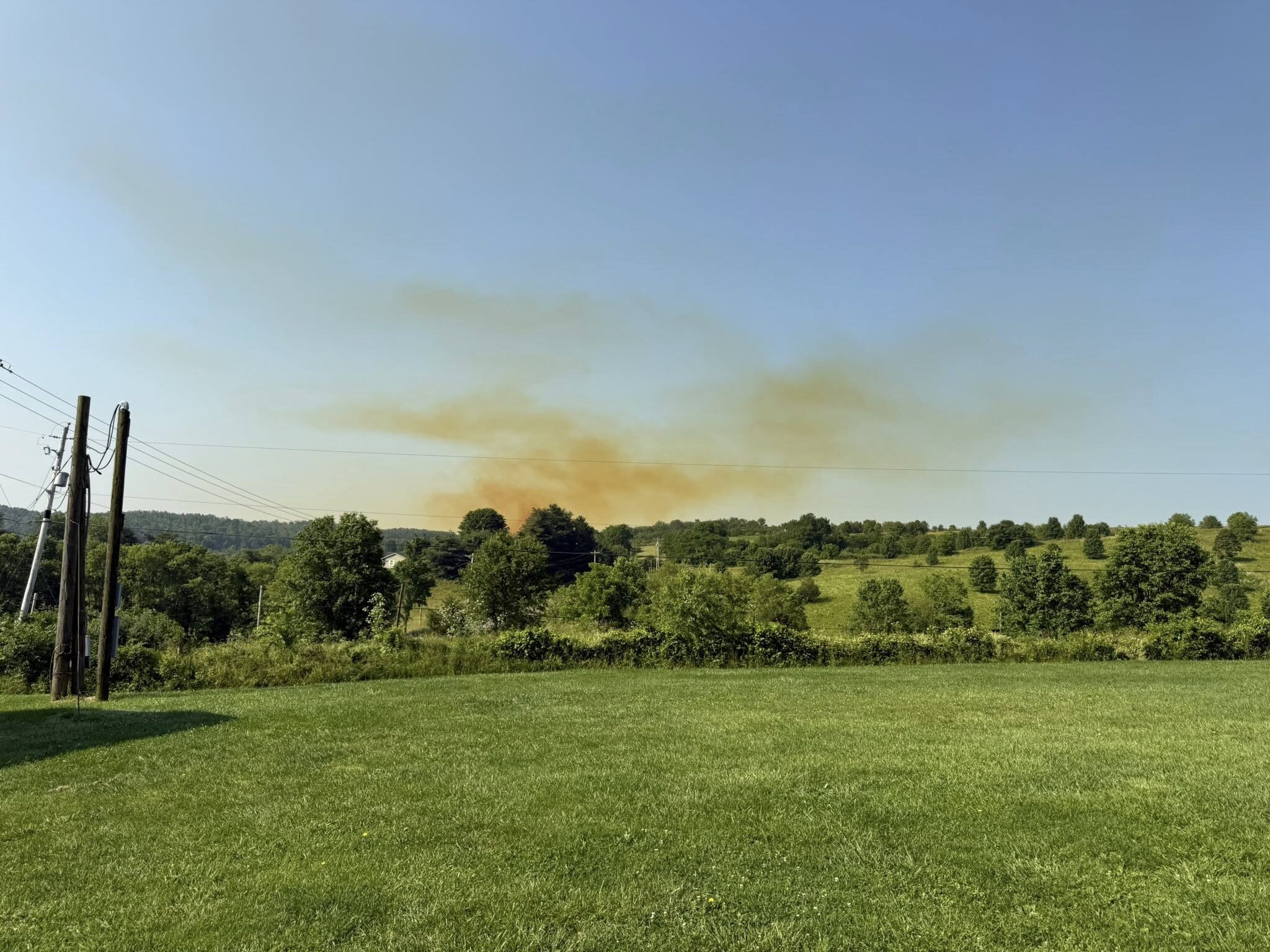
MCARTHUR, Ohio — Cleveland-based Austin Powder Company will pay over $50,000 to resolve an Occupational Safety and Health Administration citation related to the June 11, 2025, chemical release that caused officials to evacuate parts of Vinton County, records show.
OSHA’s months-long investigation into the explosives manufacturer resulted in a citation, issued Nov. 25, 2025. OSHA found that the company’s actions prior to the June 2025 chemical release could have resulted in “a catastrophic release of nitric acid or sulfuric acid,” from which “death and/or permanently disabling injury are reasonably predictable outcomes.”
Austin Powder Company manufactures explosives for mining operations worldwide. The Red Diamond facility in Vinton County, where the June 2025 chemical release occurred, is the company’s primary site in North America, according to its website. The facility produces pentaerythritol tetranitrate, or PETN, an explosive more powerful than TNT. PETN is manufactured using concentrated nitric acid.
The citation found that ahead of the chemical release, the company failed to maintain a safety plan or adhere to required safety processes. The citation also said company management knew about serious safety issues, which they failed to address.
The catastrophe OSHA said was possible because of Austin Powder’s actions did not occur. Instead, a chemical reaction converted nitric acid into nitric oxide, which is much less hazardous. The company vented the nitric oxide into the atmosphere, which produced an orange plume and prompted the evacuation of the Village of Zaleski and surrounding areas in Vinton County.
No health effects or environmental damages were reported from the incident, according to information from the Ohio Environmental Protection Agency that was obtained by the Independent.

Nitric oxide, NOx, is known for hazardous health effects, primarily when released indoors, according to Pierre Herckes, a molecular sciences professor at Arizona State University who specializes in atmospheric chemistry.
“As you vent [nitric oxide] to largely the ambient air, there’s immediately a lot of dilution,” Herckes told the Independent in an interview. “In terms of direct health effects for humans, it’s mostly an issue … in confined rooms.”
Nitric acid, which OSHA said could have been released due to the company’s actions, poses a “substantially higher health risk than nitric oxide,” he said. As such, storage tanks are often designed with a vent off failsafe to release gaseous material in order to prevent the tank from rupturing.
In its November 2025 citation, OSHA initially fined Austin Powder $101,669. However, a month later, the fines were reduced to $50,835 through an informal settlement agreement.
The settlement agreement reclassified some citation items to less serious violations, and vacated or affirmed other citation items.
Brad Kostka, a communications consultant representing Austin Powder, told the Independent in an email that Austin Powder “cooperated fully with OSHA throughout its review of this matter.”
This was not the first time the company received a citation from OSHA.
In 2009, three employees were injured in an explosion at the Vinton County factory; one suffered burns to 90% of their body and died of their injuries one month after the incident. The other two employees were treated for concussions, acute hearing loss, cuts and possible broken bones, according to an OSHA report.
OSHA inspections of the plant in 2013 and 2015 resulted in hundreds of thousands in fines for safety violations.
OSHA investigation reveals causes of June 11 incident
OSHA’s investigation into the events leading to the June 11, 2025, incident discovered several factors which OSHA’s citation said contributed to the chemical release.
- On April 29, 2025, a device used to concentrate nitric acid suffered a catastrophic failure and was rendered inoperable. The OSHA report states that since this device wasn’t available to process acid, it created multiple hazardous scenarios, such as the consolidation of material at the bottom of the nitric acid storage tank and decomposition reactions. In response, Austin Powder immediately paused production of PETN, the powerful explosive manufactured at the Vinton County plant.
- On May 29, 2025, the company initiated a “small production run” of PETN using materials “that had already been fed into the system,” even though the acid concentrator was still broken, the OSHA report says. This production process began without the company engaging in a process required by OSHA to recognize risk and mitigate danger before implementing changes to a system.
- According to the report, plant officials failed to properly implement internal shutdown procedures. According to company documentation, the tank should have been emptied after the acid concentrator broke, which did not happen. Managers were aware excess PETN remained in the tank, and that the excess PETN was in the tank during manufacturing on May 29, 2025.
- Starting on May 29, 2025, and continuing until June 11 that year,the tank’s contents were above the alarm temperature (50 degrees Fahrenheit), per the OSHA report. The temperature increased over time, eventually reaching 155 F around the time of the June 11 chemical release. The report states that Austin Powder’s system “recognized” the alarm, but the company did not document any actions to cool the tank. During this same time, management and the control room did not communicate about the tank’s temperature. However, the report states that Austin Powder managers were aware of the temperature alarm prior to the June 11, 2025, chemical release.
- OSHA’s report states that it’s unclear if Austin Powder ever maintained documentation related to several considerations relevant to the tank and PETN manufacturing, including safety systems and operating limits. The report also noted that operating procedures for regular operations of the tank “did not contain the Process Safety Information” required by OSHA.
- The most recent OSHA-required hazard analysis for the storage tank was in 2017 and didn’t address the tank’s cooling water supply. The hazard analysis also didn’t fully analyze “all process hazards,” including high concentrations of explosive material in the tank, according to the report. OSHA policy requires that hazard analyses be updated every five years; the analysis should have been updated in 2022.
- The report noted that a water supply line used to cool the tank had been damaged, resulting in a blockage. OSHA investigators also found that the valve for the water supply line had been “throttled,” and wasn’t completely open.
The report also notes that each of the 33 employees working in the PETN production area of the facility were continuously and wrongfully exposed to potentially disastrous hazards.
After being cited last year, Austin Powder agreed to correct safety issues identified in OSHA, as amended in the Dec. 22, 2025, settlement agreement.
The company also agreed to engage a third-party consultant to develop and conduct a training program on Management of Change, a set of procedures OSHA requires employers to develop and implement in order to address safety and health impacts from changes to typical operating procedures. Austin Powder’s failure to adhere to Management of Change procedures in the events leading to the June 11 incident was among the issues identified in OSHA’s citation.
The settlement also required Austin Powder to submit the results of a third-party consultant’s whole site audit on compliance with OSHA’s Process Safety Management requirements. The company had already contracted with a consultant to conduct such an audit by the time the settlement agreement was signed.
“The agreement reflects our commitment to continuous improvement and outlines steps to further strengthen our processes and procedures,” Kostka, Austin Powder’s communications consultant, told the Independent.
Chemical release had little impact, tests submitted to Ohio EPA show
The Ohio Environmental Protection Agency did not fine Austin Powder over the chemical release from the company’s Vinton County factory that prompted an evacuation in the area this summer. The agency also did not investigate the root cause of the incident.
“Determining the root cause of this incident falls outside of our agency’s responsibility,” Ohio EPA Public Information Officer Anthony Chenault said in an email to the Independent. “It is common in a situation like this to allow the responsible party to assess the cause and any damage resulting from an incident.”
The Ohio EPA report on the June 11, 2025, chemical release did not identify any environmental or health impacts as a result of the incident. The report included testing by local community responders, including fire departments and HAZMAT teams, as well as testing contracted by Austin Powder.
Austin Powder said its contractors and local community responders conducted air monitoring in the days immediately following the June 11 release. The air monitoring did not detect nitric oxide or other chemicals associated with the release.
Austin Powder also conducted surface water monitoring at several locations, showing that the acidity of nearby waterways was neutral.
The Ohio EPA’s emergency response unit conducted a single test of acidity at a stream near the Austin Powder plant, in a Raccoon Creek tributary. The Ohio EPA report does not refer to any other testing conducted by the agency.
The final estimated amount of nitric oxide gas that Austin Powder released was just under two tons, according to the Ohio EPA report. While the release happened in a short time span and from a single location, producing a visible orange cloud in the air, it pales in comparison to the amount of nitric oxide normally released into the atmosphere.
“Actually anytime you burn something at high temperature, you make nitric oxide,” Herckes, the molecular sciences professor at Arizona State University, said.
Ohio’s electric industry emitted 34,673 tons of nitrogen oxide gases (NOx and NO2) in 2024 according to the U.S. Energy Information Administration – about 95 tons per day.
On June 11, when the company released a plume of nitric oxide into the atmosphere, the Ohio EPA sent Austin Powder a ‘Notice of Response and Regulatory Interest,’ outlining several steps the company had to take to avoid being hit with a violation. These included eliminating the source of the discharge, preventing the discharge from impacting waterways, monitoring the incident site, and restoring the impacted environment.
“Based on the short-term environmental impact, no additional follow-up from the Ohio EPA is needed at this time,” Chenault, the Ohio EPA public information officer, told the Independent in a Dec. 5, 2025, email.

