
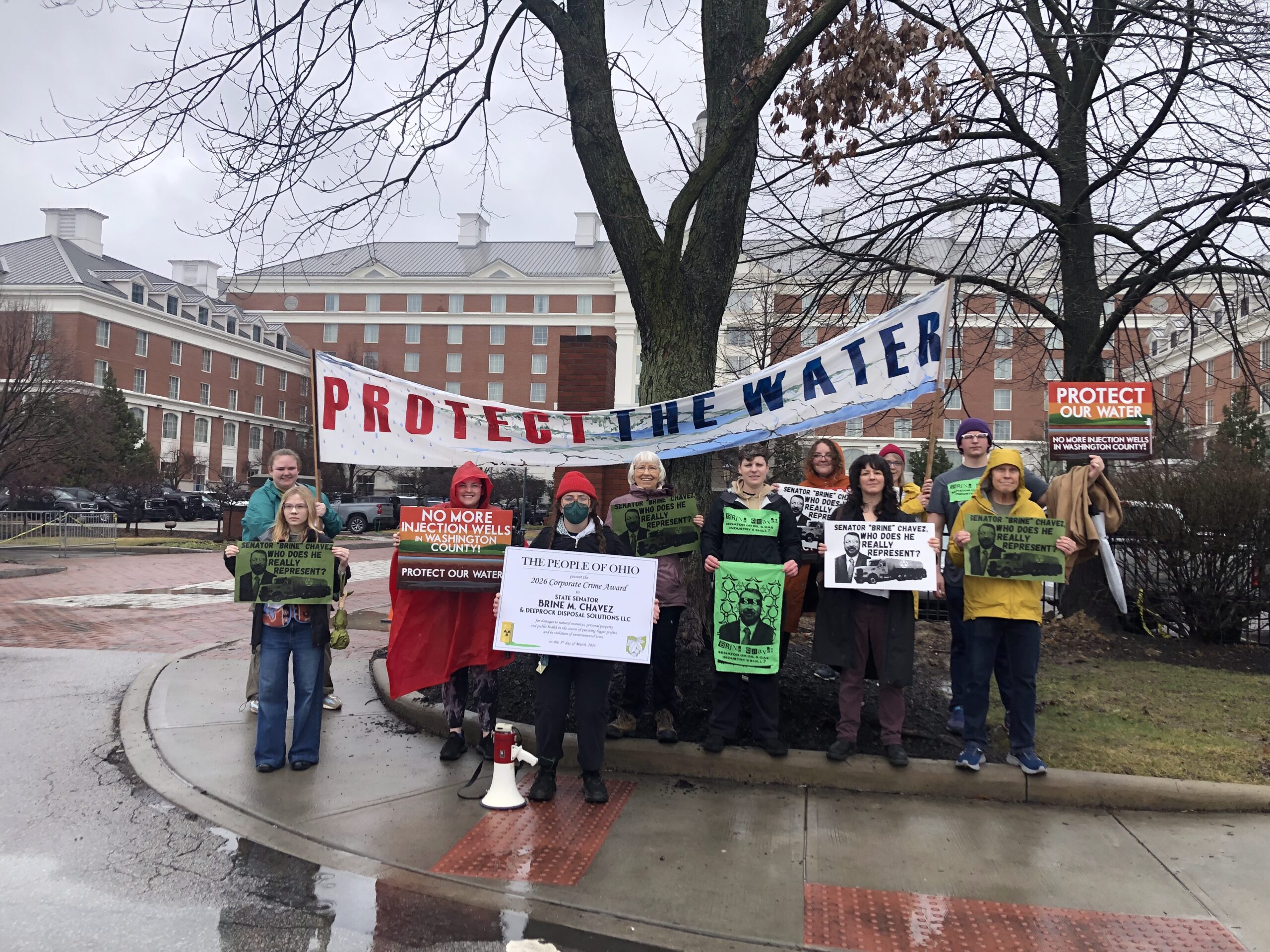
COLUMBUS, Ohio — Challengers to new Washington County injection wells faced two setbacks in the courts last week, with one case dismissed and another recommended for dismissal by a magistrate.
Both cases pertained to the same issue: permits to drill new injection wells in Washington County that the Ohio Department of Natural Resources Division of Oil and Gas Resources Management issued to DeepRock Disposal Solutions, a company with ties to sitting Ohio Senator Brian Chavez (R-30).
The permits were issued under the regulations that were in place when DeepRock submitted its permit applications in December 2021. New and more stringent rules went into effect just weeks later, in January 2022, which ODNR adopted when the old rules proved insufficient to protect against the uncontrolled, underground spread of fracking waste from Southeast Ohio injection wells.
Fracking waste contains highly toxic chemicals such as PFAS and radioactive compounds. Its uncontrolled spread poses a risk to drinking water and the environment, the ODNR has repeatedly found.
DeepRock’s permits were granted under the old rules in 2025.
Nonprofit organization Buckeye Environmental Network sued the ODNR in Ohio’s Tenth District Court of Appeals over the agency’s decision to apply the old rules to two DeepRock permit applications.
Meanwhile, the City of Marietta appealed to the Ohio Oil and Gas Commission to prevent execution of one of the permits.

On April 16, a magistrate recommended that the court dismiss Buckeye Environmental Network’s lawsuit, finding that the ODNR had no obligation to apply the new rules to DeepRock’s permit applications. The court has not yet officially adopted the magistrate’s decision, as is required by the Ohio Rules of Civil Procedure.
The next day, the Ohio Oil and Gas Commission dismissed Marietta’s separate case, finding that the commission lacked jurisdiction to hear it.
Asked about the decisions, media representative for the ODNR Karina Cheung told the Independent in an email, “We believe that the decision speaks for itself, so we have no additional comment.”
Bev Reed, an organizer with Buckeye Environmental Network, told the Independent that the nonprofit and activists will continue to fight the injection wells, motivated by the threat the wells could pose to health and the environment.
Reed said she continues to come back to the same question: “Why wouldn’t they use the most updated, current rules, especially with all the migration issues in Southeast Ohio?”
Reed said Buckeye Environmental Network will object to the magistrate’s recommendation in the case before the Tenth District Court of Appeals. Reed said the two legal cases are just one mechanism that a coalition of local activists, oil and gas producers, and government officials have used to challenge the new injection wells.
Nine political subdivisions in Washington County approved resolutions calling for a moratorium on new injection wells in the county, among other demands. Representatives of the subdivisions delivered those resolutions to the Ohio governor’s office as part of a series of actions challenging the new wells at the beginning of March.
The political subdivisions calling for the moratorium include the City of Marietta; the Warren, Putnam, Highland Ridge, Little Hocking, and Tri-County water districts; Muskingum and Waterford Townships; and the Village of Beverly.
Activists also submitted a draft complaint to the Joint Legislative Ethics Committee alleging Chavez has used his position to change oil and gas industry regulations for personal gain.

Court of Appeals case
In the April 16 decision, Magistrate Thomas Scholl determined that Buckeye Environmental Network failed to demonstrate that the ODNR “had a clear legal duty to use the new regulations in their review of DeepRock’s applications for permit to drill.”
Instead, Scholl agreed with the arguments from ODNR and DeepRock. “The Ohio Supreme Court has long recognized that the issuance of a permit is governed by the law in effect at the time of the application for such permit,” Scholl said.
Scholl’s decision is not the final word on the subject.
The court must decide whether to adopt the magistrate’s decision as well as rule on any objections to that decision, according to the Ohio Rules of Civil Procedure. Buckeye Environmental Network has 14 days from the April 16 decision to file an objection, and Reed told the Independent that the nonprofit intends to pursue that option.
The magistrate rejected Buckeye Environmental Network’s legal arguments, however.
School found that in the primary case the nonprofit had cited as relevant caselaw, the circumstances were too distinct, “negating any precedential value.”
Furthermore, the magistrate said case law alone was insufficient to form the basis of an argument in a mandamus case. In such a case, a court orders an entity to do something that it has a legal duty to do. Scholl said that duty cannot be determined only by case law, but must refer to a statute or administrative rule.
Scholl found Buckeye Environmental Network “can point to no statute requiring [ODNR] to apply the new regulations to DeepRock’s applications.”
Getting to the fundamental arguments in the case, Scholl determined that requiring applicants for permits to submit new applications in the event of legislative or administrative changes would unfairly burden applicants.
“Well permit applications require substantial investments of time, capital, and technical resources to complete,” Scholl wrote. “To force applicants to submit new applications after a regulatory change takes place during the pendency of their original application would unfairly burden applicants who had already spent significant time, effort, and money in reliance upon the necessary requirements of the prior regulatory scheme.”
Scholl added, “Although an applicant should not expect regulations to never change, once the applicant submits the type of complex and time-consuming application at issue here, the applicant should be certain that it will be reviewed under the regulations that were applicable at the time of submission.”
For these reasons, Scholl decided that DeepRock and other respondents in the case are entitled to the dismissal of the case.
Earthjustice attorney Megan Hunter, representing Buckeye Environmental Network, declined to comment in depth on the magistrate’s decision beyond stating, “Obviously, we disagree.” Hunter confirmed to the Independent that Earthjustice plans to object to the magistrate’s decision on behalf of Buckeye Environmental Network.
Ohio Oil and Gas Commission case
The April 17 dismissal of Marietta’s case before the Ohio Oil and Gas Commission was final.
The commission found that it does not have the authority to review permits granted by the ODNR Division of Oil and Gas Resources Management — only formal orders by the division chief.
Marietta anticipated that the commission may determine it lacked jurisdiction. However, the city argued that an eventual permit for DeepRock to actually begin injecting waste into the new wells could be reviewed by the commission, according to established case law.
Despite anticipating the jurisdiction issues, Marietta Law Director Paul Bertram wrote in the city’s initial appeal, “As a courtesy to DeepRock Disposal Solutions, I nonetheless file this appeal at this stage in order to prevent DeepRock from unnecessarily expending funds to drill an injection well, which we believe this Commission will ultimately find may not be injected with waste.”
Bertram wrote that even if the city’s initial appeal were dismissed, the city would appeal any future decision “that permits DeepRock Disposal Solutions, LLC to begin injecting waste fluids.”
Bertram did not respond to the Independent’s request for comment in time for publication.
