
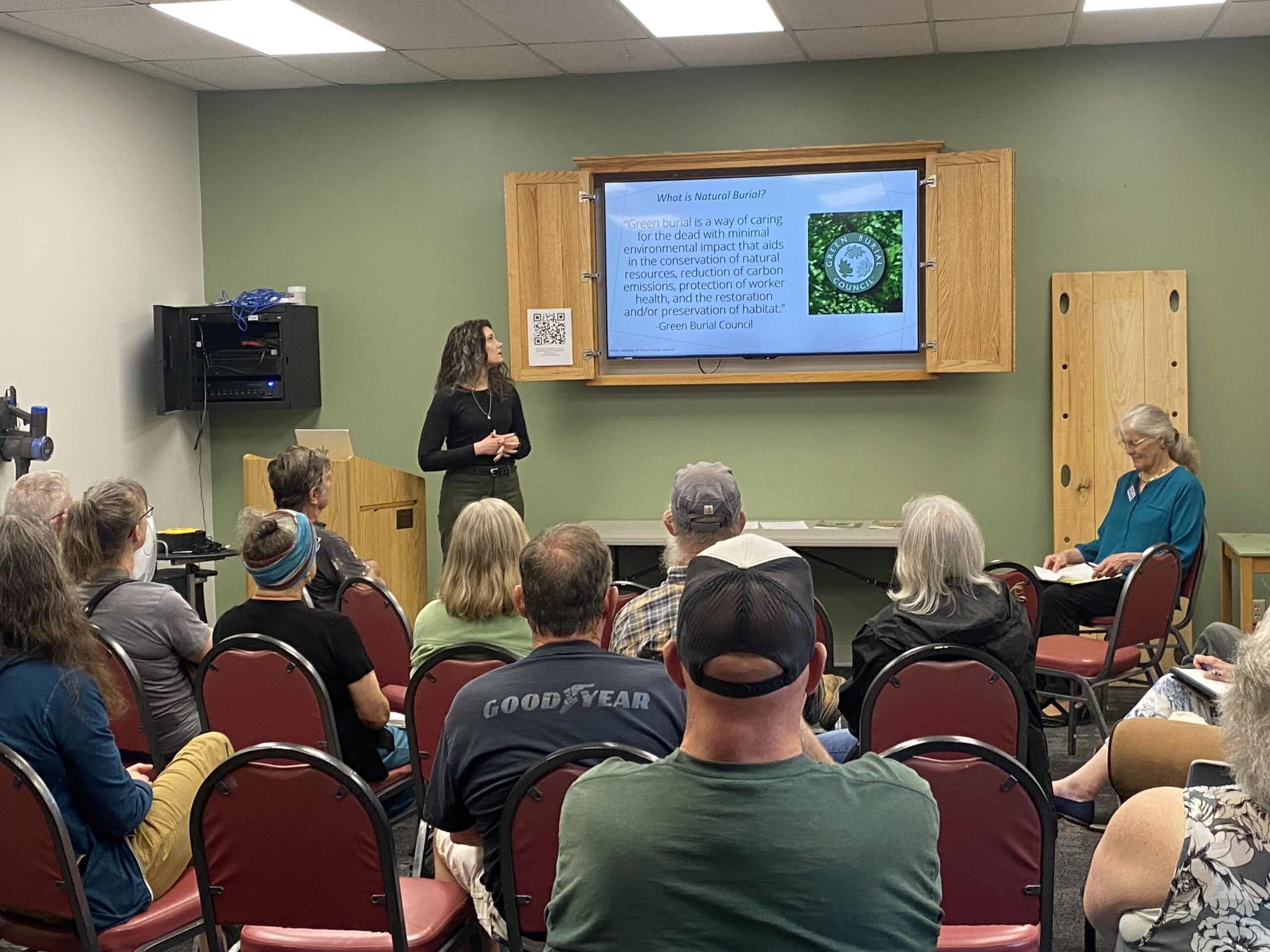
THE PLAINS, Ohio — When Athens resident Natalie Wilson considered attending mortuary school, she was put off by the industry’s practices, and its environmental impact — “all of this stuff we’re putting in the ground.”
“I started thinking about that. Like, why are we doing this?” Wilson said during a May 20 presentation at The Plains Public Library.
That question led her away from a career in the industry and toward volunteer advocacy with Southeast Ohio Natural Burial Working Group, which encourages local people and governments to consider doing things a different way.
Although some businesses market environmentally friendly burials that use pricey products such as mushroom burial suits, Wilson described such marketing as greenwashing. Burials do not need to include such products, she said.
Families may choose to invest in materials for a natural burial, which could include natural fibers to wrap the body, a shrouding board to carry the body and lower it into the ground, and ropes to lower the body. Some might prefer a casket made of simple natural materials.
“Culturally, this is really a return to burial practices that we practiced before the Civil War,” Wilson said at the group’s May 20 presentation.
Before the 1860s, death was mainly a private matter handled by families at home. The dead were typically buried relatively quickly, without embalming or burial vaults, which are often made of metal or concrete today.
The embalming industry sprung up as a method to preserve the bodies of soldiers for return to families during the war. And with people profiting from the new industry, the wartime cultural practices established a new norm for managing death in the United States. Each year, the U.S. uses about 5.3 million gallons of embalming fluid, with environmental and health impacts.
But Wilson and others in the working group argue the old way had many benefits: Natural burials (also called green burials) are generally much cheaper, are better for the environment, and can offer a more intimate experience for families.
Wilson said the local natural burials working group has recently seen an uptick in interest. The May 20 presentation was attended by about 20 people, and the group recently hosted another well-attended presentation. Additionally, one of the group’s social media posts went viral, and people throughout the state have been reaching out to the local group.
Erom Garrison travelled to The Plains from Zanesville to learn about natural burials, inspired by her father’s recent passing and more traditional funeral.
“You have to buy a fancy casket, and then a vault. Just the formaldehyde that we put into the ground, I think, is what really just turns my stomach – the environmental impact on the one planet we have. We’ve got to do a better job of maintaining it for the rest of the world’s species,” Garrison said.
Garrison said the experience of her father’s death reinvigorated her sense that “we got to do better about this.”
Also among attendees at the May 20 presentation was Terry Gilkey, who has extensive experience working with the city of Athens on cemetery maintenance. He said he is enthused about natural burials because he hates to see the amount of material that enters the ground for more conventional burials.
Gilkey said he was also motivated to attend the presentation to learn more about burials on private property.
Wenda Sheard, a local lawyer and volunteer with the group, said at the May 20 presentation that no state or federal laws prevent natural burials or bar burial on private land, despite common misconceptions.
And while local laws may regulate the practices in some places, Sheard said she did not know of any such laws in any Athens County municipalities. Sheard encouraged attendees to speak with an attorney if they’re interested in creating a family cemetery on private land, noting that attorneys could assist in understanding any local regulations and in preserving a record of burials in property deeds.
Locals who wish to pursue natural burials have many options, including burials on private land that do not involve funeral homes or any outside services. Such burials can cost as little as $10, Sheard said — the cost of a burial permit in Ohio.
A traditional full service burial can cost about $8,000, while cremation costs around $5,600. And while cremation is often billed as an environmentally friendly option, it still takes a toll due to the fossil fuels used to reach and maintain high heat.
The cost of natural burials can go up substantially if families work with funeral homes or established cemeteries, although it will generally be cheaper than conventional approaches.
Locally, Alexander Cemetery’s Jewish burial ground conducts burials with many conventional features like simple caskets, but without the use of embalming, Wilson said. Additionally, Southeast Ohio Natural Burial Working Group worked with York Township to establish a section of Pedigo Cemetery that is open to natural burials.
For those interested in advocating for more local natural burial grounds, Sheard encouraged residents who live outside city limits to speak with their township trustees, who manage and maintain cemeteries.
Conservation cemeteries are also an option elsewhere in the state. Such cemeteries have a dual mission to support natural burials and preserve land. In Ohio, such cemeteries include Foxfield Preserve in Wilmont, Kokosking Nature Preserve in Gambier, and Heritage Acres Memorial Cemetery near Cincinnati.
Local funeral homes can help assist with natural burials. Wilson cited Ewing, Hughes and White Funeral Homes as an option for people locally, noting that the working group had spoken with the funeral homes and representatives would not be surprised by questions on natural burial.
Wilson said funeral home directors are “members of our community.”
“They really want to make people happy,” Wilson said. “They are running a business. They do need to keep that business going, but really they are members of our community, and I respect them greatly. And if you work with them, they’re going to try to give you what you want.”
The Southeast Ohio Natural Burial Working Group is also available as a resource for local area residents interested in learning more about natural burials.
