
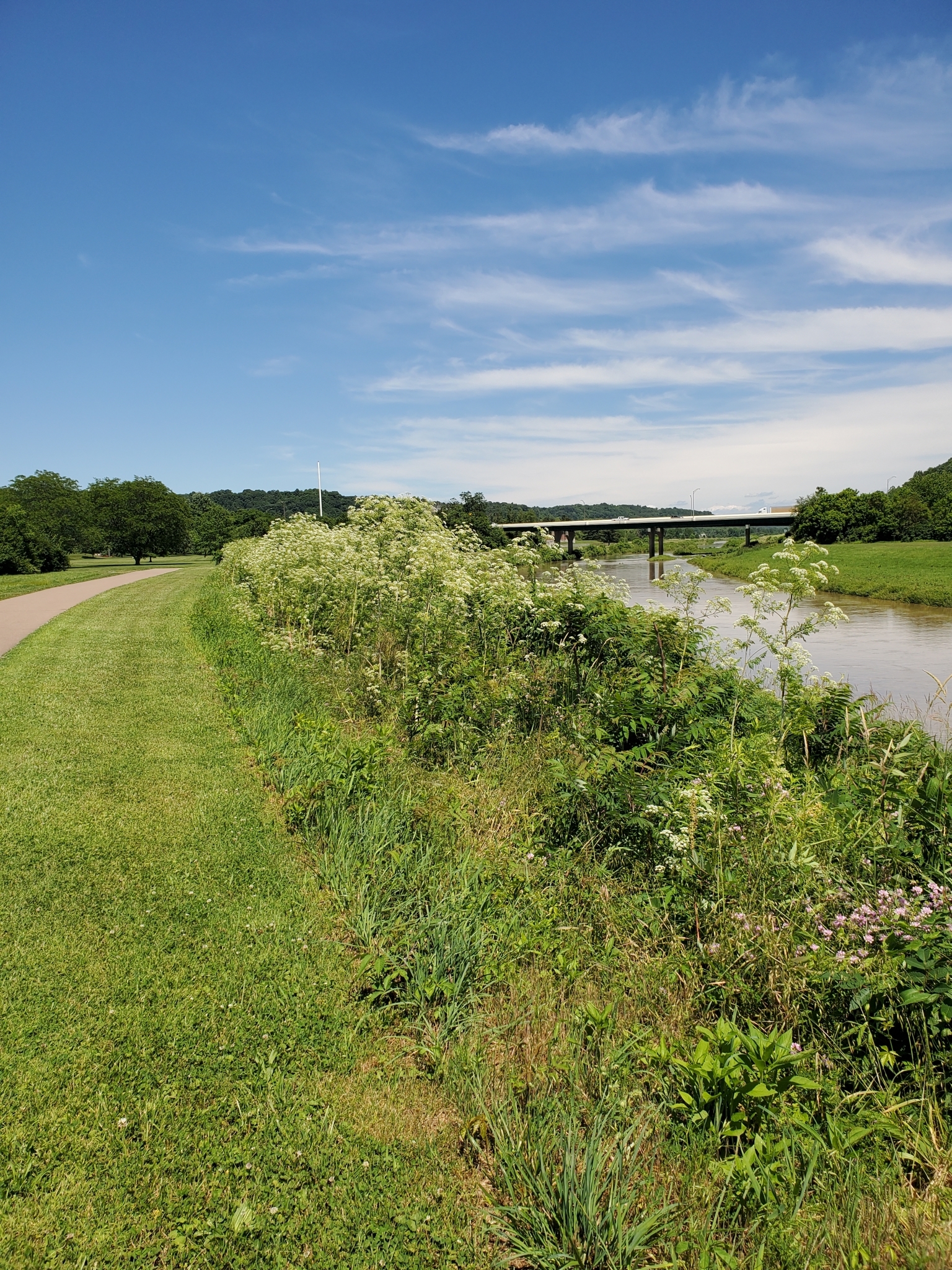
ATHENS COUNTY, Ohio — For the past decade, the invasive plant poison hemlock has been making inroads in Athens County, and local municipalities are now working to address its spread.
The Athens County Emergency Management Agency described the plant in a May 28 Facebook post as among the most toxic in North America, noting that all parts of poison hemlock contain a deadly toxin.
“Poisoning can occur through ingestion, inhalation, or absorption via the eyes and broken skin,” the post said. “Poison hemlock rarely causes a severe skin rash, but the sap is highly dangerous if it enters the bloodstream through minor skin cuts, scratches, or abrasions.”
The plant, Conium maculatum, is a member of the carrot family and can be distinguished from other species by its purple-spotted stem and fern-like leaves. It grows four to eight feet tall and has numerous small, white, five-petaled flowers at the end of its branches.
The EMA post about dangers from the plant gained so much traction that it posted a follow up saying “there is no need for panic” and that the primary danger associated with the plant is ingestion. (It can also be dangerous to inhale parts of the plant during mowing or touch its sap.)
Based on the public’s response to their posts, the EMA got in touch with Athens County Planner Connor LaVelle to establish a system for residents to report poison hemlock growth on public property, LaVelle told the Independent.
LaVelle said he has fielded “a lot of responses from folks” to the countyplanner@athensoh.org email address.
LaVelle’s office handles county parks and some sections of the Hockhocking Adena Bikeway. Mainly, however, the inquiries LaVelle has received have pertained to other jurisdictions, such as the city of Athens or local townships.
“I’m happy to direct them towards who they need to talk to,” LaVelle said.
The Ohio State University Athens Extension office also is a resource for residents concerned about the plant.
“We do education on it, and kind of make everyone aware,” said Ed Brown, Agriculture and Natural Resource Educator for the Ohio State University Athens County Extension. “We give them the life cycle of the plant and what the options are. There’s easy options and a little bit more expensive options.”
The plant is most visible in the late spring and early summer, when it has grown tall and is flowering. However, Brown said the plant can be most effectively addressed in the early spring, before it flowers and goes to seed.
The spread of poison hemlock
“It’s been here for a long time, but it’s been slowly advancing,” Brown said. “Really, I’ve seen the last four or five years, probably, it was becoming very noticeable.”
In 2017, poison hemlock was first recorded in Athens County on iNaturalist, a website and app where individuals can record observations in nature. That year, one person observed two plants. Every year since 2019, observations of the plant submitted to the app have been in the double digits.
Poison hemlock has been found locally in “local ditches, roadsides, fencerows, floodplains, meadows and fields,” according to the EMA’s Facebook post. Almost all Athens County reports on iNaturalist are located in the central or eastern portions of the county. Many are located in the city of Athens and along the Hocking River and bike path.
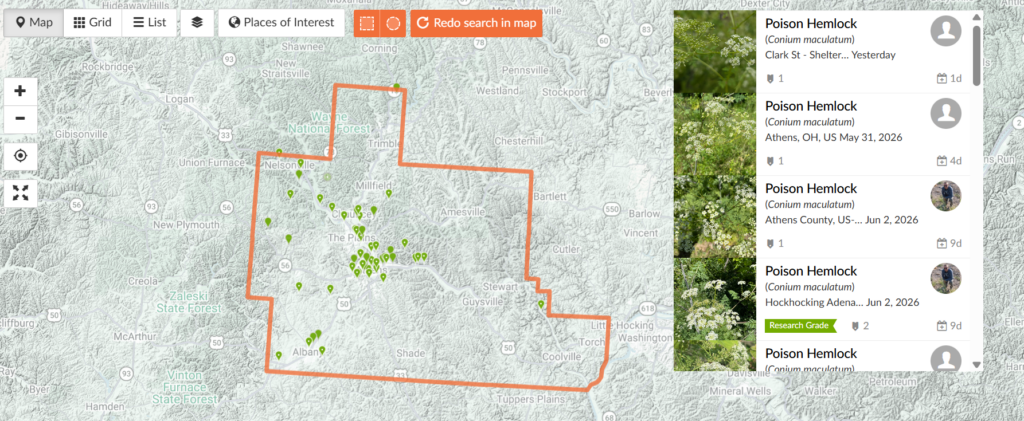
Poison hemlock has also been frequently recorded along major roadways, according to Brown.
Local governments respond
Addressing the spread of invasive species falls within the county’s Hazard Mitigation Plan, last updated in 2025 and overseen by the EMA. Although poison hemlock is not specifically identified in the plan, LaVelle said he expects it will be included in future iterations. He added that the EMA’s posts about poison hemlock support the plan’s “goals of increasing public awareness and education regarding natural hazards.”
Actually curbing the spread on public land falls to local municipalities, all of which are obligated under Ohio’s noxious weed laws to address poison hemlock along roadways and lands they manage. Each different municipality within the county takes its own approach.
“From the county’s side, I think that they’ve got it pretty much under control along the bike path. They have a very regular maintenance schedule, so they keep it pretty tightly mowed,” LaVelle said.
LaVelle noted that the county maintains a three- to five-foot shoulder on areas of the bike path. The county has also mowed another area where the plant was found on its land, at the Athens County Job and Family Services building. Maintenance workers had to remain in the enclosed cab tractor to limit exposure, he said.
“They’ve tried to keep ahead of it,” LaVelle said.
Athens Arts, Parks & Rec Director Katherine Ann Jordan said her department has previously removed poison hemlock, specifically pointing to a project to clear invasive species from the riparian area behind the community center. She said the plant has sprung back up along the bike path near Walmart.
“That’s something that we’re keeping on our radar to treat, hopefully in the next year or so,” she said.
She added she does not have her staff mow the plant due to concerns that the plant will get in maintenance workers’ eyes and lungs.
“It’s more of figuring out what makes sense within the staff that we have and the safety equipment that we have and the processes that we have in place,” she said.
The Hocking Conservancy District manages land on the banks of the Hocking River, where many iNaturalist observations of poison hemlock have been logged. The district has not yet taken steps to address the spread of the plant. However, Mark Holdcroft, secretary-treasurer at the district, told the Independent that poison hemlock management has been an active conversation over the past month.
“We just haven’t determined the best method yet of how to handle this plant,” Holdcroft said. He said the district is planning to seek guidance from the Ohio Department of Natural Resources.
Holdcroft said he had confirmed the plant on land the district manages off Harmony Road and suspects it’s “all along the bike path.”
“It seems to have really gotten bad this year as compared to years in the past, but maybe we just haven’t noticed it in years in the past to this degree,” Holdcroft said. Regardless, he added, “It’s there now, so we have to address it.”
Township trustees in Athens and Alexander townships and a Buchtel Village Council member all told the Independent they had never responded to reports of the plant. Township trustees are required to address reports of noxious weeds, including poison hemlock, on private land.
Ohio University and the EMA did not respond to June 10 requests for comment (by email and phone respectively) in time for publication.
Managing the plant on private property
Brown, with the OSU Athens County Extension office, said there are many options to address the spread of the plant on private land. The first step is understanding its biennial life cycle, he said.
“This year, half of the plants you won’t even notice, because they just have a rosette. It looks almost like carrot leaves down at ground level, and they’ll just stay green, even through the winter months. Those will be green, kind of like carrot leaves, kind of feathery,” Brown said. “And then the second year, in the spring, this time of year, they send up a shoot – flower stalk – and they flower, make seed, and then they die.”
The cheapest way to address the spread of the plant is to cut the stalks off on the plant as soon as they come up, Brown said. He cautioned people to be careful not to ingest or touch the plant’s sap when removing it. The plants will not generate a new stalk and will then die.
The next year, the plants that did not flower in year one will send up stalks. If those are also removed, Brown said there will then be a noticeable decline in the population. However, seeds will remain in the seed bank so continued effort will be necessary in the following years.
In addition to hand-removing the plants, Brown said herbicide use in the early spring is another option.
Brown said his office can give people more specific recommendations on herbicides and address other questions related to managing the plant. Call them at 740-593-8555 or visit their offices at 280 W. Union St., Athens, between 8:30 a.m. and 4:30 p.m. Monday through Friday.
