
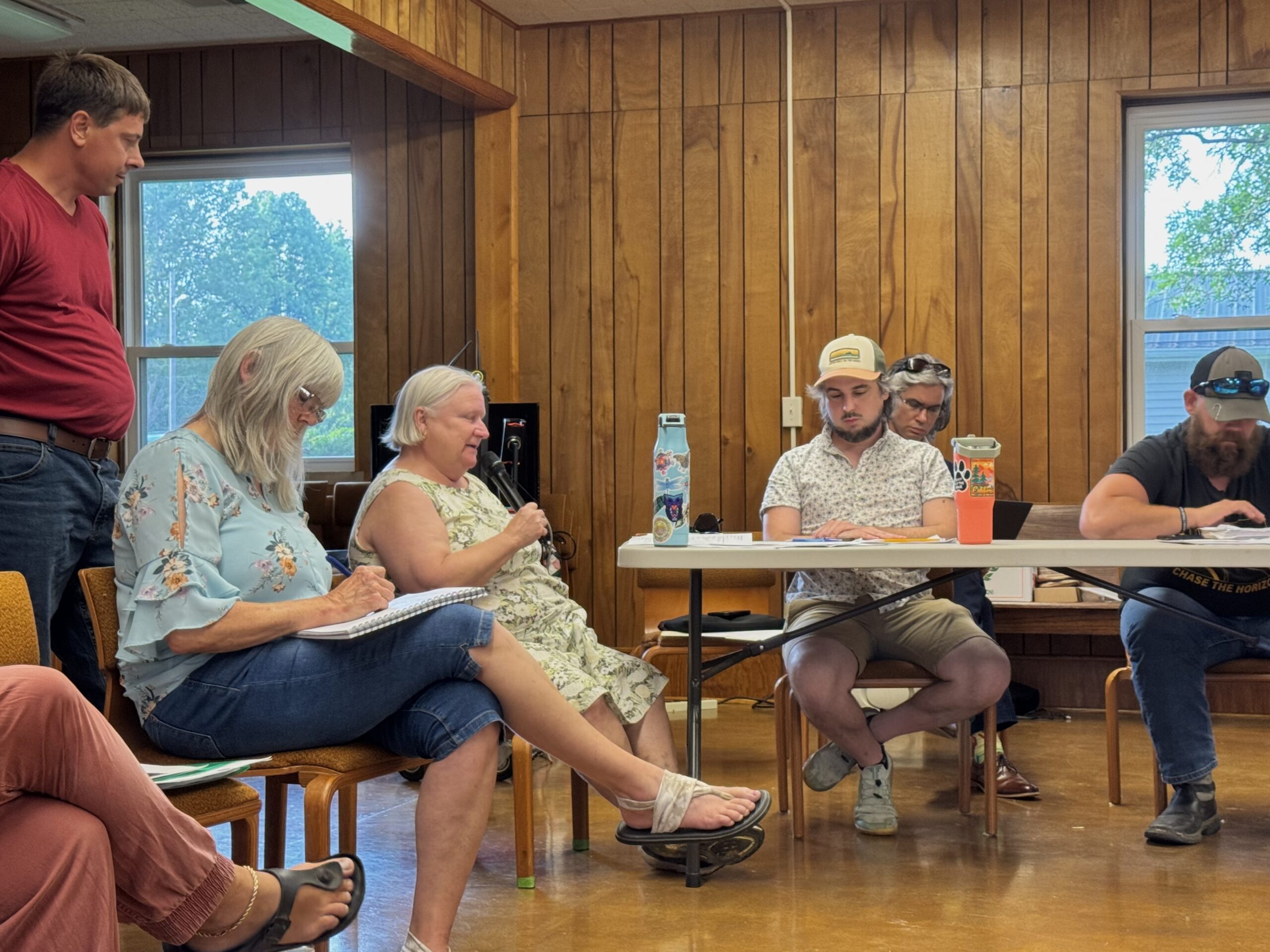
CHAUNCEY, Ohio — In a crowded and tense meeting that lasted nearly three hours on Wednesday, Chauncey Village Council voted to keep their anti-discrimination ordinance in place, while repealing a resolution calling for a ceasefire in Palestine.
At least 50 people attended the meeting. Council amended the meeting agenda to allow public comment before a vote on the ordinance and resolution. Over 20 people spoke on the ordinance and resolution, including Chauncey and Athens County residents and people from other communities across Ohio, including at least one person who had travelled from Columbus.
Council had seemed ready to repeal the anti-discrimination ordinance at its last meeting, in May, when the majority of council members who spoke in the discussion favored repeal. Two council members remained silent in that discussion, but voted to accept the second reading of the ordinance to repeal.
The anti-discrimination ordinance bars discrimination in employment, housing, and public accommodation on the basis of gender, sexuality, age, marital status, and other classes. Gender and sexuality are not included in state or federal fair housing law.
At the June 10 meeting, some Chauncey residents said council repealing the unlawful discriminatory practices ordinance would cause them to no longer feel welcome in Chauncey.
“I would not have purchased a house in this community knowing that something like this was going to happen,” a resident said, “and I could actually consider leaving if this passes.”
One resident who recently moved to Chauncey said, “If I would have known what was going on, I would not have moved here.”
Council members Connaught Cullen, Dylan Skees, and Natasha Taylor all voted to retain the ordinance on unlawful discriminatory practices, with council members Joe Jenne and Karla Dellinger in favor of repealing it.
Council member Connaught Cullen was the only member to vote in favor of keeping the ceasefire resolution.
Council member Amanda Moore was not in attendance.
After the council’s verdict, a resident said, “Could I just say that those of us who disagree with that, we don’t hate you, and we don’t agree with any hateful messages on Facebook. We don’t want hate on any side.”
Council member Jenne responded, “I had my entire family threatened to be burned up in a house, so that’s where the hate lied.”
“My best friend is a lesbian, has been for 20 years. I have faced a lot of hate over the past week and a half that was totally unnecessary,” Jenne said.
Jenne also said that an op-ed published by the Independent had “totally [taken] his words out of context.” He then spoke directly to the author, Damon Krane, who was in attendance, saying, “If you was here and would’ve listened, you would have heard me say that if you don’t feel comfortable here, then don’t move here, because you don’t live here anyways.”
Jenne and Krane then got into an argument, before a resident yelled, “Stop arguing, please. We’re talking about getting along with one another and not hating one another. Just stop, have a conversation.”
Campbell then called for order, the third time during the meeting.
Campbell had previously called for order twice during public comment, once when a member of the public interrupted another’s speaking time, and again when a person called the repealment “virtue signaling,” before telling council to “stroke your egos and maybe pocketbooks about it.”
Campbell told the Independent after the meeting that he was “very frustrated” that the ordinance staying in place. “Unfortunately, what happens in the end is, it didn’t benefit a single person,” he said.
“Unfortunately tonight, everybody lost, and we can’t fix it at this point,” Campbell said. “We were trying to do the right thing and make something that was good for everybody, and all the negativity that surrounded it swayed some of the council members.”
Though it was not repealed, Campbell claimed the ordinance could not be enforced in its current state due to the lack of a whereas statement.
Contacted for comment on Friday, Chauncey Village solicitor Jonathan Robe told the Independent, who explained, “Any legislative action, to be valid, has to have a rational basis, and the whereas clauses are where the council provides legislative fact findings and reasons for its actions.”
“If there’s a lack of rational basis,” Robe continued, “then the entire legislative action could be invalidated.”
