
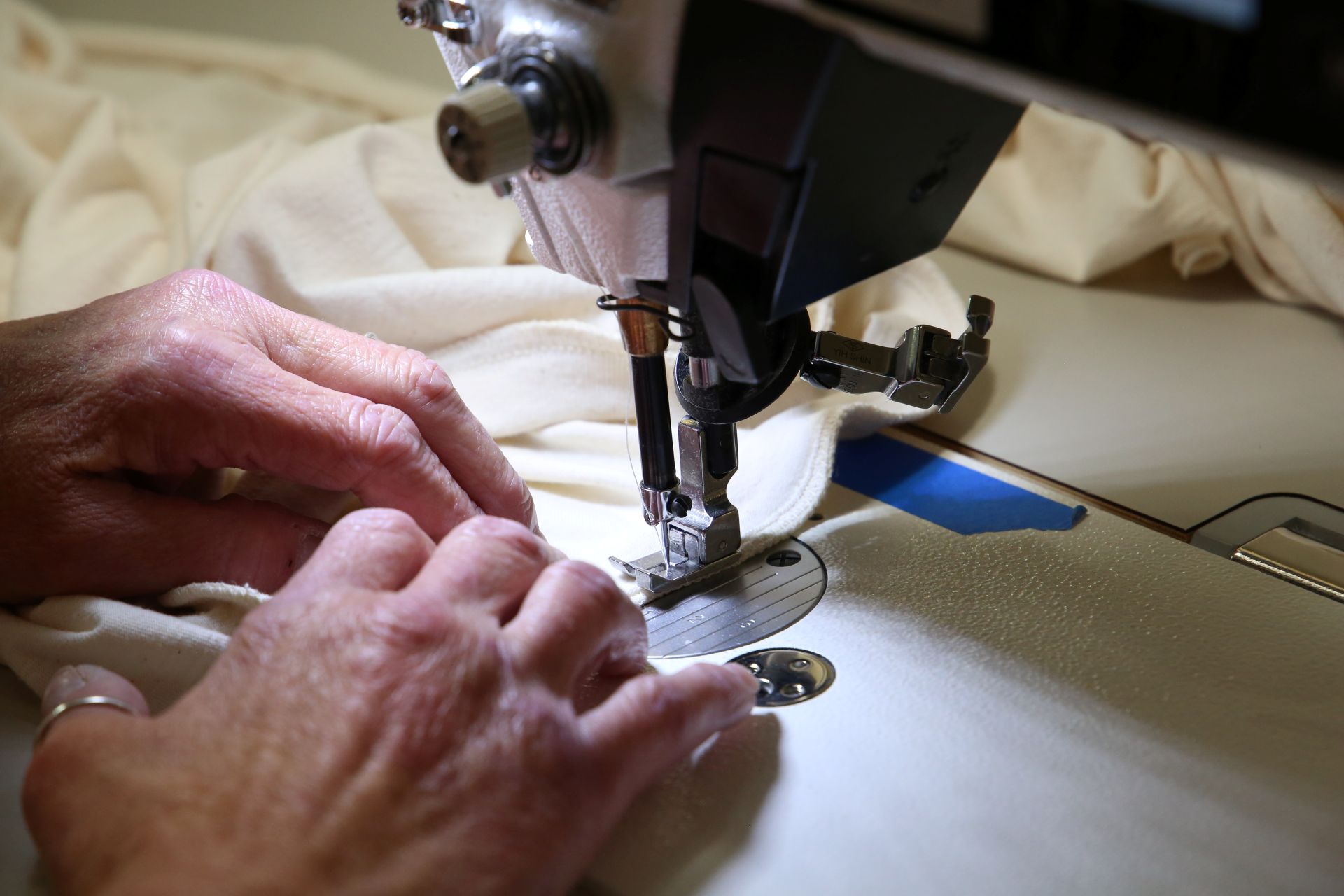
BUCHTEL, Ohio — A few years ago, Betsy Franjola was talking with her friend Sarah Adkins about the latter’s work with Rising Suns Pharmacy.
“She was doing rural clinics with her med students, and she’d talk about poverty and drug addiction,” Franjola told the Independent. “She’d say, ‘We just need jobs here. I don’t know why industries aren’t coming to this region.’”
Raised in Athens County, Franjola spent 25 years in the textiles industry in New York City and Los Angeles. “It all clicked in my head — we need jobs where I’m from, and I’m in this industry where we need factories with high-skilled sewing,” she said. “What if I went back home and started training people in industrial sewing, and then we could be that factory?”
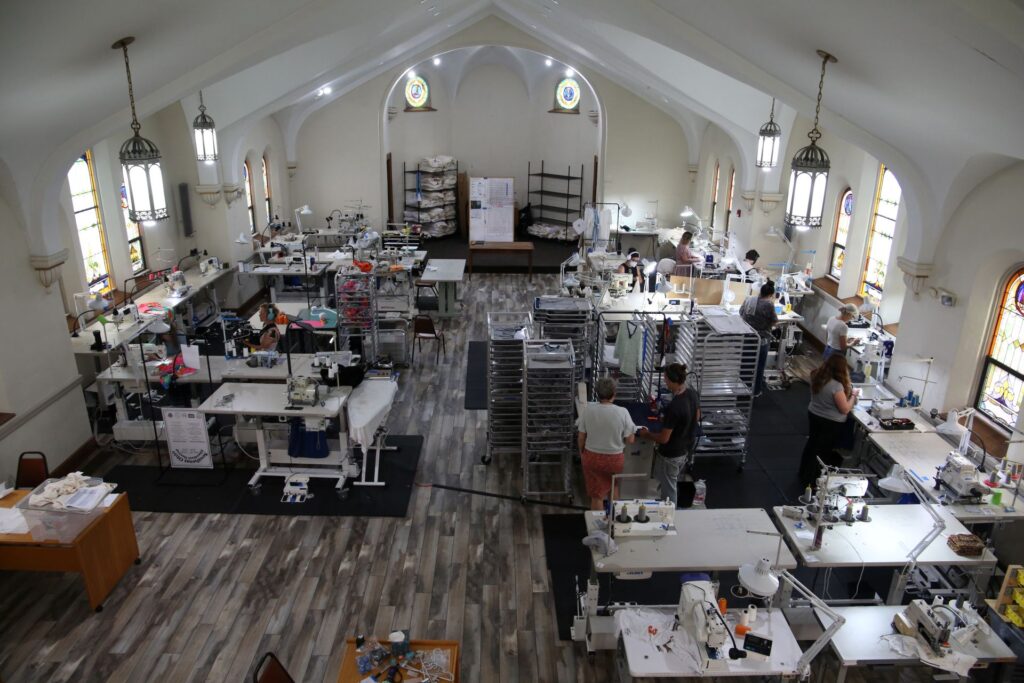
In 2024, Franjola opened the Hocking Hills Garment Center at 17645 Bank St. in Buchtel. The center employs 18 people.
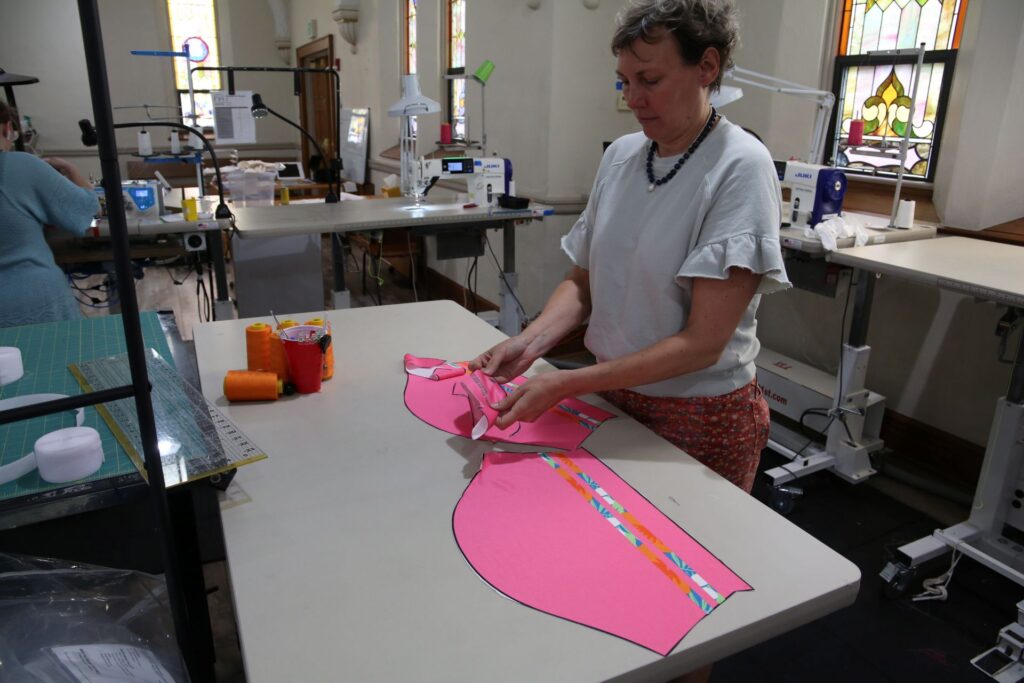
Franjola began by looking at industry production models, eventually visiting a factory in North Carolina that used a production model known as one-piece flow. The one-piece flow manufacturing method produces one piece of clothing at a time, rather than passing around batches of clothing between stations.
For example, a person may sew the sleeves onto a shirt and then immediately pass it to a person sewing the collar, who then passes it to a person sewing buttons on. For Franjola, the one-piece flow method of production was appealing due to the built-in quality control measures.
“So if somebody in that line makes a mistake, immediately the next person sees it because they’re picking it up and they’re like, ‘Oh wait a minute, this isn’t right,’” Franjola said. “So you catch [mistakes] in real time. You’re working as a team, and then you don’t have as many mistakes.”
When that North Carolina factory eventually went out of business, Franjola purchased much of its sewing equipment at a steep discount at auction. At the same time, Franjola was in conversation with the Steubenville Dioceses about purchasing the former Catholic church in Buchtel, for use as a factory space.
Franjola said that the Dioceses agreed to let her store the manufacturing equipment in the former church free of charge during the sale process.
“[The Steubenville Dioceses] did not want this building to go to a developer, they didn’t want it to be a hotel or an Airbnb or a brewery,” Franjola said. “They wanted it to be something that was going to benefit the community.
Workforce development
Once Franjola secured the factory space and manufacturing equipment, she developed a training program focused on training staff on as many machines as possible.
“We received some workforce development grants, which was incredibly helpful,” Franjola said. “We pay people while they’re training $15 an hour, and so they’ll go through a six- to eight-week program of learning all of the machinery, learning the basics, and then once they get a certificate, they then make $18 an hour. That is as much as a sewist in L.A. makes.”
According to the Bureau of Labor Statistics the average annual salary for a sewist in Ohio is $37,030 or $17.80 an hour. The MIT Living Wage Calculator shows $18 an hour is just under the living wage for Athens County of $20.86 for a single adult with no children, though still exceeds the poverty wage and minimum wage.
In addition, the garment center is establishing an apprenticeship program with Hocking College. This apprenticeship program comes with the added benefit of Workforce Innovation and Opportunity Act funding, which will partially reimburse apprenticeship wages to the garment center.
“It’s an additional 2,000 hours of on-the-job training that we’re hopeful we can find WIOA [Workforce Innovation and Opportunity Act] funding to support those workers with 50% of their wages,” Franjola said. “They’re literally 50% slower than they will be, so that will stop the bleeding of paying people while they can’t quite make the [production] numbers.”
Partially thanks to these training efforts, Hocking Hills Garment Center can complete orders faster. Franjola said that last summer it would take their staff around 45 minutes to complete a T-shirt.
Now, the center can sew a T-shirt from start to finish in about 15 minutes. While a marked improvement, it’s still far from the industry standard of four-and-a-half minutes.
“We are very lucky that we found clients that are willing to pay very very close to that 15-minute cost,” Franjola said. “What we’re trying to do is really train ourselves up so maybe we can get to a 12 minute [T-shirt].”
Sustainable manufacturing
Sustainability is an important goal for the Hocking Hills Garment Center, both financially and environmentally.
“[Sustainabillity] has so many meanings,” Franjola said. “It can mean your raw material, economic sustainability is so critical, but also regionally sustainable. So let’s look at this industry as a model that you could take, and then let’s go to Indiana and start the same thing.”
The center recently hosted the Southeast Ohio Fibershed meetup to discuss the state of the textile industry in the region and what can be done to grow it.
Franjola sits on the board of directors for the fibershed and said that “what we’re trying to do is create that pipeline from agriculture to textile industry.”
For the garment center, this commitment to local agriculture can best be demonstrated in how it sources fabrics. The raw cotton is grown by a farmer in Virginia, then made into fabric in North Carolina, and shipped to the center in Butchel to be made into clothing.
The center is also looking to incorporate end-of-life fabrics, such as shredding wool clothing and respinning it back into yarn. This would primarily be done by other businesses, with the garment center buying the finished product.
“Maybe we could use the yarn to manufacture again, we would truly have a closed loop system,” Franjola said. “That’s something that I’m hyper focused on: how can we build up other support systems to minimize and reduce [waste]?”
Another element of sustainability in the textile industry that has received renewed attention due to the rise of “fast fashion” is the durability of clothing. Franjola told the Independent that a common way manufacturers take shortcuts in production is by using a wider stitch length or cheaper thread, resulting in a less durable product.
“We’re going to do the stitch length that’s appropriate to the strength of the garment,” Franjola said. “We’re not cutting corners.”
Local partners
Even before it opened, the Hocking Hills Garment Center had interest from local businesses and retailers. Events like Nelsonville Music Festival and the Ohio Pawpaw Festival have partnered with the center to make merchandise.
For the 2025 Nelsonville Music Festival, the garment center did a zero waste project where they transformed old denim jeans and jackets into tote bags.
“Out of the denim, we made 50 tote bags,” Franjola said. “They were super cute, had the pockets on them. The back pockets kind of became new pockets. It had a little carrier inside for your water bottle or your wine bottle or whatever.”
Leah Schmelzenbach, the merchandise coordinator for the Ohio Pawpaw Festival, told the Independent that it partnered with the garment center to make T-shirts last year. The T-shirts were then brought to Athens to Precision Imprint for screen printing, creating an all-local business T-shirt.
“We’re really excited about being able to offer a shirt that is so engaged with the local community,” Schmelzenbach said. “It is about as local of a piece of clothing as we can get, especially with the cotton now being farmed in Virginia. It’s really as local as it comes, which is awesome.”
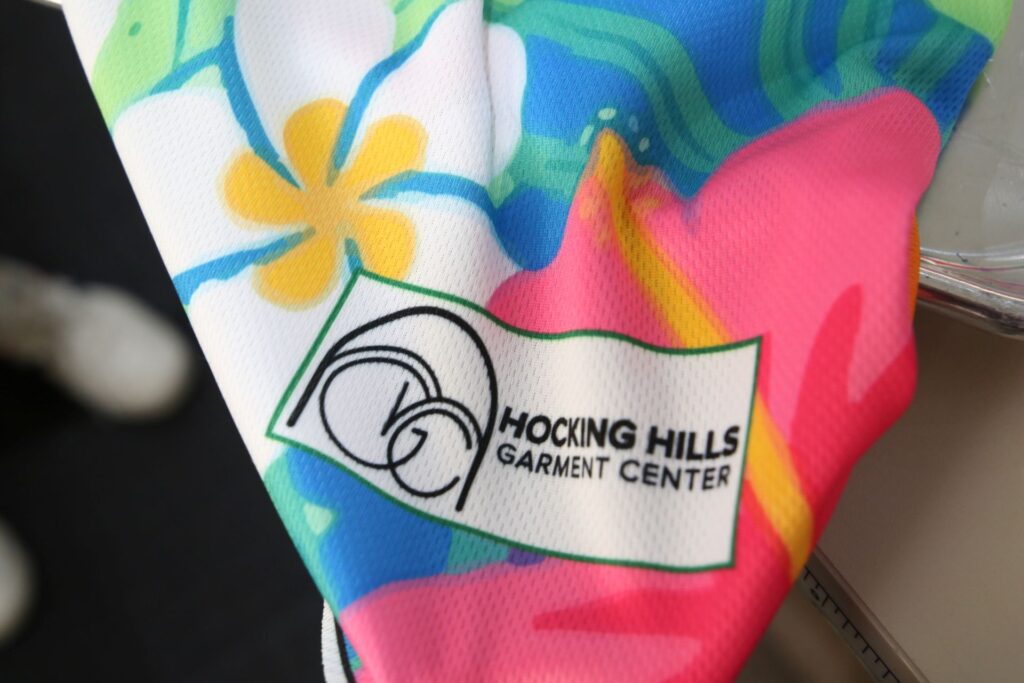
Another prominent local partner of the Hocking Hills Garment Center is the Southern Ohio Copperheads. The baseball team partnered with the center this year to create their jerseys, both their traditional jerseys and a special Hawaiian-shirt themed jersey.
Jake Lietzow, the executive director of the Copperheads, said that the decision to partner with the garment center was an easy one and aligns with the team’s locally focused mission.
“We’re so excited to be able to partner with them specifically because they’re bringing jobs back here,” Lietzow said. “The jerseys are printed in Carroll, [Ohio], manufactured in Buchtel and were designed in Athens. It’s pretty special to have that all contained within southern Ohio.”
Both Schmelzenbach and Lietzow told the Independent that the Ohio Pawpaw Festival and Copperheads are interested in expanding their partnerships with the Hocking Hills Garment Center in the future.
“I’m thinking about ways in which we can use unique theme jerseys year over year,” Lietzow said. “Also, options for fans –– what would a line specific to the Hocking Hills Garment Center look like? So that our fans could also take part in supporting the Hocking Hills Garment Center.”
While local businesses represent the majority of local purchases from the garment center, residents have the opportunity to purchase surplus clothing from the center directly on special occasions.
Franjola told the Independent that she would eventually like to have a storefront that could sell the factory seconds directly to the public, but for now factory seconds will only be sold occasionally and sales will be announced via social media.
“Buying factory seconds is huge,” Franjola said. “Our quality may not have hit the parameters for the brand, but there’s nothing really wrong with it. Maybe the sleeves are an inch short or whatever. All of that cost us money. It cost us money for the material, the labor. So I would say, right now, the biggest community sports come buy our factory seconds.”
The future
Franjola sees a bright future for the Hocking Hills Garment Center with a large staff, a personal brand and large contracts. Franjola told the Independent that her goal is to train 10 new staff members each year, with the goal of having 50 employees.

In addition to growing the staff, Franjola hopes to launch a clothing brand to keep a steady supply of work for the center.
“One of the things about being a contract manufacturer is that business ebbs and flows,” Franjola said. “How do we keep everybody employed for the long term and not have to go through those dips? Having your own internal brand is a great way to do that. So we are in the process of launching a brand.”
Alongside the internal brand, the center may also be moving to a 40-hour work week in order to meet demand from a particularly large supplier.
“We are pitching right now, I can’t say who, but we’re making some samples for a large, well-known fashion brand,” Franjola said. “They loved our storytelling. They loved everything about the farm partner to our making story, and so they actually want to do it in collaboration with our name.”
Learn more about the Hocking Hills Garment Center via its website, Facebookand Instagram pages.
