
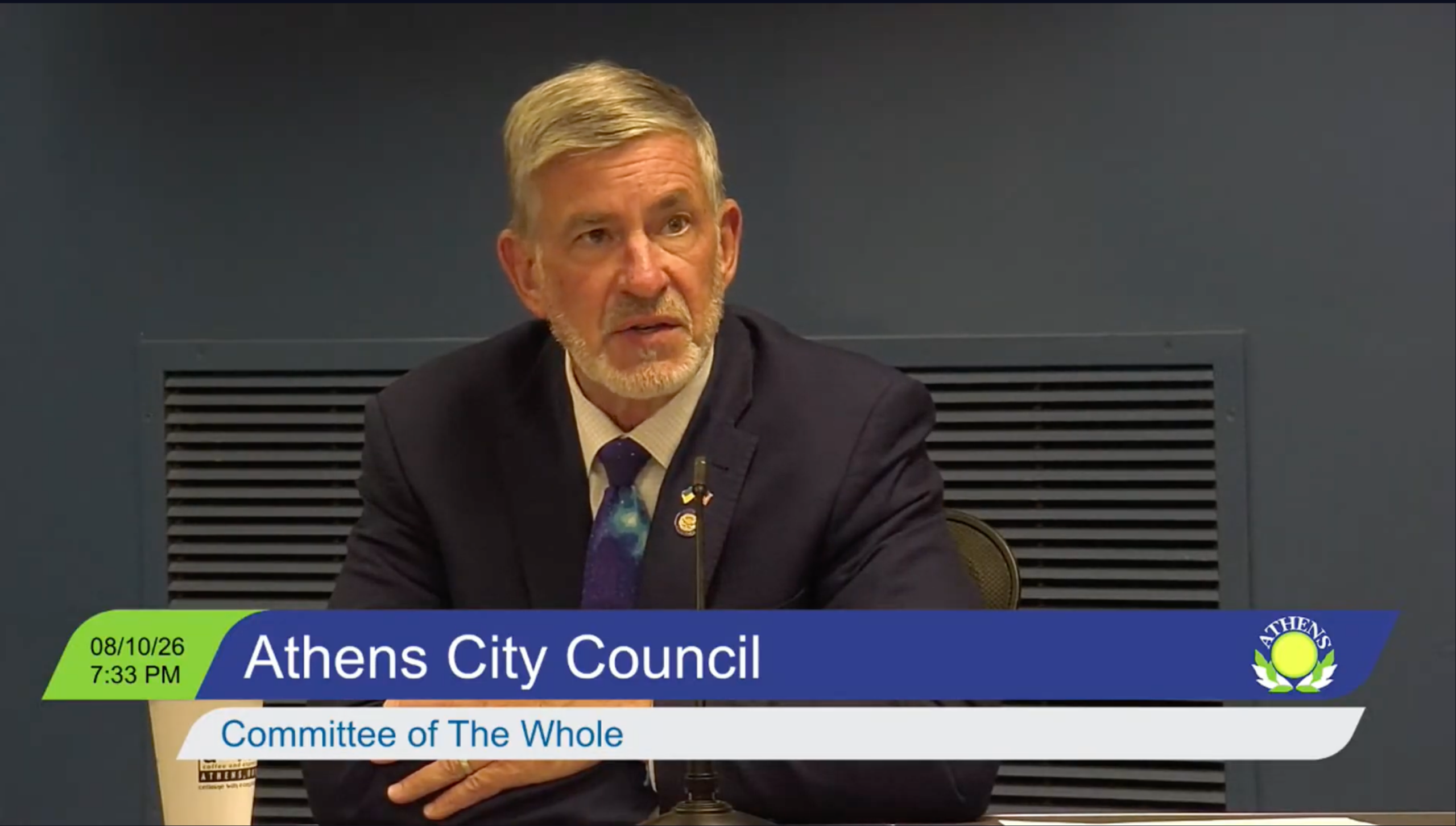
ATHENS, Ohio — As it does this time of year, the Athens City Council Committee of the Whole discussed Monday city fees and penalties — including a proposed 4% increase in sewer rates, starting next year.
The increase to keep pace with rising personnel costs, electricity costs, and overall debt service on sewer projects. Council members were told that similar sewer rate increases will be necessary each year moving forward to match rising costs.
The Committee of the Whole, with all council members present, also discussed doubling parking meter violation penalties in 2027 — from $15 to $30 — and heard a presentation about how community reinvestment areas could be used as economic development incentives in the city.
Council mulls sewer rate increase; set for upcoming ordinance
Reading highlights from an email exchange with city Service Safety Director Andy Stone, Council President Micah McCarey said a sewer rate increase of 4%, applied to residential, commercial and industrial customers, would result in an additional $260,000 to the sewer fund, currently estimated to bring in $6.5 million for 2026. Last year, the city implemented a 3% rate increase.
In an Friday, Aug. 7 email to McCarey, Stone noted that the city’s contract with members of the American Federation of State, County and Municipal Employees includes a 4.25% pay increase for 2027. That will use about $90,000 of the additional revenue, Stone wrote.
“So that leaves $170,000 additional from the 4% rate increase,” he wrote. “With the highest electric cost in the city ($500,000+/year) and the expected increase there along with other inflationary pressures, I just hope that $170k covers them.”
Stone added, “This does not include debt.”
The sewer fund produces $770,000 per year, and when the debt fund on all current sewer projects is considered, that amount increases to $1.1 million per year, he stated. This creates a need for an additional $330,000 yearly to cover sewer debt.
However, Stone noted, as did city Auditor Josh Thomas during Monday’s discussion, that up to $8 million in sewer projects loan forgiveness can be achieved with successfully completed projects. Low-interest loans for sewer projects have been approved through the Ohio Water Development Authority and the Water Pollution Control Loan Fund.
“While we understand that some of this debt will be forgiven, that is not a foregone conclusion,” Stone wrote. “Even if it is forgiven, we expect the EPA [Environmental Protection Agency] to mandate another large project at the plant around 2030 to increase the size of the equalization tank as well as other treatment process changes.”
Mayor Steve Patterson told the committee there were areas within a major, $20 million waste water treatment plant project completed during the 2015–’16 budget cycles that were not addressed — and will have to be in the near future. They include expansion of tanks known as “clarifiers,” which separate suspended solids and oils from water, as well as aeration tanks. These improvements will be necessary with the state EPA “rolling out ever-changing criteria” for sewer operations, he added.
The city also has aging sewer lines in some parts of the city, Patterson said. He also referenced the current sewer line “deep dig” project that is extending a large sewer line under Dairy Lane at Richland Avenue. The project will connect the sewer line to a new lift station at the Richland Avenue bridge. The sewer line has already been extended underneath the Hocking River to connection points alongside Peden Stadium.
Patterson said the lift station work, including the project that is closing Richland Avenue for up to one month starting Tuesday, is the kind of project that only occurs every 50 years. But it has to be done, he said.
In the meantime, drivers are encouraged to use alternate routes such as the U.S. 50/U.S. 33 interchange at the south end of Richland, Patterson said.
“We want folks to understand that this is a major system that our community depends on,” McCarey said. “It’s not always seen; we don’t always necessarily see behind-the-scenes costs in energy or aging infrastructure.
Auditor Thomas said the newest sewer projects involve loans paid back at 0% interest, while previous projects carry a 1.82% interest rate. If there were a time to take on more debt, “this is the time to do it,” he said.
Thomas also said the 4% sewer rate hike as proposed will not be a big increase for most ratepayers in the city. For a family of two, it will likely amount to an additional $1.60 per month, he said. For a family of four, it would be about $2.60, depending on usage. Currently, the base residential rate in Athens is $32.28 for usage under 15,000 gallons.
Council member Alan Swank, 4th Ward, asked what income has been realized from bringing in county residents who now have sewer lines tied into the city sewer system.
Thomas said those initial tie-ins have already been paid. Patterson said the city allowed in its agreement with the county for 1,100 county sewer accounts, which has been capped at 1,500 as more housing tie-ins occur from new sewer connections.
Swank noted that many of the individual homes’ sewer line tie-ins were former aging septic systems, resulting in an environmental need for improvement. Patterson agreed, noting that individual septic lines in the past had impacted waterways such as Margaret Creek.
Michael Wood, 3rd Ward, asked if additional revenue from the sewer fund could be used for flood mitigation. Patterson said the fund must be related to sewer projects Water line breaks are handled by a separate propriety fund, the mayor said.
Patterson said the council has the authority to determine what rates are set on items, such as storm system improvements. He also noted that the council sets the sewer rates, with city administration setting water rates. Storm system rates are entirely separate.
Jessica Thomas, At Large, said with sewer project debt service and other factors facing the city, it would not be the time to seek less than a 4% rate increase.
Council member Paul Isherwood, At Large, said the city will get a lot of questions about rising sewer rate costs given recent passage of a 0.2% city income tax increase, and the rising cost of living. The city will need to explain the implications of how sewer system operations would be affected without rate increases, he said.
Auditor Thomas said he expects sewer rates to increase as the city is asked to provide service to undeveloped areas. Stone has offered to create a projection of year-by-year increases through 2040.
“I’m just going to be honest; we’ll just have to continue to increase to keep up with what’s happening,” Auditor Thomas said. “And that’s just kind of the reality of it.”
Patterson said the solar array near the wastewater treatment plant currently provides 60% of the plant’s electricity needs. Within the next four-and-a-half years, when the city completes payment to Kokosing Solar for the solar array, it will own the equipment and realize the savings from all solar areas in the East State Street area, he said. The result will be future electricity savings of $300,000 annually at the sewer plant.
Increasing fees
The Committee of the Whole also discussed new proposed ordinances related to parking meter fee penalties, and a fee for yard waste bag pickup.
Patterson informed the council that a doubling of the parking meter penalty from $15 to $30 is necessary because the fine is not yet high enough to discourage violations.
“It harms the businesses, in my opinion,” Patterson said.
Wood called the parking fine doubling “probably overdue,” but said giving those penalized just five days to pay the fine is too fast, suggesting two weeks. Swank said the biggest complaint he hears is that many parking meters do not work, and thus all should be tested before implementing the change.
According to Stone, per his email to McCarey, the city takes in about $268,000 per year in parking fine revenue, with additional revenue projected from doubling the parking penalty and another $268,000, amounting to a general fund increase of 1.38%.
Auditor Thomas said the goal is not to increase city revenue from parking meter penalties, but to deter the practice of long overstays on parking meters.
Committee members also heard the city’s proposal to increase the fee for yard waste pickup from $2 per bag to $2.50. Stone wrote this is a heavily subsidized item in the street fund, with the amount of service provided amounting to $50,000 per year.
The city subsidizes 80% of that cost, with about $10,000 from the current $2 per bag revenue, or 5,000 bags in one year. The fee increase to $2.50 will increase the residents’ portion to $12,500 per year, and drop the city subsidy to 75%.
“There are only a couple hundred residents who use this service,” Stone wrote.
McCarey said the city will also be moving forward on proposed rates for temporary street closures. Such fees would be entirely new for the city.
Swank said the city needs to examine the cost per trash bag that the city controls through its contract with its waste hauler, Rumpke. The amount charged for each additional bag is not consistent, and should be in order to incentivize customers to reduce their trash amounts going to the landfill, Swank said. The difference in $1 for an additional bag does little to disincentivize trash accumulation, he added.
Cybersecurity policy updated
In what was termed a routine revision to the city’s cybersecurity policy, adopted last year, and in order to satisfy state requirements, McCarey briefly discussed the policy.
The revised policy, updated in June, addresses citywide standards for network and device security, employee training, passwords and access controls, multi-factor authentication, incident reporting and response, and a ransomware policy.
“The city of Athens will not pay ransom in response to cyber extortion or ransomware attacks,” the policy states. “Paying does not guarantee data recovery and encourages further attacks.”
Instead, the policy initiates procedures such as isolating and securing affected systems and notifying authorities, while prohibiting unauthorized communication or payment with the attackers.
The city in November 2024 fell victim to a cyberscam where it lost $722,000, a quarter of which it recovered.
Community reinvestment areas proposed
The Committee of the Whole engaged in a lengthy discussion on the topic of Community Reinvestment Areas at the beginning of Monday’s meeting. The presentation was delivered by Mollie Fitzgerald, executive director of the Athens County Economic Development Council.
“CRAs, Community Reinvestment Areas, are just another tool in the tool box of economic development, so it allows you to incentivize the types of development you want to see in your community,” Fitzgerald said. She added that a Community Reinvestment Area already exists for ongoing plans involving The Ridges, and provided a potential draft ordinance template for the city.

In Ohio, Community Reinvestment Areas allow cities and other governmental entities to manage areas for specific economic needs considered necessary, where investment has been slow or nonexistent.
The incentives given to businesses, as well as homeowners, involve tax abatements for a period of years. Fitzgerald explained that Community Reinvestment Areas can be as simple or detailed as desired, so that Athens, for example, could have one Community Reinvestment Area for the city divided by areas of investment, or could have numerous areas to meet economic needs.
Fitzgerald said each Community Reinvestment Area has a housing council that reviews projects as well as its own tax incentive review council.
Typical Community Reinvestment Areas spur investments such as construction and rehabilitation of residential housing; supporting commercial investment, business expansion, and redevelopment; promoting industrial development and jobs; encouraging redevelopment and reuse of under-used properties; and to increase affordable housing options as well as other economic growth opportunities.
Fitzgerald said two potential zones for Community Reinvestment Areas within Athens would be Columbus Road for commercial development, and the West side for residential home remodeling and renovation.
Individuals applying for tax abatements would receive tax exemptions “negotiated on a case-by-case basis in advance of construction or remodeling,” according to the draft ordinance.
Community Reinvestment Areas could become complex, Swank said, depending on how many are initiated within the city. He said there would be impacts on area school districts from tax abatements.
Swank proposed that the council’s Planning and Development Committee, which he chairs, study Community Reinvestment Areas and report back to the full council with recommendations.
In Bowling Green, Ohio, Swank noted, Community Reinvestment Areas are typically used to incentivize new additions for homes, such as sun rooms. Those investments can be in the range of $25,000, he said, but Fitzgerald said investments may be considerably lower, depending on what the council decides for its ordinance.
McCarey suggested the development of a questionnaire sent to potential stakeholders.
Audience member Mary Abel asked if accessory dwelling units would be allowed for consideration as part of a Community Reinvestment Area.
Abel said accessory dwelling units within a Community Reinvestment Area would be “quite a departure” from what the city allows currently within its zoning. Fitzgerald said accessory dwelling units would be allowed within a Community Reinvestment Area depending on the way an ordinance is written. Accessory dwelling units would need to be considered in a thoughtful way, Abel said, so as not to affect the characters of city neighborhoods.
Curb improvements timeline
Beth Clodfelter, At Large, who chairs the Transportation Committee, said a timeline has been established for Community Development Block Grant-funded curb ramp and crosswalk improvements at West State and Court streets. The project will begin around Thanksgiving and be completed by spring of 2027, she said.
The amount of Community Development Block Grant funds required is yet to be determined, Clodfelter said. A design-build concept will be used, she said, in which the project engineer works within the construction contract.
To get a picture of what the badly needed improvements will look like, Clodfelter said they are similar to ones in place on the Court Street side of Ohio University’s Baker Center.
To satisfy all interested parties, Patterson said the new curbs and their ramps will involve concrete underneath with brick work on top, and with a “concrete apron” to spread out vehicle impacts so that curbs do not subside over time.
Swank said Baker Center offers a good representation of what the city will be doing.
Athens City Council’s next regular meeting will be at 7 p.m. Monday, Aug. 17 at Athens City Hall, Council Chambers, third floor, 8 E. Washington St. Meetings are also streamed online. Regular sessions are on the first and third Mondays of the month; committee meetings are on the second and fourth Mondays.
