
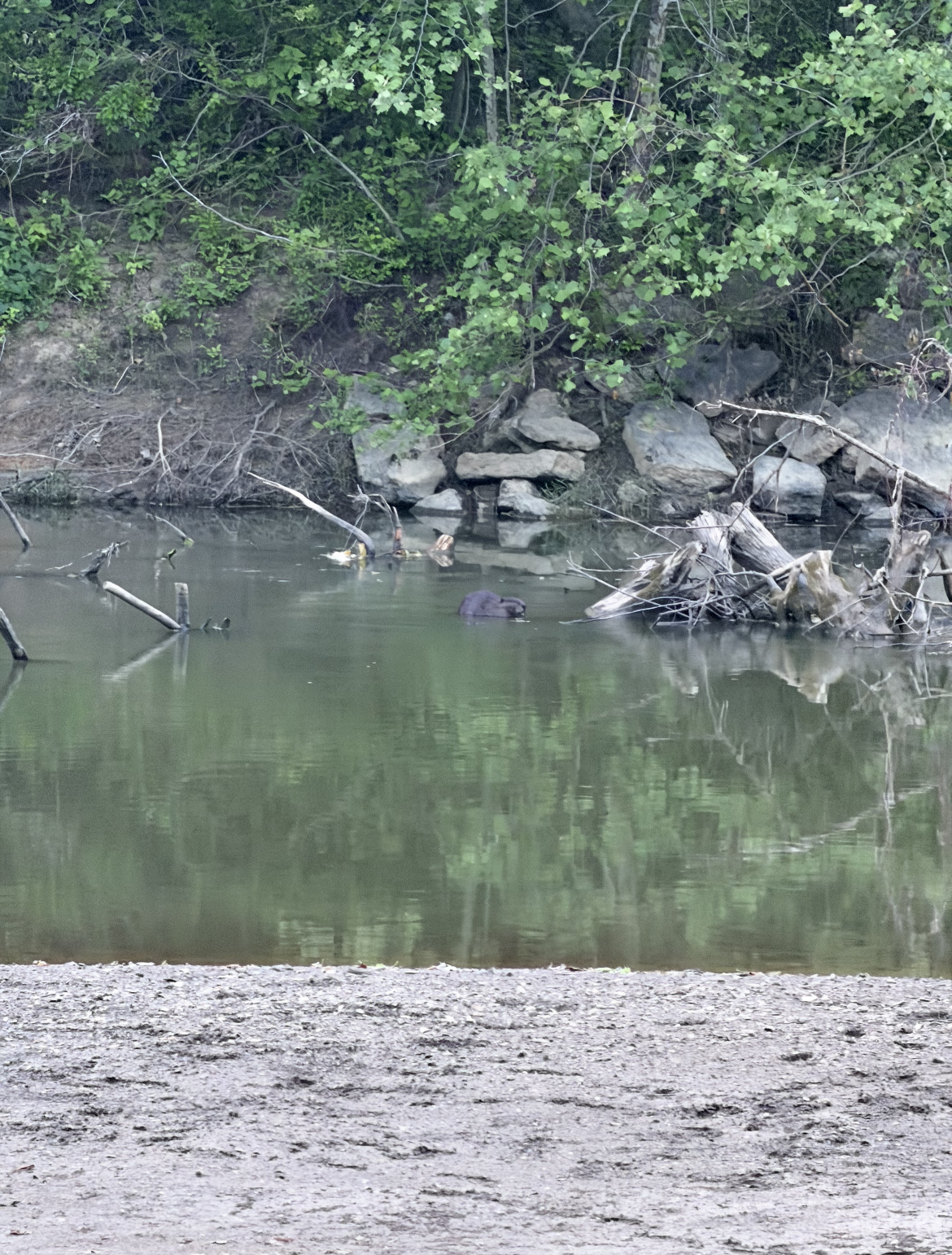
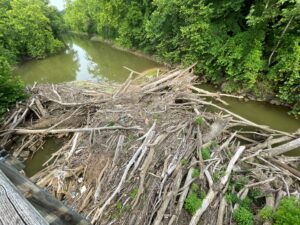
ATHENS, Ohio — The county’s mission to remove a logjam from the Hocking River faces new challenges after a potential beaver spotting.
On social media, local residents have discussed the possibility of a beaver living in and around the near the Currier Street bridge along the Hockhocking Adena Bikeway in Athens. Photos and videos sent to the Independent show an animal that resembles a beaver.
Athens County Planner Connor LaVelle told the Independent that officials will determine whether a beaver is present around the logjam before starting to remove the logs.
“[The Hocking River] is a waterway of the United States, and an environmental review and an understanding of what impact the project would have is [required],” LaVelle said.
Gary Lamberti, a river ecology researcher at Notre Dame University, told the Independent he was not able to identify whether the animal in the video was a beaver.
“I never saw [the animal’s] tail in the video,” Lamberti said. “Now I’m assuming that people who took that video heard a tail slap, and [that the animal] looked reasonably large from the video. But I wouldn’t stake my life on the fact that that’s a beaver.”
A beaver wouldn’t naturally build its dam or lodge on such a wide section of a river, Lamberti said.
Lindsay Rist, a wildlife communications specialist with the Ohio Department of Natural Resources, told the Independent that beavers on rivers the size of the Hocking don’t typically construct dams.
“Beavers living along larger rivers like this wouldn’t need to construct a dam or manipulate water levels, so they will make burrows in the bank with an underwater entrance which wouldn’t be as visible as a lodge,” Rist said.
Rist also told the Independent that if a beaver is present at the logjam, the animal may abandon the site once logjam removal begins.
“Beavers are resilient and are constantly adapting their habitat to fit their needs,” Rist said. “Sometimes displacement is temporary and they will return to the same area, and sometimes they will move on and construct a new permanent burrow or lodge elsewhere. There are a lot of different factors that could affect where they reside at any given time, and the Hocking River is large enough to provide plenty of habitat opportunities.”
“Ecological engineers”
Beavers are native animals to North America and played a major economic role during the frontier era. The amphibious rodents were were highly valued for their pelts, which are water resistant and could be made into high-quality clothing. According to the National Parks Service, beaver populations were overharvested and began to rebound only after beaver pelt fashion fell out of style.
Today, biologists and wildlife experts view beavers as a keystone species for their role in creating and maintaining ecosystems.
Beaver dams create slow-moving, deep pools of water that are ideal for fish, amphibians and other wildlife, according to the World Wildlife Fund. The U.S. Forest Service has promoted species restoration because their pools have been shown to reduce the damage from wildfires and droughts.
Beaver dams also trap decaying plant matter in river systems, allowing the nutrients to be absorbed by local plants. This trapping effect also applies to various types of pollution: Beavers sequester an estimated $75 million worth of greenhouse gasses each year.
“[Beavers are] often referred to as ecological engineers or environmental engineers in the sense that they are performing this function of impounding water, creating wetland habitat and providing and sustaining flows in downstream areas,” Lamberti said.
While beaver dams can be beneficial for stream and river quality, they also can increase erosion and water temperature — as well as damage to bridges, culverts, and drains.
“Creating and maintaining this habitat can be beneficial for other species that thrive in those conditions, but can also generate water flow issues that may interfere with human infrastructure,” Rist said.
Next steps
If there is a beaver on site, Ohio law has “pretty disappointing” protections in place, Nathan Johnson, a senior attorney with the Ohio Environmental Council, told the Independent. While state legislatures have updated beaver protection policies, Ohio’s beaver laws haven’t been updated since 2015.
Johnson explained that a beaver at the Currier Street logjam might be considered a nuisance animal under Ohio law.
“A nuisance wild animal means a wild animal that interferes with the use or enjoyment of property, is causing a threat to public safety, or may cause damage or harm to a structure, property or person,“ Johnson said.
The Ohio Administrative Code states that it is “unlawful to fail to euthanize, or release on site, any nuisance raccoon, skunk, beaver, coyote, red fox, or opossum that is captured, trapped or taken.” The Ohio Department of Natural Resources told the Independent that this policy would also apply to nuisance beavers.
“Beavers are not a species that are eligible for relocation, and that includes by ODNR,” Rist said. “Under nuisance regulations, a beaver would need to be euthanized or released on site.”
