
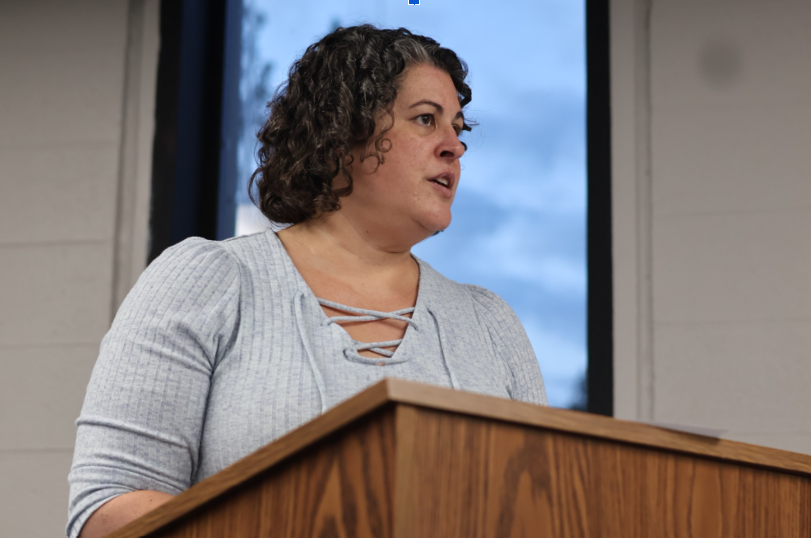
NELSONVILLE, Ohio –– Nelsonville’s charter-based city council continued to discuss a policy for use of artificial intelligence by city employees at meetings of the Utilities Committee and full council on Sept. 28.
AI policy close to final
Council members opted against adopting a proposed version of the policy which came before the council during its Aug. 24 regular session, sending the proposal back to the Utilities Committee for further consideration.
Since then, Nelsonville’s charter government has been refining a new policy in a joint effort by city administration and council members. Elkins and council member Nic Joseph-Saul presented previous drafts at the Utilities Committee’s Sept. 14 meeting. Some elements of those drafts remain in the most recent version of the policy, a collaborative effort between City Manager Danette Miller, Special Projects Manager Erica Padgett, City Auditor Brian Elkins, and Joseph-Saul.
Elkins said revisions to the draft policy since the utilities committee last met included changes to the way that it determines which models are permitted for use by the city.
“Instead of disallowing or allowing specific [models], we have requirements that the model must meet,” Elkins said. For example, the policy would require that models are locally or domestically hosted, and isolate their data, meaning data isn’t shared with third party sources.
The new draft policy says the city will use AI products provided by iTech, an IT vendor that the city recently entered into a contract with as part of a larger effort to abide by cybersecurity recommendations from its insurer, the Public Entities Pool of Ohio. Joseph-Saul said the city requested a comprehensive list of the available products from a contact at iTech.
Reading from the new draft, Joseph-Saul said the policy provides that “the city shall provide a public facing resource that provides a transparent overview of AI products currently and formally authorized for use in connection with city business, and details which public servants are responsible for each AI product, how the use of listed AI products benefits residents, and what city data they use.” The draft also includes that the decision to use AI products as provided by iTech will be subject to quarterly review.
Another point of uncertainty has been the issue of how public records laws should be applied when artificial intelligence is used in city business. For example, the proposed policy would match the city’s existing document retention timeline of 10 years.
In addition, in keeping with existing public records laws, the policy would exclude materials associated with the process of creating documents. “It’s the output that is the record,” Elkins said. “The chats, or the conversation log, are treated functionally the same as informal notes, or a conversation between colleagues”.
Finally, Joseph-Saul drew colleagues’ attention to provisions outlining a disciplinary process for violations of the policy. The levels of penalty included:
- Written warning.
- Remedial training.
- Temporary or permanent revocation of the user, vendor or products authorization.
- Suspension or loss of committee assignments or seniority, removal from position or office referral (in the case of investigatory agencies).
Committee members agreed they would forward the new policy to the city’s legal team for final review, after which the policy will come before the full council once again. A second agenda item concerning streetlights on Canal St. was tabled due to insufficient time.
Regular council session
Council President Cameron Peck opened the regular session by thanking first responders for their service in responding to flooding that affected Nelsonville last week.
City Manager Dannette Miller announced that the city’s request for a DORA zone was approved by the state liquor department as of Sept. 28. Miller said that she had pushed for an approval before Nelsonville’s inaugural Bigfoot Festival the weekend of Oct. 2. Padgett will take over implementation of the DORA project from here, Padgett said later in the meeting.
Miller also provided the latest updates on plans to develop a “pocket park” on a parcel located at 10 W Washington St. Miller said an Athens County Commissioners’ assistant told her that the city must wait for the completion of the county’s bidding process before it moves forward with purchasing the parcel. Bids were due for the property on Sept. 29.
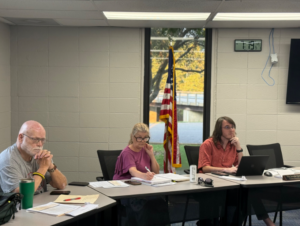
Erica Padgett delivered the Special Projects Manager’s report, her first in the role since she resigned as City Clerk on Sept. 14. Padgett said in her report she would continue to assist with clerk duties for transitional purposes. Her role was filled for Monday’s meeting by Nic Joseph-Saul, who will serve as temporary clerk while the position remains vacant.
Padgett addressed in her report projects that she has taken on under the new role including the establishment of a Charter Commission, a Health and Human Services Commission, and a Records Commission.
Padgett also said she has worked to implement iTech services and a possible plan to switch the internet provider for city buildings from FreedomLinx to Spectrum.
The final report at the meeting came from Law Director John Haseley. He said that while Nelsonville’s municipal court dismissed several cases in the last two weeks, prosecutors’ handle on their caseload has improved. “In terms of concern over the dismissals in the past, [I] just want to assure the council that we are not having that situation right now,” Haseley said.
Ordinances read
Council performed a second reading of Ordinance 54-26, which was subsequently adopted under suspension of the rules. The ordinance will replace the city’s existing fee structure for handling delinquent utility bills with an up-front, refundable deposit of $150 on all water, sewer, and trash collection accounts.
Meanwhile, Ordinance 76-26, which establishes fees for public records requests associated with the cost of producing and redacting record materials, was tabled for further legal review after council member McCray Powell raised the question of whether Ohio law would require fees to be waived for journalists.
Council adopted four ordinances making amendments to the city’s 2026 amended appropriations. The amendments account for city employees’ dental plans via Delta Dental (81-26) along with professional services for delinquent water and sewer assessments (82-26) and the sewer office itself (83-26), and fire department vision services (87-26).
- Ordinance 85-26, which declares a structure located at 204 Saint Charles St. a public nuisance, was adopted on first reading under suspension of the rules.
- Ordinance 86-26, which authorizes the city manager to seek a loan from the Ohio EPA Water Supply Revolving Loan Account to finance water system improvements, was also adopted under a suspension of the rules.
The readings concluded with a resolution honoring council members Charlotte Beach and Amy Hollenbaugh for their efforts in preserving historic tiles from Nelsonville’s Mechem building, which was demolished earlier this month.
“This is beautifully written,” Beach said in response to the reading. Beach abstained from voting on the resolution’s adoption.
Council then headed into executive session, returning briefly for other business before adjourning. Council President Cameron Peck moved to reschedule the charter council’s Oct. 12 meeting, which falls on Columbus Day, a federal holiday.
Nelsonville’s charter City Council will hold its next regular meeting at Nelsonville City Hall on Monday, Oct. 14, at 7 p.m.
