

ATHENS, Ohio — Voters in the Athens City School District will decide this fall whether to make a 1% earned-income tax a permanent levy, rather than renewing it periodically. The current levy is set to expire at the end of 2028, but if re-approved it would contribute funding indefinitely to the city’s schools.
Since first passing the income tax in 2006, voters have renewed it three times, most recently for a decade beginning in January 2019. Nearly two-thirds of voters supported the latest renewal. Additionally, in November 2016, voters approved a $6.7 million emergency levy to renew funding for the school district, generating nearly $4 million in revenue.
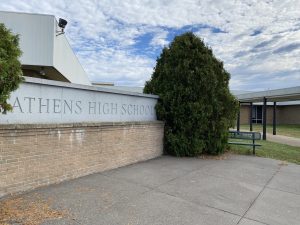
In late 2023, voters agreed to a $24 million bond issue for the district to help replace an aging Athens High School. The new high school, still under construction, is expected to open next year.
Jared Bunting, the district’s treasurer and chief financial officer, told the Independent that after two decades, the levy now comprises 13.8% of the district’s operating budget, providing more than $5 million in funding.
“If we were to lose that revenue funding, a lot of changes would have to be made in short order that would be detrimental to our student instruction,” Bunting said.
The district is facing declining student enrollment and projects a budget shortfall, said Chad Springer, who became the district’s superintendent last year. Springer told the Independent that the district has made “cuts through attrition” to reduce staff numbers.
“Over the past two years, we’ve made a reduction through attrition of one teacher at every grade level first through sixth,” he said.
Springer expects this trend to continue even if the levy is renewed. He said the school district is suffering from income insufficiency as it prepares, like other districts in the state, to “leave the 20-mill floor.”
Public education in the state is funded through local property taxes, despite a 1997 decision from the Ohio Supreme Court that found this method of funding unconstitutional. Since the mid-1970s, the amount of money a tax levy in Ohio can generate has been restricted to prevent property taxes bills from rising through inflation. While property values generally rise over time, actual tax rates are adjusted to remain based on the valuations in place when the levy passed. Ohioans home value may skyrocket, but their tax levy fees will not.
Under Ohio law, the effective millage cannot drop below a floor of 20 mills. The floor provides school districts with a minimum funding level despite increases in property valuations, which reduces the amount of millage available. (One mill equals $1 of taxes for every $1,000 of a property’s value.)
If voters allow a $5 million levy, for example, and property values then increase, the millage rate is decreased to generate that original $5 million amount.
As property costs rise and millage rates decline, the 20-mill floor helps keep school districts stable, ensuring they cannot dip below a certain funding threshold.
However, a state bill passed December 2025 limits how much additional funding beyond the floor school districts can receive, upending financial forecasts and creating budgetary headaches for districts. “This bill primarily caps revenue growth for districts on the 20-mill floor,” notes the Ohio School Boards Association.
Due to the recent adoption of a separate state bill that counts emergency or “fixed-sum” levies towards the 20-mill floor, the Athens City School District will move “above the floor,” causing a loss of millage and initiating a potential monetary crisis. In March, the district predicted a loss of $600,000 in millage growth next year, warning that it could exhaust all cash reserves by 2030.
“We are facing financial hardship no matter what,” Springer said. “It’s just that the levy renewal keeps us more stable for another one to two years.” Slashing programs does not typically generate large sums, so more lucrative cuts would target staff numbers and personnel benefits, he said.
The district currently employs nearly 190 teaching staff and educates 2,150 students, plus an estimated 89 students who attend the Tri-County Career Center, according to Bunting and Springer.
As the district seeks to cut costs, it begins with not replacing staff who have retired from their roles. But if the levy expires without a renewal, the district projects more than $6 million in cuts within the next three to five years, according to Bunting.
The state said it provided unprecedented levels of public education funding during fiscal year 2025, totalling more than $13 billion. Springer does not dispute the increase in state funding, but he said it has not kept pace with stubborn inflation rates and climbing operating costs.
“If we couldn’t get the levy renewed, we would run out of cash two years sooner than if it did renew,” Springer said. “We’re operating on money-in, money-out.”
