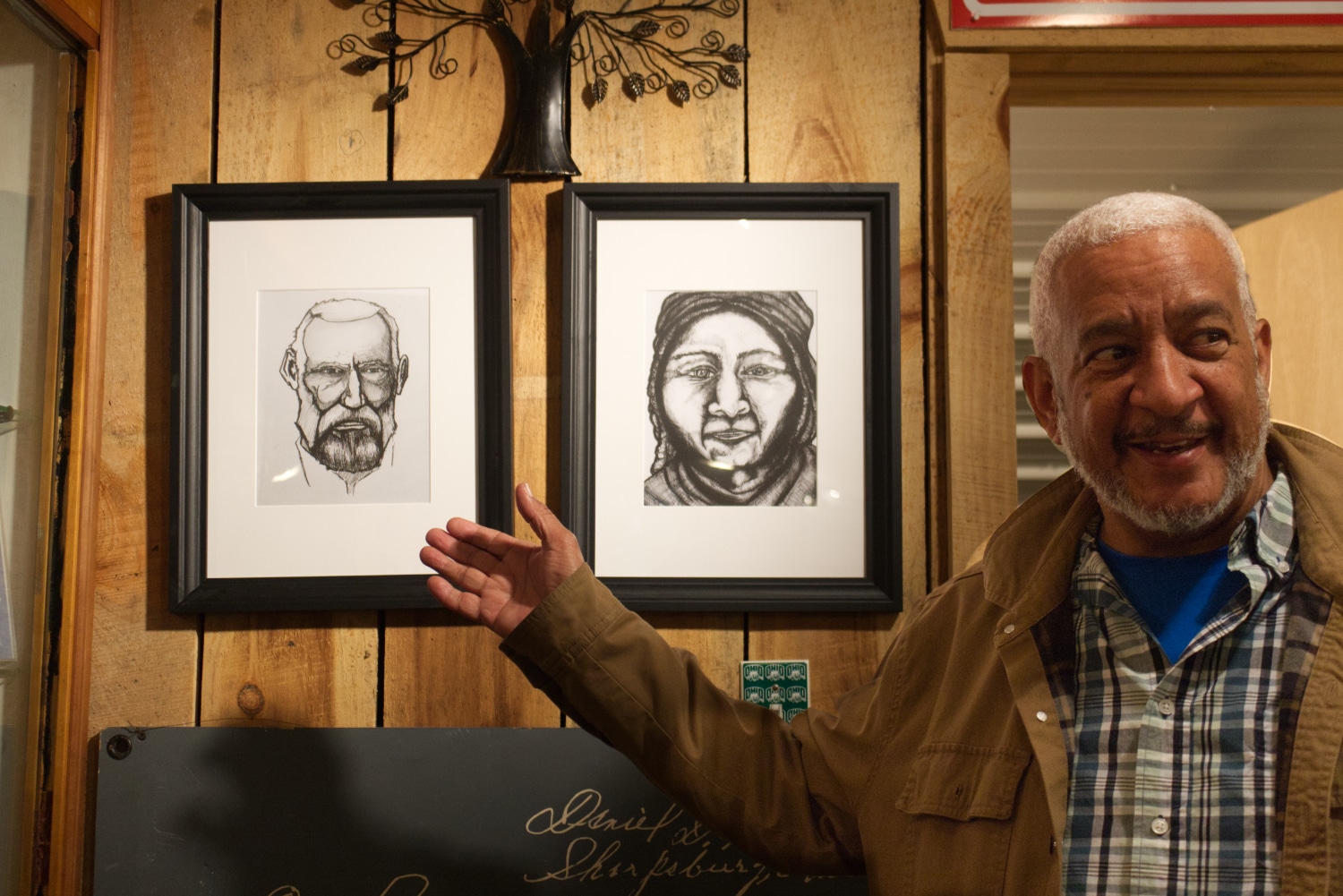
David Butcher is well known around Athens County for his work in local history — especially his own family’s place in the area’s past, from his ancestor’s mixed-race marriage to his uncle’s career in journalism. Those stories are the centerpiece of his People of Color Museum.
Now, his efforts have gained wider recognition.
Butcher recently was one of five people to receive the Black Appalachian Storytellers Fellowship, awarded by the National Association of Black Storytellers. Each fellow received $4,000 to support their work and was invited to present at the National Black Storytelling Festival and Conference in Baltimore earlier this month.
Butcher describes himself as someone who loves his family, and although he has many family members in southeast Ohio, he tends to tell the story of his ancestors from Virginia, whose experiences have been passed down through oral history.
Michael Tabler, Butcher’s eighth great-grandfather, was born in what is now West Virginia. The white son of a plantation owner, Michael fell in love with one of his father’s slaves, a woman named Hannah. Michael’s father disapproved and unsuccessfully attempted to keep them apart. Michael emancipated Hannah in 1818 and the couple had six children together. The family eventually ended up moving to eastern Athens County, settling in what is now called Kilvert.
This interview has been edited for length and clarity.
Could you talk about the Black Appalachian Storytellers Fellowship?
Truly, I am honored to get the award. But I had really no knowledge of it beforehand. And so that’s what’s really exciting: that the information of what we’re doing here is reaching that kind of organization that we’ll be presenting [to], in Baltimore, about our local history here along with my nephew, Kenton Butcher.
And so that’s important. I think my goal is to preserve our history and culture, but also it is to pass it onto the next generation, and he is definitely very important to our next generation.
I feel more confident now about leaving our history in the hands of the next generation. They’re more educated. They’re smart. They’re in a lot of different fields. My niece, JoAnna Flowers, is an archaeologist, and Kenton is working on his Ph.D [in English].
These are things that are going to be able to help save our community. The fact that we’re given this opportunity to go to Baltimore and present, I’m looking forward to it. (Ed. note: this interview was conducted before the Nov. 8-13 conference.)
What does storytelling and oral history mean to you?
That started with me very, very young. And I think this is what my ancestors saw in me and my relatives: that maybe when other kids were out, playing, I would be close to older people and enamored and asking questions about World War I, ‘Did you know anybody that was in the Civil War?’ I would ask these questions and I became very intuitive.
A lot of this comes from going around with my uncle, Alvin Adams. (Ed. note: Adams was one of the first Black graduates of Ohio University’s E.W. Scripps School of Journalism.) When he would come here, and go do research and do recordings. I wanted to be just like my Uncle Alvin. I guess the storytelling content comes from that.
From traveling with Uncle Alvin, while he was doing his interviews, many times it was just him and I doing these interviews. They may be on a recording somewhere, I’m sure they are, but I may be the only person alive that heard the story. It’s important for me to try to pass this on before I’m the last person.
As you get older you begin to forget things. And that’s why it became so important to me to try to get as much done as we possibly can and keep telling this story. It will be sad if we were the generation who lost this nearly 200-year-old oral history. Let’s not even talk about the artifacts that could have been lost, and maybe many have been lost. But we’re going to try to save the ones we can.
What gave you the inspiration to start the People of Color Museum?
In 2003, I walked up to the Kennedy Museum with a box full of photos and different items and artifacts. And I went to the front desk, and I said I would like to speak to someone about doing an exhibit on local art and artifacts, because I considered what my people had created to be art, like quilts. I don’t know how I convinced them, but they did [the exhibit], and it was very successful.
I was hoping that would help start a traveling exhibit or something like that—I didn’t know exactly. I didn’t have the knowledge to make things happen. And so everything got put in storage. I did a few exhibits here and there, a few reunions.
Then I got a call one day from Lisa Flowers from Ohio University and [she] said, ‘We have a group of adults from Ghana and they want to learn about community service.’ I said, ‘Well, I’ve been digging out some of my old 2003 exhibit panels. Maybe I can set something up here in the building.’
I thought, ‘You know what, we could do this,’ [which we did] with a lot of help from my wife, Rosetta Flowers, and my mom, Dessie Nichols Workman. We started cleaning, and the Kennedy Museum loaned us the lighting. And we just took off from there. And I gotta say, I’ve never advertised, I don’t have set hours, by appointment only. And this worked out pretty good.
What do you plan to do with the money from the fellowship?
Well, everything we have done, almost up to this point until I started working with the Voinovich School [of Leadership and Public Service] at Ohio University, has come out of pocket. And so it is nice to be recognized. But it’s also nice to get something that can help you. I mean, even buying things like archival boxes. We’re going to install a new heating and cooling system, that is through a grant we got through the Voinovich School.
We don’t charge people. I don’t want anybody to be turned down that can’t afford it. We run on donations. So, it’s nice that we’re being recognized. Most people that come understand that even though we don’t charge, we have to pay taxes on the building, we have to pay utility bills, we have to buy gas.
A lot of times when we have large groups, we provide food and drink. And these things come out of pocket. So it’s nice that we get donations from individuals, but it’s also really nice to get a large donation from the fellowship award.
What is your take on Ohio University’s representation of Black history?
When Alvin was living, we used to have Community Campus Day. It seems like universities’ ideas change with their administration. [Now] there’s different people, we’re starting to make some new connections [with]. I think we’re very fortunate because we have people from around the world coming to this university.
But my biggest fear for them is that if you’re going to start something, finish it or keep it going; don’t let it change within the administration. Every time you get a new president, everything changes. It’s kind of like starting over again. And you know, I don’t know if they realize how hard that was for us to get that Community Campus Day. People put a lot of work and we had people set up displays and tables, you know—there’s a lot of work and we had speakers.
The first Black president of Ohio University, Roderick McDavis, he came to our community, and we had a reception for him. I was a little disappointed he didn’t come back. I understood the pressures he was under, because when he came to the university, [people] thought the ship was sinking. So I think he did an excellent job. But also, I think you got to remember who stuck their hand out and greeted you when you first came here.
The People of Color Museum is located next to David Butcher’s house in Stewart in Rome Township. It does not have set hours, but Butcher encourages people interested in seeing it to come visit. Call him at (740) 590-6368 to organize a tour. Cell service can be spotty, so don’t be discouraged if he doesn’t answer at first.