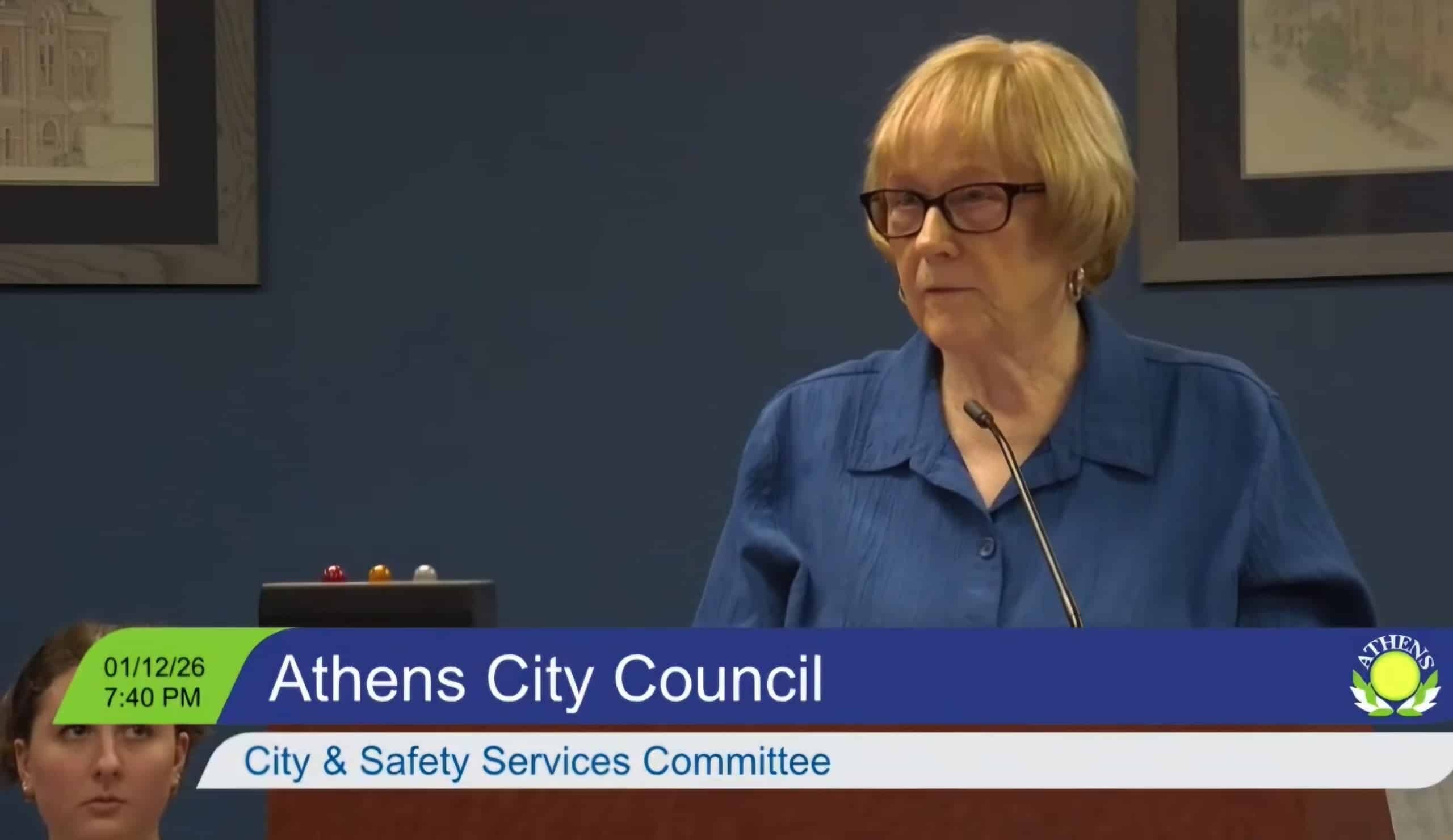

ATHENS, Ohio — A proposal to initiate a streetlight utility service fee that would cost Athens utility customers $30 annually received pushback during Monday’s Athens City Council committees meetings Monday, Jan. 12. So much pushback — including from two council members — that the council tabled the concept for two weeks. Concerns raised included overall rising electricity costs and the impact on persons with fixed incomes.
City and Safety Services Committee Chair Paul Isherwood, At-Large, said the city has approximately 700 streetlights that are leased from American Electric Power, along with another 400 city-owned streetlights. The lights span from residential areas into commercial corridors and industrial sites, and Uptown Athens.
The cost of electricity for the city’s streetlights works out to $160,000 annually, Isherwood said. A streetlight utility, similar to what other cities have, would generate about $167,000 and “take some of the pressure off” of the city’s general fund, Isherwood said.

Mayor Steve Patterson said the way the utility would be implemented was developed by Service-Safety Director Andy Stone. If enacted, the utility would become a proprietary fund, dedicated for the purpose of covering electricity costs for streetlights. Currently, streetlight costs come out of the general fund, without a dedicated budget line.
Under the proposal, all utility account holders in Athens who receive bills for water, sewer and trash would be billed an additional $2.50 per month for streetlights, or $30 annually. Isherwood said there are 4,772 residential account holders, 597 commercial and 11 industrial.
Patterson said cities such as Monroe, Ohio, have a streetlight utility.
“This isn’t anything new when it comes to what other municipalities do, how they treat it to offset things,” he said.
Audience opposition to the utility from at least one community member, Mary Abel, was immediate. She started by saying that streetlights are a safety feature offered by cities. Abel said she has been reading publications informing the public that electricity costs, starting this June, are expected to increase.
Abel suggested that instead of a streetlight utility, the city should dovetail its electricity costs into its push to city voters to approve a city earned income tax of 0.2%, set to appear on the May 5 ballot. It would increase the current city income tax from 1.95% to 2.15% and generate an additional $1.8 million toward the city’s $21 million general fund.
The general fund pays for all city departments and their personnel, including police, fire, code enforcement, engineering and public works, the mayor’s office, among others.
Isherwood offered that Hocking Athens Perry Community Action Program offers utility assistance to persons who are income-eligible. Committee member Michael Wood, 3rd Ward, said he agreed with Isherwood that perhaps commercial business and industrial rate-payers could perhaps be asked to pay a bit more than residential customers.
“I think what Mary said speaks to me,” Wood said.
Committee member Alan Swank, 4th Ward, said before considering the streetlight utility, he wanted the council to see the city’s 2025 carryover reserve balance. It was not available Monday.
Swank said he had also wanted for the council to view all city revenue sources from 2025 — not just the general fund, but also grants, state funding for water and sewer projects, and other revenue bringing the city’s total to $84.8 million. That data also was not available Monday. The Independent has since requested it from the auditor’s office.
Swank said once a city begins charging for a service, such as streetlights, people expect the service to be functional. But there have been instances where streetlights have been down for up to three months, he said.
Swank said that city income tax revenue has increased as part of the general fund, from $10.5 million at the end of 2024 to about $11.1 million in 2025. The first property tax bills of 2026 will have payments due soon.
“Taxes first and foremost are on peoples’ minds,” Swank said. He added that with reductions in Supplemental Nutrition Assistance Program benefits and other burdens residents face, such as higher food costs, a small increase in a bill such as a street utility can be “make or break.”
City Treasurer Josh Thomas said despite city income tax revenue increasing by 5.4%, that increase isn’t enough to cover the city’s increasing costs, such as employees’ medical insurance payouts.
The streetlights utility proposal is likely to come before the City and Safety Services Committee Jan. 26. If introduced as an ordinance, the first reading opportunity would be February.
Public depositories: City investments
Every five years, the city treasurer’s office sends letters and receives applications from local financial institutions, mainly banks, who wish to work with the city on continued investment of city funds. The March 1 deadline for sending out letters is fast approaching, said Jessica Thomas, At-Large, chair of the Finance and Personnel Committee.
The city needs to initiate and fast-track two resolutions, which she said would be on next Monday’s regular council agenda. One estimates the amount of investible city money available for “interim investments,” a resolution due Feb. 9, while another states the city’s intent to send letters and receive applications Feb. 1–7.
The city invests leftover funds as they are available. Local institutions are in effect competing to offer the city the highest return rates possible on invested funds.
City Treasurer Josh Thomas said the city currently invests about $31 million with several banks’ Athens locations, including Hocking Valley Bank, Chase, and Peoples Bank. The city also invests funds through RedTree Investment Group of Cincinnati. Patterson said it has been his priority to work with minority-owned financial institutions, such as Adelphi Bank of Columbus.
Thomas said invested funds fluctuate because funds are often taken out when needed to pay for their intended purpose. As one example, the city received a $2.5 million training grant for a Fire Department training center. The grant money is not needed currently so it has been invested, but will be pulled later to cover training center costs.
In a subsequent discussion on appropriations, Jessica Thomas said an amount of $236,477 in unrestricted funds will be moved to the city’s Athens Community Improvement Corporation fund.
Patterson said the funds come from the Host Community Cannabis Fund — the city’s share from the state excise tax on recreational marijuana sales. But under state rules, despite being “unrestricted,” the cannabis funds cannot be used for new construction or renovations of a building, Patterson said.
The city now has three dispensaries for recreational cannabis, with two of them having generated excise tax revenue the past two years. It has taken that long to receive the funds, he noted.
Rules of council discussed
With three new council members seated Jan. 5 — Isherwood, Megan Almeida, 1st Ward, and John Staser, 2nd Ward — city council reviewed rules of order within meetings, including how the council’s four committees go about conducting business. The council currently conducts regular meetings and committee meetings according to 36 rules that range from how to convene a meeting to how to suspend the rules.
One new rule took effect Monday. In the past, council members who are not seated on any of the four committees — each committee having four members — could sit in the audience and comment on committee discussion as audience members.
That changed when Beth Clodfelter, At-Large, was prevented from making remarks as an audience member on the streetlight utility proposal. Swank, a safety and services committee member, said advice on the rule change had come from the council’s Parliamentarian, City Law Director Lisa Eliason.
The Committee as a Whole also discussed items that may soon come before the council for rules consideration. One involved saying the Pledge of Allegiance. Currently, the council does not recite the pledge before meetings begin. Swank said that is something the council may want to consider, as some organizations and councils do recite it as the second item on an agenda before a quorum is established.
Jessica Thomas said that due to religious references contained within the Pledge of Allegiance, she is not in favor of its inclusion. The pledge has changed throughout its history from inception, with Thomas noting that the words “under God” were not added until the 1950s. She said she is an atheist.
From Ireland, and a naturalized U.S. citizen since 2023 who has taught history, Isherwood said, “I am very proud to be an American.” However, as regards the Pledge of Allegiance, he said it has changed considerably over time and “came out of an anti-immigrant sentiment.”
Council member Michael Wood said he was against reciting the Pledge for three specific reasons.
“One, article of faith: I’m a Quaker, so I don’t do that, so I won’t,” Wood said. “Two, it feels performative; and three, I’m uncomfortable performing that in this current moment with this current administration. I think anything that feels like a fealty pledge I strongly dislike and so I am firmly against that.”
Swank noted that participation in the Pledge “is not required.” Clodfelter said she would not support a rules change that makes three fellow councilors feel uncomfortable. Specific rules changes may be discussed again at the next council committees meeting on Jan. 26.
Due to Martin Luther King Jr. Day, Athens City Council’s next regular meeting will be at 7 p.m. Tuesday, Jan. 20, 2026, at Athens City Hall, Council Chambers, third floor, 8 E. Washington St. Meetings are also streamed online. Regular sessions are on the first and third Mondays of the month; committee meetings are on the second and fourth Mondays.
Keri Johnson contributed to this reporting.