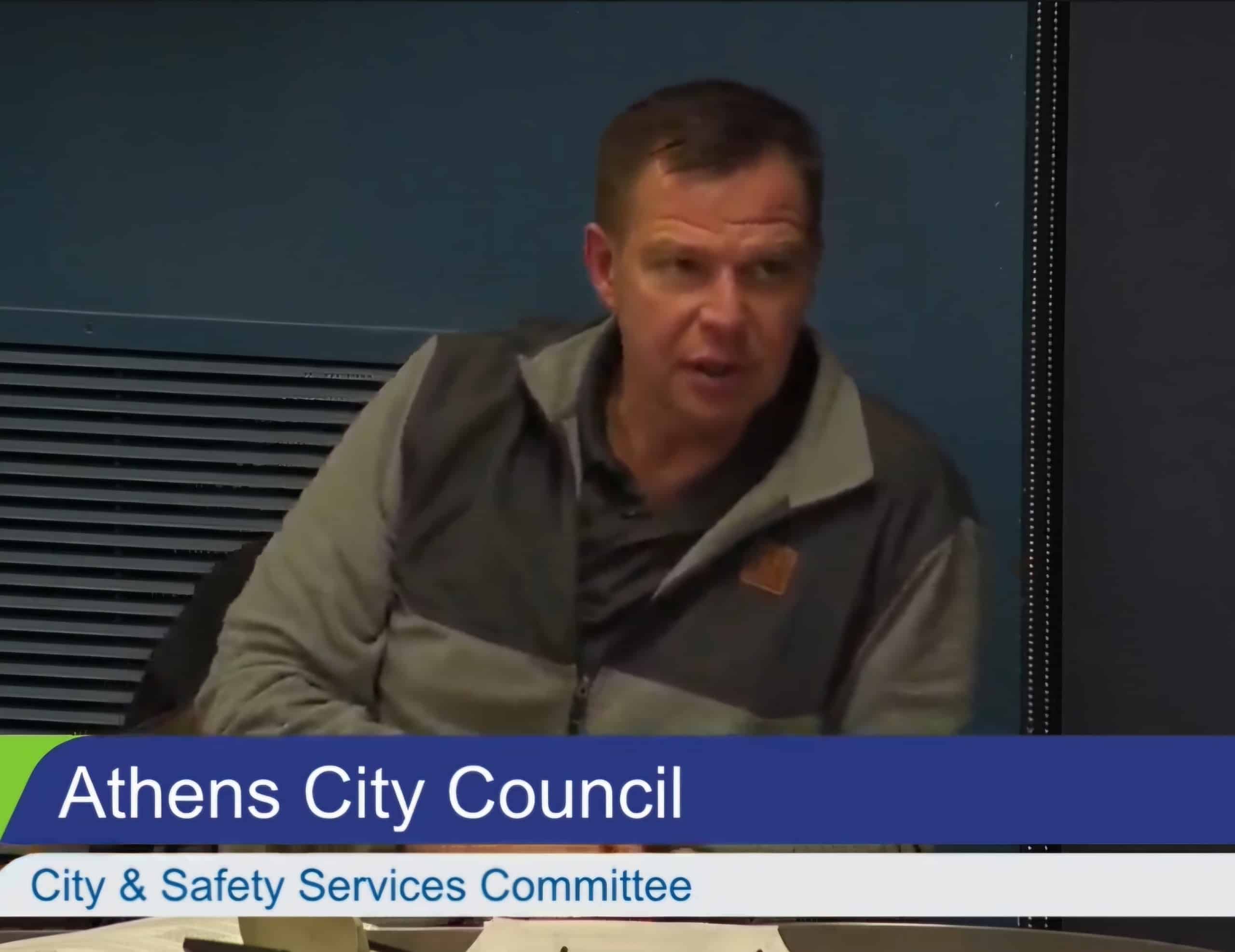

ATHENS, Ohio — Athens’ participation in a state-paid, city police-controlled drone program for criminal surveillance purposes died in committee Monday evening. The proposal did not make it out of the City and Safety Services Committee, a necessary step before forwarding to the Athens City Council for approval.
City Service-Safety Director Andrew Stone said Athens was poised to become one of 10 entities to participate in the state’s new Drones for First Responders Pilot Program.
The program would have provided the city with a sophisticated drone — controlled by police dispatchers, with recording capabilities — to be the first to arrive on an emergency scene. The $300,000 cost of the program would have initially been paid up-front by the city, and then reimbursed by the state. All training and maintenance was provided in the proposal and would have been covered during the first two years of operation.
The deadline to approve and sign onto the Drones for First Responders program is Feb. 17, which is the date of the next council meeting, as Feb. 16 is President’s Day. That would have required an emergency ordinance on Feb. 17, Stone said.
The proposal did not make it out of the City and Safety Services Committee due to the lack of a second on a motion by committee Chair Paul Isherwood, At-Large. The committee also consists of Michael Wood, 3rd Ward, Megan Almeida, 1st Ward, and Alan Swank, 4th Ward.
Swank was absent Monday, attending a conference, and Mayor Steve Patterson was also absent.
“The civil libertarian in me is not keen on anything like this,” Wood said. He added that any police officer “worth his salt” could create a reason to investigate a secondary matter that was not the initial reason for drone dispatch, “a pretty common (police) trick.”
Stone had noted that no recording by the drone would occur until it was air-bound and proceeding toward a call, and that facial recognition software would not be used. He emphasized that drone flight logs and recordings would be public record, minus redactions, for instance to protect the identity of a minor child.
Wood, however, remained firm on his argument that giving police control over drones could have unintended consequences, such as revealing unclothed persons lounging in their backyards behind fences.
Stone said one of the uses of a police-controlled drone would be to quietly investigate crimes of voyeurism, as happened on the city’s Westside in recent years, when someone was caught peering into the windows of homes. The advantage of a sophisticated drone would be its ability to get to a scene much faster than a police cruiser to “get eyes on” a scene quickly, Stone said.
As another example of the drone’s possible use, Stone discusses searches for missing persons, even outside the city, such as in the Bailey’s Trail System.
But Stone offered that he had a discussion with his own father about drone use, with his father mentioning he would feel prone to “shoot down” a drone were it hovering over his property. Stone added that government-controlled drones are considered aircraft, so shooting them is illegal.
All of the pushback against the drone proposal among committee members came from Wood. He referenced business entities, such as Palantir Technologies, when discussing concerns related to civil liberties. Palantir has faced criticism for developing government surveillance technology used for such purposes as immigration enforcement.
“I think, in general, we’ve given up so many civil liberties in my lifetime since 9/11,” Wood said. “We do it pretty freely and it’s impossible to put back in.”

Audience member Rob Delach said there would need to be considerable privacy restrictions on drones so they do not engage in “warrantless searches.” But Delach noted that he has his own drone and believes their applications are potentially beneficial to local law enforcement.
Almeida asked Stone about maintenance related costs. Stone said all expenses for the drone program would be covered the first two years. After that, however, the cost to maintain the program could be in the thousands of dollars. Council would need to evaluate if the program were worth continuing.
Isherwood said he believed if Swank were present, Swank would have voted to send the drone proposal onto the council for approval. Wood said how someone might vote who is absent does not affect the vote at hand.

Streetlights presentation
Jason Tanko, owner of San Francisco-based Tanko Lighting, delivered a streetlight system support proposal to all council committees, with slides and discussion centered on how much the city would potentially save by taking ownership of 653 American Electric Power-owned streetlights leased to the city. Stone said those lights are unmetered and subject to a flat rate. The city also operates 459 streetlights that it owns.
Currently, the city pays $157,466 annually for streetlights electricity costs. Were the city to own its own streetlights, that cost would decrease to $93,822, a yearly savings of $63,645, according to Tanko’s analysis.
A large part of that savings would come through the city shopping for its own electric rates. Stone noted that Athens was one of the first Ohio cities to switch from high-pressure sodium lights to LED lights.
The up-front cost to the city for owning its streetlights would be considerable, at $491,500, according to Tanko. The payback period based on cost savings realized per year would take 6.6 years. But over 20 years, the city would save over $2 million in electricity costs.
Tanko said his company performed a streetlight audit and inventory analysis for Athens in 2019, when no decision about owning all of its streetlights was made. Stone and Tanko acknowledged that AEP could fight the move legally, but Tanko said home rule would give the city grounds for the change. Tanko would provide consulting services as well as streetlight maintenance during a transition period, he said. Tanko Lights works with local contractors in every market to provide maintenance, he offered.
“Our contract with the city would serve at your will,” Tanko said.
The city taking ownership of all its streetlights is just one idea under consideration for addressing streetlight electricity costs. The city is also considering implementing a streetlights utility, which would amount to $30 annually placed on residential, commercial and industrial utility bills.
The proposed utility would be collected as $2.50 added to monthly utility bills and would generate $167,000 annually. The proposed streetlights utility has been met with public opposition and has not moved toward an ordinance.
Retirement incentive program
The Finance and Personnel Committee heard a report from Stone on a proposed retirement incentive program intended to combat the high costs of medical coverage for city employees, particularly long-standing employees with enough years amassed to qualify for retirement.
The city self-insures its medical coverage costs using a third-party administrator. Over the last few years, employees have had a series of high-cost medical claims, which has depleted city funds.
There is more than one option available to induce retirement with an attractive offer, Stone said. One option involves providing an employee who retires $30,000, at $10,000 per year over three years, as a pre-taxed vehicle for boosting their medical coverage needs. The city estimates it has 18 employees who currently would qualify for the retirement incentive program, so the total amount it would cost the city would be $540,000.
Due to President’s Day, Athens City Council’s next regular meeting will be at 7 p.m. Tuesday, Feb. 17 at Athens City Hall, Council Chambers, third floor, 8 E. Washington St. Meetings are also streamed online. Regular sessions are on the first and third Mondays of the month; committee meetings are on the second and fourth Mondays.