


ATHENS, Ohio — With a public hearing scheduled Nov. 3, Athens City Council’s Planning and Development Committee on Monday night took up the issue of a forthcoming ordinance to allow conditionally permitted uses of temporary shelters in certain zones.
The ordinance in question would allow the shelters in zones R-3, multi-family housing, and B-3, general business zones. The proposal is similar to one that would allow three Conestoga huts to be occupied and stationed in the parking lot of The Gathering Place on North Congress Street, which offers peer support for substance use and mental health. That property is zoned R-3.
Planning committee chair Alan Swank, 4th Ward, started Monday’s discussion by noting that the temporary shelters in R-3 and B-3 zones would require restroom access within 200 feet of shelters, with one restroom for every three temporary housing units.
A new requirement being introduced would also require supervision and care from a licensed health and welfare agency.
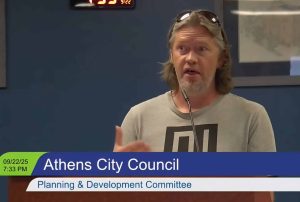
In the subsequent public discussion, Elmwood Place resident Jack Stauffer said that the ordinance would allow shelters to obstruct views and lower homeowner property values, especially if in areas abutting properties in R-1 zones, single-family homes.
“We don’t need to encourage unfortunate souls to our town where the living is easy,” Stauffer said. “People, especially desperate people, take the path of least resistance.”
Rob Delach, chair of the Board of Zoning Appeals, said the board would offer important checks and balances on temporary shelters, with each project possibly subject to individual conditions that involve site plans, lighting, fencing, screening and security. The temporary housing units would also need approval from City Service-Safety Director Andy Stone.
Stone said that while there is no perfect solution, the proposal at hand “is an attempt to do something” for housing needs that are increasing.
An unhoused person who occupied a city storage unit demonstrated how serious the housing shortage is, Stone said. He added that while “it’s easy to oppose” such projects, it’s harder to take action to alleviate the problem.
Stone said that this past Friday, a local developer told Mayor Steve Patterson that he would sue over the “spot zoning” involved in approving a variance for the Gathering Place.
In her Sept. 15 legal opinion, Law Director Lisa Eliason wrote that “spot zoning” was “improper,” but not necessarily illegal.
Loraine McCosker, an Elmwood Place resident, said she has seen unhoused persons on the street she and Stauffer live on, a problem that has grown.
“We’re all in this together,” she said, adding that proposed cuts in federal funding to help unhoused persons will only exacerbate housing needs.
Committee member Jessica Thomas, At-Large, expressed frustration with residents who continually voice opposition to any housing project, such as the renovation of the Sunset Motel.
“I really don’t want to hear ‘not in this place’ anymore,” Thomas said.
Thomas said that she has received emails each month since June concerning temporary shelters, including the Conestoga Huts project, and since that time has been in support of their conditional use, as they would be regulated by the board of zoning appeals and service-safety director.
Thomas also said that allegations that Athens Police Department’s input has not been considered are unfounded, because she has spoken with the police chief who has “no concerns” over the Gathering Place Pilot Project. Records obtained by the Independent show that Thomas did reach out to APD Chief Nick Magruder via email.
Magruder told the Independent that the police department doesn’t get involved in zoning concerns. He noted that the police become involved only when funding dries up for temporary housing for unsheltered people in the county, which increases the number of encampments in the city. The chain of command means he would raise any concerns with the city administration first, he said, not the council.
Magruder said he believes the Gathering Place manages its operations well. He understands the public’s concerns about the Conestoga housing project, “But I mean, I don’t have many concerns. … From a PD standpoint, we don’t have any concerns.”
Swank said that he has not heard from his constituents on the Far East Side about the project. He said he hopes that council members attend the Nov. 3 hearing with open minds.
“This is a pilot project — I don’t think it’s appropriate to make the entire city, or at least R-3 and B-3 zones, a pilot project,” Swank said.
Thomas said that although she favors the temporary shelters, that does not mean she won’t listen to any and all valid concerns. “I think it’s questionable ethically to keep trying and putting this off, trying to control a narrative and fearmonger,” she said.
Solveig Spjeldnes, 1st Ward, who has also voiced strong support for the Conestoga Huts project, said given the need for health and welfare agencies to oversee temporary shelters in R-3 and B-3 zones, she does not yet know where such shelters might be able to exist.
But the expansion of the Conestoga Huts project is worth pursuing for the handful of locations where it might work, Spjeldnes added.
Spjeldnes said that the “serious guardrails” for the projects, as the board of zoning appeals’ and service-safety director’s approval, are enough to give expanding the zoning due consideration.
Things get testy
Swank said conditional permits for temporary shelters in R-3 and B-3 zones are important enough as a topic to bring back to the planning committee, following the Nov. 3 public hearing.
Thomas strongly disagreed, stating that the issue has been pushed back long enough; the proposal could then spill over into next year. A heated exchange soon followed.
“I don’t think we should bring it back to committee, I think we need to carry it forward as we’ve been planning to, as has been — as we should’ve done months ago, in my opinion, and we continue to November,” Thomas said.
“Let me say this: If that is your opinion, you might as well not come next week, because you’ve already made up your mind on what—,” Swank said.
“I have,” Thomas replied.
“There you go,” Swank said.
“I’ve heard from the public, I have emails from the public. I don’t know what you wanna — by ‘There you go,’” Thomas said. “But you do it all the time, Alan. I don’t think you should throw any stones here.”
“Oh, I’m going to throw bricks and rocks,” Swank said.
“Go for it,” Thomas said. “Go for it 100%, bud.”
The heated exchange was contentious enough that Jeff Risner, 2nd Ward — who isn’t a member of the planning committee, but kept time for public comments — asked Swank and Thomas to de-escalate, and “get the temperature down.”
“Arguing amongst yourselves like this is not gonna solve anything,” Risner said.
The exchange wasn’t yet over, with Swank stating that he had the floor.
“I will have it next,” Thomas said.
“When I recognize you and if I recognize you,” Swank responded.
Later in the meeting, Swank apologized to Thomas, offering that his remarks were not appropriate. She accepted the apology.
Audience supports Shade Tree Commission
Members of the Athens Shade Tree Commission and supporting audience members pushed back on a proposal by the city administration to transfer the commission’s regulatory duties to the planning commission. If implemented, the Shade Tree Commission would have only an advisory role in development.
The Shade Tree Commission currently regulates tree and landscaping requirements for subdivisions, large commercial developments and redevelopments.

Stone and Swank both noted that the Shade Tree Commission is the only city commission — other than the Athens Planning Commission — with regulatory powers. Stone called the proposal a “streamlining” measure. Swank said that other cities do not have shade tree commissions. Those that do, such as Mount Vernon’s Shade Tree & Beautification Committee, have them in advisory roles, he said.
Stone said the Shade Tree Commission in a new, advisory capacity would serve the city much as a city department does, which involves providing input for the planning commission to make decisions.
Audience members, however, were united in opposition to changing the commission’s duties.
Commission Chair Tristan Kinnison said he feared the move was a way to push the Shade Tree Commission aside — and out of the way of developers. Doing so may affect the city’s urban tree canopy, he added.
“We have trouble getting anyone to our meetings from the city administration,” Kinnison said. For example, he alleged that the city has been unresponsive about removing a dead tree on South Court Street. The Independent’s public records request for communications between the commission and the city administration on the matter is pending.
The Shade Tree Commission meets once monthly but has only four of the statutory seven members, each of whom serves three-year terms. Kinnison said that is because Mayor Steve Patterson controls those appointments and has not moved to fill vacancies.
Spjeldnes said by not filling three open positions, city administration has treated the Shade Tree Commission as something less powerful than a commission with regulatory powers.
City resident Mary Reed, who is affiliated with the Athens Arbor Day Committee, said the Shade Tree Commission and city administration have recently been working well together. She said she does not understand the move to take away the commission’s regulatory powers for the sake of being “nimble,” or more efficient.
“Democracy is not really designed to be efficient,” Reid said. “It’s designed to be accountable and transparent, and I’m worried about losing some accountability and transparency when the Shade Tree Commission actually no longer has authority.”
Joanna Sokol, a Shade Tree Commission member, said there are two certified arborists on the commission; the Athens Planning Commission lacks any. Adding the Shade Tree Commission’s duties to the Athens Planning Commission will add work to a body with an already full plate — but with less tree canopy knowledge and experience.
Gene Deubler, a Shade Tree Commission member and certified arborist, said removing regulatory powers from the body would further weaken its capacity to see code enforced on tree plantings and landscaping — which, he said, are among the city’s most impactful, and least costly, assets.
City resident Laura Wallace said the Shade Tree Commission’s duties are especially important amid climate change.
“So the trees, they make Athens,” Wallace said. “I don’t know about you guys, but I go out just about every weekend to enjoy nature.”
Planning and Development Committee members Spjeldnes and Michael Wood, 3rd Ward, indicated their preference to keep the Shade Tree Commission as is.
“I’ve heard overwhelmingly from the public against this,” he said.
Spjeldnes said being the only city in the region to have a Shade Tree Commission is not a bad thing and indicates “being ahead of the game.”
Stone said that personally, he is part of the American Tree Farm System and that he does not oppose a vibrant tree presence in Athens.
“I’m supportive of the tree canopy we have within the city, and want to make sure we’re not lessening our requirements,” he said.
First look at 2026 operating budget
In what will be an ongoing process scheduled for final approval in December, the Finance and Personnel Committee took a first look at the proposed 2026 operating budget appropriations, which would go into effect in January 2026.


“If you were going to compare it to previous years, it’s pretty modest,” Stone said.
Expenditures from the general fund, which represents most of the budget, total just over $18 million. Those departments are in line or slightly down from last year’s spending, including the mayor’s office, auditor, treasurer, law office, city council, municipal court, police, fire, code enforcement, parking enforcement, lands and buildings, and other administration.
Stone said the city will be proposing a 2% increase in non-union compensation, which includes city administrators. Nonunion benefits are not anticipated to change.
Stone said the city’s income tax revenue mix will be adjusted due to medical costs, with an additional amount of 2% going toward the medical fund. The fund has been used at a faster rate than being paid into, as the city is a self-insured entity. Five employees this year have already reached the paid-out threshold of $110,000, with another seven employees approaching it, he said.
In the area of annual debt service, the city’s largest annual payments are for the new fire station, just over $1 million; the city pool at $557,000; and sewer debt of just over $1.5 million.
Stone noted that the new budget is still in preliminary mode and may be subject to change.
Athens City Council’s next regular meeting will be Monday, Nov. 3, at Athens City Hall, Council Chambers, third floor, 8 E. Washington St. Meetings are also streamed online. Regular sessions are on the first and third Mondays of the month; committee meetings are on the second and fourth Mondays.
Keri Johnson contributed to this reporting.