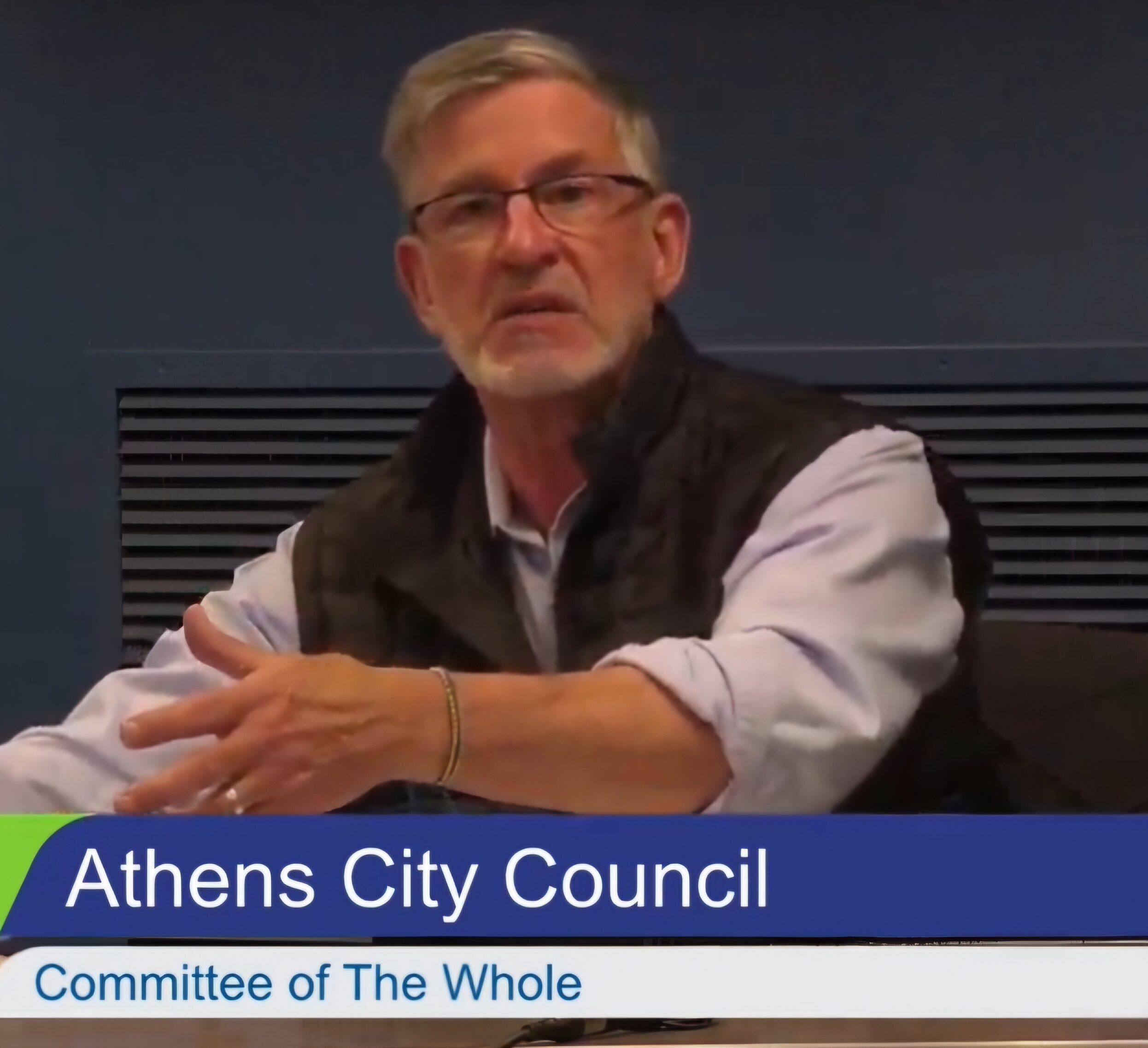

ATHENS, Ohio — Athens City Council and city administration discussed Monday, Nov. 10, placing another proposed earned income tax increase before voters.
City voters last rejected a 0.3% income tax increase this past May, which would’ve raised the tax rate to 1.95% to 2.25%. The measure failed by a 14% margin. If passed, it would’ve generated about $2.6 million for the city annually.

Mayor Steve Patterson is now proposing an 0.2% earned income tax increase to go before voters in May 2026. That would raise the rate from 1.95% to 2.15%, or about a 10% increase.
It would generate an additional $1.8 million for the city’s general fund, Treasurer Josh Thomas said.
The general fund, set at about $21 million for 2026, funds city departments such as police, fire, the mayor’s office, parking services, municipal court and code enforcement.
Treasurer Thomas and Mayor Steve Patterson also said the proposed income tax increase would help most by stabilizing the ever-rising costs of medical coverage for city employees.
Patterson said the city’s revenue will keep up with its expenditures in the future if the city does not increase its income tax. The last time voters passed an income tax increase was 2016, he said, and new revenue will allow the city to keep the level of services intact that city residents have come to expect.
Council member Alan Swank, 4th Ward, noted that the 2026 calendar-year budget as proposed involves a modest increase of just 1.2%.
Rob Delach, of Athens, said city leaders must go much further this time round in explaining the need for an income tax increase.
“I guess, my one piece of advice is that I think the city needs to make a good case for it to pass,” Delach said, adding that the city should specify why it needs the increase and what it will support.
“We need to make this case or else it’s not going to pass, again,” Delach added.

In a related matter, the council held a special session Monday and suspended the rules in order and adopted 6-1 appropriations Ordinance 127-25, which provided an interfund transfer of $750,000 from the general fund to the medical fund.
Patterson said the city, which is self-insured for employees’ medical coverage, has stop-loss coverage capped at $110,000 per employee. Currently, five employees have exceeded that amount, while seven more have exceeded half of the insured amount.
Patterson said following the meeting that the $750,000 will not require the city to tap into its reserves. The ordinance was also amended so that $25,000 would be appropriated from the general fund toward parking garage elevator repairs, credit cards fees and year-end electricity costs.
Another $1,000 was appropriated to provide refunds to Athens Public Transit customers who bought fare tickets, since Athens Public Transit is offering free rides through April 2026.
Council member Beth Clodfelter, At-Large, said the impact of the large expenditure was not fully made clear to her, and she voted against the ordinance.
The new income tax proposal touched off a discussion on strategy moving forward.
Swank offered that last May’s resounding defeat at the ballot box wasn’t failure, rather feedback. The city has responded by tightening its spending, he said.
Addressing Delach’s request that the city specify its budgetary needs for the proposed income tax increase, Patterson said, “I’ll flip the script just a little bit. A win keeps the city sustainable moving forward.”
Clodfelter said the city will need to do better marketing about the income tax proposal, while council member Solveig Spjeldnes, 1st Ward, suggested public hearings so the community can comment on the budget. Patterson said the new 2026 budget will have three ordinance readings, so residents can voice their budget feedback at the meetings when the readings will occur.
Addressing a concern from Spjeldnes about city officials’ involvement in marketing the tax increase proposal, Patterson said the city’s elected officials “very much can advocate for passage” before the public.
Treasurer Thomas said council members need to prepare themselves with facts, so that when residents email or call them about the income tax proposal they can be on target about needs.
Council and audience members did not mention another factor that they have said previously likely affected the income tax defeat last May: In November 2024, a cyber-scam pilfered a $722,000 payment from the city, intended for payment to Pepper Construction for the Stimson Avenue fire station.

There were no phone calls made to verify the account electronic transfer. The city has since adopted a state-mandated cybersecurity policy. The city is engaged in a legal process to recoup at least partial funds from the theft.
More conflict: Temporary housing in R-3 and B-3
Following a Nov. 3 public hearing based on an August recommendation from the Athens Planning Commission, it had appeared that the first reading was imminent of an ordinance that would allow conditionally permitted temporary housing shelters in R-3 and B-3 zones.
However, the status of that first reading now is up in the air following Monday’s Planning and Development Committee meeting, and a pending legal opinion requested from Law Director Lisa Eliason.
The proposed ordinance would require such shelters to pass through review and approval from the Athens Board of Zoning Appeals, and the city service-safety director on an annual basis. It would also require shelter occupants to be under the oversight of a health and welfare agency.
A copy of the draft for the ordinance that would permit conditional zoning approval for temporary housing shelters in R-3 and B-3 zones. Obtained Nov. 12 via public records request.
Planning and Development Committee member Solveig Spjeldnes, who supports an ordinance to allow Conestoga huts as temporary shelters at The Gathering Place as a permitted variance, said she does not support, for now, the proposed ordinance for conditionally permitted temporary shelters in R-3 and B-3 zones.
Spjeldnes added that she has received a letter of support on the proposal from Ginger Schmalenberg, director of The Gathering Place, stating that if the forthcoming ordinance were not to be approved, it would prevent TGP from working with the city and other entities to find locations for other temporary shelters.
However, Spjeldnes said she cannot support the conditional use ordinance for temporary shelters for now “because of what the outcomes might be.” She also said to her knowledge, no builders have come forward and said, “I want this.”
Committee member Jessica Thomas, At-Large, said with Athens Board of Zoning Appeals’ approval providing a strict approval process for temporary shelters, the city could still approve the ordinance, and have it in effect, even if no temporary shelters were sought for a year.
Committee member Thomas said she would also be amenable to a provision that any health and welfare agency overseeing temporary shelters be based in Athens County. She said “100%” supported moving the proposal forward into a first ordinance reading so that it can go to a vote.
Not to do so would be “kicking the can down the road,” she added.
In addition, Thomas also said allowing temporary shelters in R-3 and B-3 zones would take away the concern — involving The Gathering Place and its related ordinance — of “spot zoning” through variances.
Swank said he had received an email from a concerned party on Strathmore Boulevard stating that zoning was not the way to handle homelessness. Any temporary shelters would need to be carefully thought out and planned, Swank said, joining Spjeldnes to ask that the ordinance be put aside for now.
Committee member Thomas said there were more than enough checks and balances proposed to include to move the concept forward into an ordinance.
Swank, without calling for a vote, then said he did not hear three committee member votes on the four-member Planning and Development Committee needed to move the ordinance forward into first reading. Swank also said it would take six council votes to amend the ordinance, or all its safeguards would “disappear.”
Council member Thomas said Swank alone could not make the determination to stop an ordinance from moving forward, with Council President Sam Crowl cutting off the start of an argument. Crowl said the council’s rules do not isolate committee chairs as the only council members who can move an item forward onto a city council agenda.
Committee members then took a cursory look at council rules, with Thomas offering that the rules did not specify either way about bringing an ordinance forward. Spjeldnes said she did not recall a committee being in such a position.
Swank said Rule 17 (B) of procedures might apply.
Athens City Council Rules of Council Rule 17 (B) states, “Requests for Council action by non-council members must be accompanied by a written explanation at the time the request is submitted to Council for consideration. All requests for Council action by non-council members shall be assigned to aCouncil Committee prior to Council action.”
Committee members agreed to suspend the discussion until city Law Director Lisa Eliason gives an opinion. Eliason did not immediately respond to a request for comment Tuesday.
Audience members also weighed in on the topic. Delach and Kent Lankas both said it was time to move the proposed temporary housing ordinance forward.
Kristie Thomas, an Avon Place resident, said the proposal was too broadly defined, such as not stating whether health and welfare agencies have to monitor temporary shelters on a daily basis, or just provide oversight.
Athens County Economic Development Council presentation
The Finance and Personnel Committee heard an annual presentation from Mollie Fitzgerald, director of the Athens County Economic Development Council.

Athens County Economic Development Council continued its mission throughout this year in focusing on site development, downtown revitalization, business retention and expansion projects, Fitzgerald said.
Athens County Economic Development Council has moved into its new location at the Athens Armory and is pleased to be part of the historic building’s revitalization, she said.
One project taken on by Athens County Economic Development Council involves receiving a certificate of completion for a 60,000 square-foot spec building in The Plains. A floor slab is awaiting approval. The funding source, the Ohio Department of Development’s Rural Industrial Park Loan program, involved an award amount of just over $1.3 million.
“Now, we need to get someone in it,” Fitzgerald said.
Athens County Economic Development Council manages reviews of tax increment financing districts in the county and city, which can involve downtown redevelopment efforts as well as enterprise zone agreements; and administers revolving loan funds for both the city and county.
An Albany access road project with an award amount of $1.5 million, known as Congressman Balderson Community Project Funding, is still pending. Athens County Economic Development Council, which also manages the Athens County Port Authority, is in charge of brownfield remediation projects and approved funding that involve site clean-ups such as old gas stations.
One is Russell’s Gas Station, which carries a remediation cost of about $225,000. Athens County Economic Development Council is also attempting to remediate an Ambassador Laundry site in Athens but is still working on “the ownership piece.”
Fitzgerald said Athens County Economic Development Council has also put a “Project Spotlight” on the Hocking Hills Garment Center in Buchtel, which received a small business grant of $50,000.
The garment center hired and trained 15 employees this year, Fitzgerald said, and is working with Athens County Economic Development Council to close a dye facility in Columbus and move it to Athens. Such “cluster development” may generate more than 50 jobs within the next five years, she said, an exciting economic development opportunity.
Athens City Council’s next regular meeting will be Monday, Nov. 17, at Athens City Hall, Council Chambers, third floor, 8 E. Washington St. Meetings are also streamed online. Regular sessions are on the first and third Mondays of the month; committee meetings are on the second and fourth Mondays.