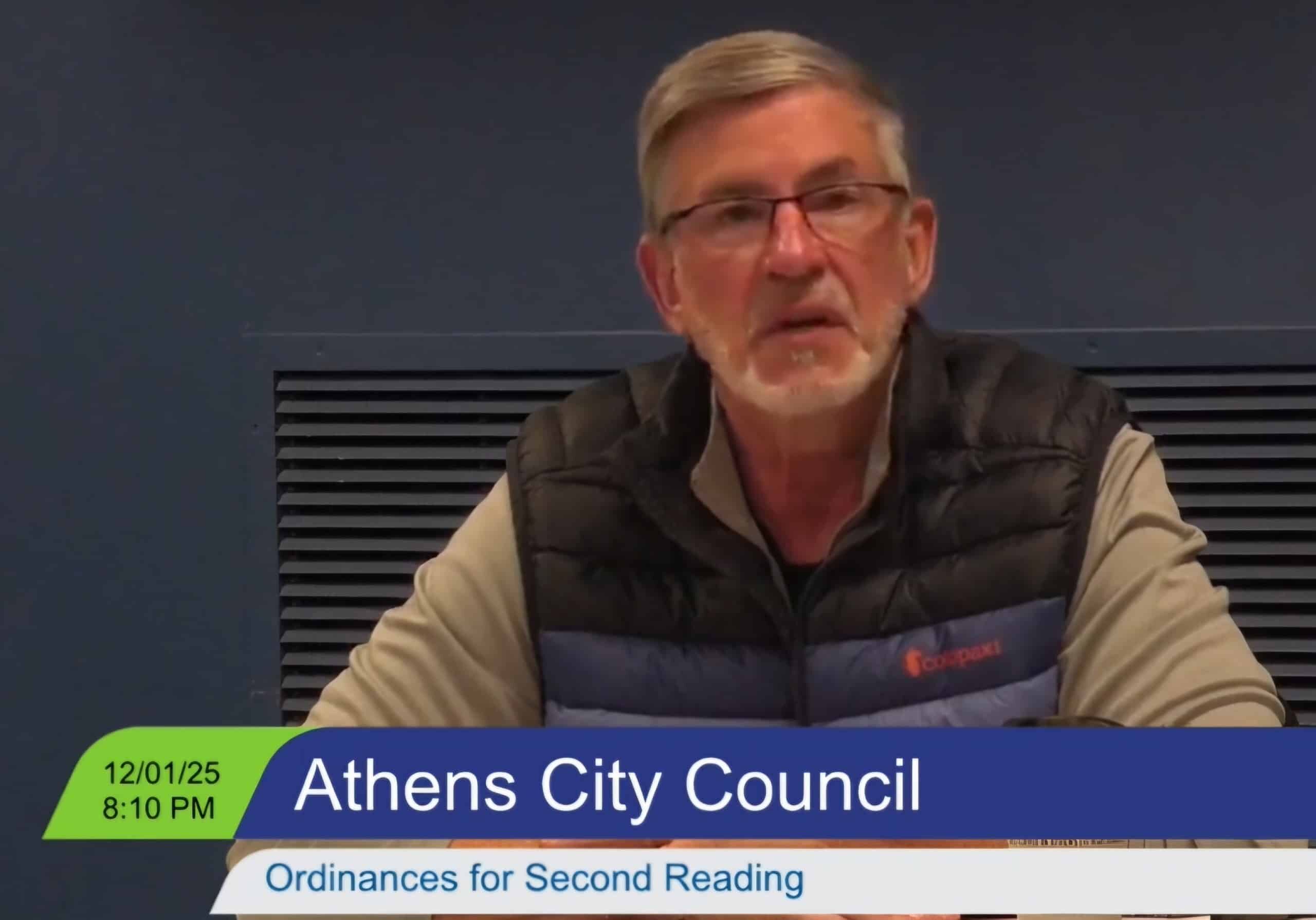

(NOL) Carryover legislation that will cost the city $750,000 in tax refunds that must be returned
to a business entity within 90 days of upcoming budget passage, the city’s staffing levels are safe
– for now. Screenshot, YouTube, City of Athens, Dec. 1, 2025.
ATHENS, Ohio — A state law passed in 2014 is forcing the City of Athens to refund $750,000 in income taxes to an unnamed business entity that lost money over several years.
Athens City Council discussed the refund at its meeting Monday night; members said they had only learned of the net operating loss law’s impact last week.
House Bill 5 requires municipalities to let businesses deduct net operating losses for up to five consecutive years. At first, the deduction was limited to 50% of net losses; starting in 2023, businesses could deduct the full amount lost.
Previously, municipalities could decide whether to allow deductions for such losses and for how long.
Because of the required refund, lines in the city’s 2026 budget appropriation for transfers and refunds will increase from $350,000 to $1.1 million from what council member Micah McCarey, At-Large, called the “unexpected expense.” Council will take up the amended budget Ordinance 120-25 at its Dec. 8 meeting.
Neither city Auditor Kathy Hecht nor Treasurer Josh Thomas were present Monday night. Mayor Steve Patterson said he will work with Hecht to determine how to adjust the budget and its $20 million general fund to handle the loss.
Addressing a concern from Councilor Alan Swank, 4th Ward, about whether $750,000 loss would affect staffing levels set for next year, Patterson said staffing for next year was set well in advance. The city may need to examine individual positions as city employees retire to determine how critical each position is, he said.
Patterson added that even if voters pass the city’s proposed income tax increase of 0.2% in May 2026 — which would raise the city’s income tax from 1.95% to 2.15% and generate an additional $1.8 million annually — it would not go into effect until January 2027. Additional revenues from the tax increase would not hit city coffers until October 2027, he said.
A net-operating loss carryforward “occurs when a company’s income tax-related deductions exceed its taxable income, allowing businesses to carry forward these losses to offset future profits and reduce future income taxes,” Swank explained.
Due to privacy rights involving tax laws, Swank said only the city auditor knows the business entity involved. It would be a criminal misdemeanor for the auditor to divulge that information, he said.
The city’s income tax applies to any business entity that earns revenue from activities within the city of Athens, as well as its employees within the city. In order to rack up $750,000 in net-operating losses, Swank said, a business would have to have taxable income of $38.4 million at Athens’ current income tax rate of 1.95%.
According to the county auditor’s 2024 Annual Comprehensive Financial Report, the top employers in the City of Athens that year were Ohio University, Athens County, the city itself, the Athens City Board of Education, Wal-Mart, Appalachian Behavioral HealthCenters, Kroger and OhioHealth.
Principal payers of real estate taxes in the city included numerous landlords as well as Menards Inc.
Patterson said it is possible that other entities will also pursue income tax refunds from the city related to net operating losses.
Council member Jeff Risner, 2nd Ward, who chairs the city’s Finance and Personnel Committee and introduced the topic, urged the council to pass the 2026 budget as amended under rules suspension.
As the city’s budget is a “living document” that is frequently adjusted as needed, Risner said there was no reason to delay passage.
Others, however, including Council President Sam Crowl, said more needs to be determined about the bill’s impact on the city, and how the administration will offset a $750,000 hit.
The council failed to suspend the rules in a 3-3. Council members Risner, Michael Wood, 3rd Ward, and Jessica Thomas, At-Large, voted in favor of rules suspension, with Swank, McCarey and Beth Clodfelter voting no. Council member Solveig Spjeldnes was absent.
Risner noted that the city has 90 days from budget adoption to pay out the $750,000 refund to the entity owed.
“Do whatever you’d like,” Risner said, addressing budget passage — and the end of his final council term. “I’m out of here in 30 days.”
Temporary shelters attempt nixed
After months in committee, a proposal to allow temporary shelters under specific conditions in zones R-3, multi-family housing, and B-3, general business came before council with first reading of Ordinance 139-25.
The ordinance is similar to one adopted Nov. 17 allowing The Gathering Place to install Conestoga Huts as temporary shelters on its property on North Congress Street.
Council member Thomas proposed amending the ordinance to require that temporary shelters be supervised by licensed, local health/welfare agencies, “or churches and other incorporated faith-based organizations, and state-licensed public welfare organizations.”

Her language would have also required that approved agencies have agreements with the city service-safety director defining operational terms and would have limited the number of total locations within the city to five, with up to six shelters per location. The Gathering Place would have counted as one location.
Thomas’ proposed amendment failed 5-1. Since an amendment to a recommendation requires approval from three-fourths of all council members, all six members present Monday night would have had to vote yes.
Among those voting against the amendment was Swank, who said he could not support the proposed ordinance — even despite Thomas’ amendment strengthening oversight — because the Conestoga Huts pilot project at The Gathering Place needs time to develop.
In addition, Swank said he also wanted to see how the former Sunset Motel works out as an overnight shelter, a project expected to be completed within a year.
The ordinance as originally proposed will move to third and final reading, probably on Dec. 15, likely the last meeting of the year.
As currently proposed, the temporary shelters must be approved by the service-safety director followed by the City Board of Zoning Appeals, with yearly approval required. The council noted that to date, no potential property owners have stepped forward with interest in creating temporary shelters.
Just getting Ordinance 139-25 to its first reading required lengthy discussion. The item was under Monday night’s agenda as a Planning and Development Committee matter before it was added to the regular council agenda by a 2-1 vote.
Swank, planning and development chair, voted no, with committee members Jessica Thomas and Wood voting to bring it to council for first reading.
Council members noted that requiring a majority vote to move a forthcoming ordinance out of a committee had not been the council’s practice.
Eliason said past practice was to allow a potential ordinance to move forward through a “consensus” of committee members.
Swank said the depth and breadth of discussion warranted it requiring a vote to come out of committee. Wood, however, said he “was a bit perturbed” that requiring votes to come out of a committee had not been the practice before.
During the committee meeting, only one audience member spoke, Jack Stauffer, of Elmwood Place. He has previously spoken against both the Conestoga Huts project and temporary shelters ordinance, offering that what the unhoused occupants of shelters need is “a real shelter inside a building.” He also said temporary shelters would have a negative impact on private property near such shelters.
Patterson said while he appreciated the amendments put forth by Thomas, he had concerns with an ordinance allowing temporary shelters to exist citywide. He did not elaborate.
The ordinance requires one toilet and one sink for every three temporary shelters, which must be within 200 feet of a building.
In other business Monday, the council:
- Adopted after third reading Ordinance 122-25, which provides non-union employees, full time and permanent part time, with a 2% hourly pay increase starting 2026.
- Adopted after third reading Ordinance 123-25, to allow the service-safety director to enter into a contract with the Employee Benefits Service Center to serve as the city’s third-party health insurance administrator.
- Heard second reading of Ordinance 130-25, which authorizes the city to begin engineering and construction of Athens Street Beautification Project #383. The $7.7 million project, with most of it funded by the Appalachian Community Grant Fund, will involve burying of overhead utility lines, improved sidewalks, lighting and other amenities.
- Heard second reading of Ordinance 131-25, which authorizes the mayor to designate Hocking Athens Perry Community Action Program to administer Athens Public Transit.
- Heard second reading of Ordinance 137-25, and two related resolutions, to place a proposed earned income tax increase of .2% before city voters May 5, 2026. The increase, if passed, would raise the city income tax rate from 1.95% to 2.15% and generate an additional $1.8 million annually. Voters rejected a proposed increase of .3% this past May by a 14% margin.
- The Planning and Development Committee set for a forthcoming ordinance a special Right of Way Use Permit at 43 S. Court St., which would allow a property owner to replace an awning in order to remodel two, two-bedroom apartments. The plans have the approval of the city’s Historic Preservation Commission.
- Heard from Patterson that the city’s new Athens Poet Laureate is Becca Lachman, who has lived in Athens for 20 years and worked as full-time communications officer for Athens County Public Libraries since 2015. She earned her Masters of English, with a concentration in poetry, from Ohio University in 2007. On her biography sheet, Lachman wrote, “I’m a poet, lyricist, composer, singer-songwriter, foster-to-adopt mum, endo warrior, and communications professional who’s called Athens, Ohio home for the last 20 years.”

Athens City Council’s next regular meeting will be 7 p.m. Monday, Dec. 8, at Athens City Hall, Council Chambers, third floor, 8 E. Washington St. Meetings are also streamed online. Regular sessions are on the first and third Mondays of the month; committee meetings are on the second and fourth Mondays.
Corinne Colbert contributed reporting to this story.