ATHENS, Ohio — At Athens City Council’s meeting Monday night, second reading of an ordinance to allow temporary shelters in R-3 and B-3 zones drew strenuous objections from one council member.
Ordinance 139-05 would allow conditionally permitted uses of temporary shelters in zones R-3, multi-family, and B-3, general business. The ordinance is now set for third reading next Monday, Dec. 15.
At the beginning of his remarks on the ordinance Dec. 12, member Alan Swank, 4th Ward, shared an emailed letter from Mark Weinberg, founding dean of Ohio University’s Voinovich School for Leadership and Public Service, opposing the matter.
In his letter, Weinberg said the shelters proposal “was a bit of a surprise” given work to renovate the former Sunset Motel as temporary shelter and the council’s deliberations of an ordinance allowing The Gathering Place to install Conestoga Hut shelters at its property on North Congress Street.

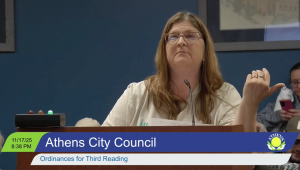
“I and other residents have heard from multiple people who live in the Near East side that they do not support this broad initiative at this time,” Weinberg wrote. “I hope that you will delay any action until we see how The Gathering Place and Sunset Motel projects play out.”
Swank then began to play video of the May 7 meeting of the city planning commission, where the concept of the ordinance originated. After about three minutes — including some technical issues with playback — Council President Sam Crowl interrupted.
“We’ve had lots of discussions about this issue since May,” Crowl said. “Can you tell us how long you want to watch this and what your point is to bring this forward?”
Swank said there were about seven more minutes of video remaining, and that “the video will make the point.”
“This is second reading. We have discussion,” Swank said.
“We have discussion — we don’t play unlimited time videos,” Crowl said.
“I have 10 minutes, sir, by our rules,” Swank replied.
The video playback continued for about another eight minutes, when Swank noted that “there was no request for shelters in R-3 and B-3 zones. “This just kind of evolved as an add-on,” he said.
Swank said he believes that the question of temporary shelters has more opponents than indicated by public comment.
Quoting a recent speaker, Swank said, “Your opinion is valuable as long as it agrees with those who are in favor.”
“I honestly believe that if you were to put this on the ballot, it would fail,” Swank said.
When Swank finished — after holding the floor for over 15 minutes — Crowl reminded council that members may speak on a topic for 10 minutes and that nothing in council rules includes playing video.
“I would encourage council, under the leadership of President-Elect (Micah) McCarey, in your orientation, to discuss how you want to move forward next year,” Crowl said.
Crowl then recognized Thomas, who launched an immediate rebuttal to Swank.
“Everything that is in this [ordinance] addresses all of the things that came out of that meeting clearly, with all of the structure, all of the requirements, all of the stopgaps and the guard rails,” she said.
“We don’t have additional amendments because member Swank voted against them last week,” she added.
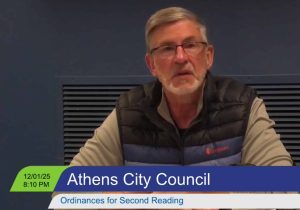
Thomas noted that the proposed ordinance had been discussed in council committee and during previous council meetings, and was the subject of a November public hearing.
“It shouldn’t take six to seven months to go through some of these processes, and it is very intentional,” Thomas said.
The projects at The Gathering Place and Sunset Motel “have nothing to do with the city of Athens or city council,” she said, and should not affect what the city does regarding temporary shelters elsewhere.
Council member Beth Clodfelter, At-Large, said that in speaking with city residents, “more people have been in favor” of the shelters “than not.”
Swank then questioned the motives of other council members in pressing the issue “when we don’t have a request for it.”
“In supply and demand terms we have no demand,” Swank said. “Yet, we want to provide the supply.”
Clodfelter said it’s good to have guidelines and guardrails in place now so that if and when an entity does step forward to request to create a temporary shelter, rules are already in place.
“It’s just a good move for the city to be in front of something like this,” Clodfelter said.
In-person public comment was sparse. Resident Jack Stauffer, who spoke out against temporary shelters at The Gathering Place, said allowing temporary shelters elsewhere in the city would draw unhoused individuals to the city, creating “homeless encampments” and situations where parents told their children “not to walk down certain streets.”
Rob Delach, who chairs the Athens Board of Zoning Appeals, said that unsheltered homelessness already exists in Athens; by providing temporary shelters, he said, the city helps meet the needs of unhoused people in dire straits while potentially reducing crime. The board of zoning appeals will be an important part of the equation for approval of temporary shelters if given the opportunity, he said, and would take all concerns with utmost seriousness.
Ginger Schmalenberg, director at The Gathering Place, said her organization may want to seek additional locations for shelters located on the outskirts of town, such as Columbus Road and Hope Drive.
2026 budget discussions
The council also adopted 5-1 staffing levels for next year through Ordinance 121-25.
Finance and Personnel Committee Chair Jeff Risner, 2nd Ward, urged council to pass the measure because it had been “thoroughly” discussed in committee and was on third reading. However, council member Solveig Spjeldnes, 1st Ward, raised the issue of the city’s 2026 budget — specifically, the impact of a request from an unnamed business entity for a $750,000 income tax refund that was revealed publicly last week.
“We’re going to be changing, dramatically, our budget due to unforeseen circumstances,” Spejeldnes said. “It seems really impossible for more to believe that we would not make any staffing changes in preparation for those changes. So I’d like to hear from the mayor about how you’re going to do it.”
Mayor Steve Patterson said the city has enough money in the budget “to move things around and pay the refund.”
“This isn’t something where I’m going to start changing the staffing ordinance because of the $750,000 refund out of the auditor’s office,” he said. “The plan is set, we know what we’re going to do, and there is money in place to be able to cover our expenditures going into 2026.”
It’s not just the tax refund, Spjeldnes said — the city cut $350,000 being cut from the budget “because we didn’t pass a levy.” Coupled with the refund, “It does make me really uncomfortable about not knowing what’s going to be cut to make that budget possible,” she said.
“Well, these are administrative decisions when we get into 2026. Again, I can’t stress enough, after having a long, lengthy conversation with the auditor this morning, we have money in the budget,” Patterson said.
That didn’t satisfy Spjeldnes, who noted that while the administration prepares the budget, the council is responsible for approving budgets and staffing levels.
“That’s pretty vague to say, basically, ‘Trust us, I’ll figure it out somehow’,” she said.
“It’s not that I figure it out somehow; we know what we’re going to do,” Patterson said.
“Great — tell us,” Spjeldnes replied.
“Well, I’m not changing the staffing ordinance, and I’m not changing current staffing — plain and simple,” Patterson said. “We have the money in the budget and we’re going to move forward with it.”
The measure passed 4-1; Spjeldnes cast the lone vote against. Council member Michael Wood, 3rd Ward, arrived after the vote.
Budget deliberations
Council also heard second reading of Ordinance 120-05, the city’s 2026 budget appropriations totaling $20.92 million.
Swank asked about $6.5 million in a fund titled “ACGP.” Patterson explained that the acronym refers to the Appalachian Communities Grant Fund, a large grant for Uptown improvements next year, such as placing power lines underground.
Spjeldnes asked why the opioid settlement fund that was $180,000 is now at $50,000.
Patterson said $8,000 from the fund was spent on automated defibrillation devices within recreational spaces, adding he will check on the funds mentioned. Swank also asked for a breakdown of projected city revenues for 2026, from the city auditor and city treasurer, who did not attend Monday’s meeting.
Swank also questioned why the budget contains only expenditures and not revenue. He asked that revenue figures be provided by third reading Monday, Dec. 15.
In other action Monday, the council:
- Adopted on third reading Ordinance 130-25, authorizing engineering and construction of Streetscape Beautification Project #383. The $7.7 million project involves $6.5 million from the city’s Appalachian Community Grant fund, and $1.2 million from the city’s Street Rehabilitation Fund 572. It involves beautification such as placing overhead power lines underground as well as improved sidewalks and lighting.
- Adopted on third reading Ordinance 131-25, which authorizes the mayor to re-designate Hocking Athens Perry Community Action to administer Athens Public Transit.
- Adopted on final reading Ordinance 137-25 and two related resolutions to place before voters in May 2026 a proposed 0.2% earned income tax increase.
Athens City Council’s next regular meeting will be 7 p.m. Monday, Dec. 15, at Athens City Hall, Council Chambers, third floor, 8 E. Washington St. Meetings are also streamed online. Regular sessions are on the first and third Mondays of the month; committee meetings are on the second and fourth Mondays.