
ATHENS, Ohio — Athens City Council’s Committee of the Whole heard a presentation Monday recommending that the city move toward creating a streetlight utility that would give it control over distribution and transmission of city-owned streetlights.
The city currently spends $160,000 annually on streetlight electricity.
The city owns about 400 of the approximately 1,100 streetlights in Athens. The other 700 are rented from AEP, which sets rates. The city approached AEP recently about the possibility of purchasing the streetlights, City Service-Safety Director Andy Stone said at the Sept. 14 meeting. That idea did not go over well.
“American Electric Power, after a couple of requests, have basically said ‘No, go pound sand,’” he said. “So, we’re really looking at our other options.”
Stone said one of those options is “municipalization,” or taking over distribution and transmission of power that accounts for about half of a customer’s electric bill.
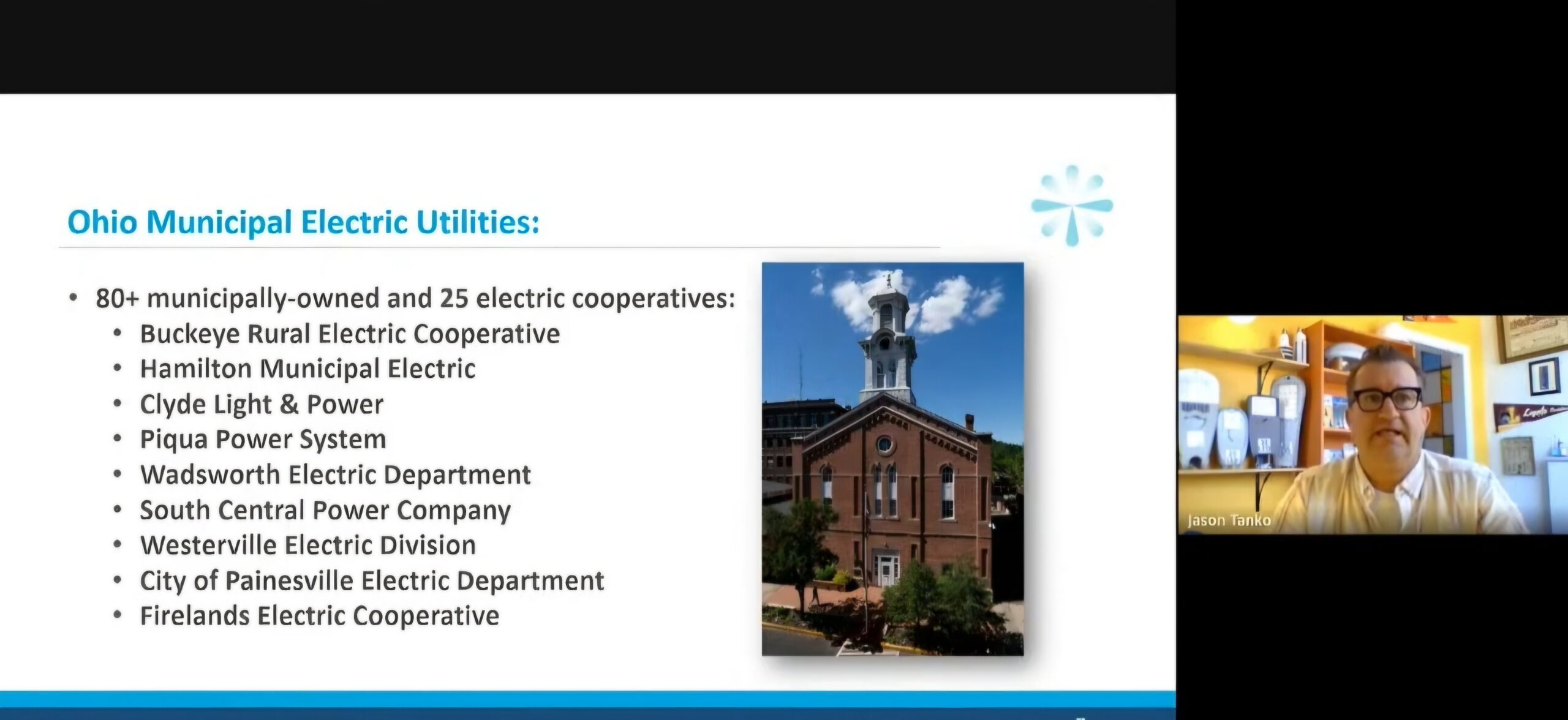
The council then watched a recorded video presentation featuring city streetlights consultant Jason Tanko, owner of Tanko Lighting.
Ohio has 80 municipally owned electric utilities, Tanko said in the video. Another 25 electric co-ops purchase their own electricity and either run the utility themselves or contract with an outside third party to do so — often a nonprofit entity. Where AEP’s focus is on shareholder returns, he said, the city’s would be on customer service.
The city has two options, Tanko said. One option is for Athens City Council to adopt an electric utility that would cost $1 per customer, each month, to pay for the system. The other is to base customer fees on the total cost of streetlights divided by total customers.
Both Stone and Mayor Steve Patterson said city electric customers would save more in the long run with city-owned electric service. About half of a hypothetical $50 electric bill goes toward distribution and transmission, which is what the city seeks to own, Stone said. Under city control, that share could drop to 40% or even 30%, he said.
In January, the council considered a proposal to impose a $30 annual fee for streetlight costs to take pressure off the General Fund. That proposal was dropped after residents pushed back on the idea, citing concerns about rising electricity costs and impact on those living on fixed incomes.
If the city adopted one of the options offered by Tanko, Stone said, there would be no set timeline for municipalization of streetlights. Council member Alan Swank said having timely maintenance of power lines would be important, something he believes AEP does well.
Morris Avenue resident Rob Delach, who chairs the city’s Board of Zoning Appeals, said he received electricity from an electric cooperative when he lived in Virginia. It was run so well, he offered, that customers received rebate checks at the end of the year.
Land bank presentation
The Committee of the Whole also saw a presentation by Athens County Treasurer Taylor Sappington on the Athens County Land Bank. Sappington, who chairs the land bank board, said the next step in the land bank’s progression is “to begin working on housing proposals across the county.” No specific projects have yet been identified.
Sappington said the land bank has become one of the best in the state at taking over tax-delinquent, dilapidated, privately owned properties; getting state grants for demolition; and then seeing properties sold and rebuilt for new residential and commercial purposes.
Since the land bank’s formal name is “Neighborhood Revitalization Program,” Sappington said, moving forward with specific housing proposals makes sense. Patterson is also seated on the Land Bank board. The Land Bank and city will work closely on any housing projects that involve both parties.
Neighborhood Corridor Overlay Zones proposed
The Planning and Development Committee heard a report from city Planner Meghan Jennings on a draft for creation of Neighborhood Corridor Overlay Zones. The city will hold a public hearing on the matter on Monday, Oct. 19.
Jennings said NCOZs are designed to create walkable areas for shopping, dining, social and recreational opportunities, and entertainment. NCOZs do not replace zoning, they add to it, Jennings said. Among their directives is to preserve the character and history within a particular area of the city. An example is the Athens Downtown Historic District, which has specific zoning requirements to preserve more than 90 buildings constructed between the 1850s and 1920s.
The city has received more than 425 comments in open houses since early last year, Jennings said. Many comments focused on support for small and local businesses, sidewalk improvements and more public spaces for people to gather.
Language for an NCOZ ordinance approved by the city Planning Commission also emphasizes multi-use buildings, with a business on the ground floor and apartments above, and canopies and balconies to entice pedestrian traffic. Blank walls would be discouraged. There would also be an emphasis on dining and bicycle use. Buildings occupying more than 10,000 square feet would require open space.
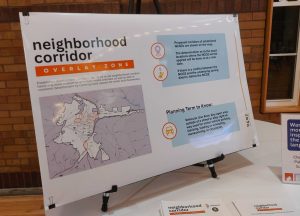
Patterson said NCOZs would “create 10-minute neighborhoods” from which pedestrians could do enough shopping by foot to save on automobile trips. One area he mentioned is Central Avenue, where reviving the long-closed Frank’s Bait Shop with a sundry-style business could work, he said.
The next step with Neighborhood Corridor Overlay Zones would be development of an ordinance approving language and a public hearing on Oct. 19. That would be followed by City Council approval of specific boundaries for one or more NCOZs.
In other items Monday:
- The Planning and Development Committee viewed a map of Athens County Children Services property that the city plans to annex from an agreement with Athens County. The area where buildings are located would be given a business classification of Zone B-3, a general business district, with the rest of the property designated as R-1 residential.
- The Planning and Development Committee discussed the need for a future ordinance to create Tax Increment Financing for Hudson Avenue, where eight new affordably priced homes are soon to be constructed as part of the Welcome Home Ohio Program. Swank said 75% of the area’s property taxes over a 10-year period would generate $350,000, needed to replace a 2-inch water line. A hydrant will be built as well. In the past, hoses have been needed from tie-ins at Lincoln Street to douse fires.
- The Finance and Personnel Committee took up the issue of selling the former Fire Department building on Columbus Road. The city attempted to find a lessee with no success, said committee Chair Jessica Thomas. The city will amend or repeal Ordinance 90-25, adopted last fall, and advertise the building being for sale. Its county-assessed value is $453,000, and the city would need to receive at least one third of that amount for a sale to happen, or $150,000, she said. If a buyer does not emerge, Stone said the building could be turned over to the Athens Community Improvement Corporation.
- The City and Safety Services Committee has asked City Council to create an ordinance allowing the city to conduct solid waste cleanups on private property, with the cost passed on to property owners as tax liens. Committee Chair Paul Isherwood noted this way of dealing with solid waste in yards is necessary where up to five fines have been assessed and no clean-up made. Swank said he would like to see construction debris included, showing slides that included roofing material that had been in the same spot in a yard for years.
Special session
Council held a brief City Council Special Session to consider two ordinances for second readings.
Ordinance 85-26 would appropriate $487,000 back into the Medical Fund to cover the costs of Employee Retirement Incentive Program buyouts of $30,000. The Medical Fund will be replenished from the department funds from which the employees took early retirement buyouts.
Council member Thomas said council should suspend the rules and pass the ordinance immediately, as medical bills continue to come into the city that must be paid. Swank said council has fallen into a habit of calling special sessions when none is needed. He was backed by Michael Wood, 3rd Ward.
Thomas said council had an especially long July recess spilling into early August, with six weeks off instead of the usual four, justifying the rules suspension. City Auditor Josh Thomas said the Medical Fund is “unpredictable” because of incoming medical bills from city employees and urged passage.
Council voted 5-2 in favor of suspending the rules, sending Ordinance 85-26 to a third and final reading.
Council also suspended the rules to adopt Ordinance 86-26, which amends the 2026 appropriation ordinance to allocate $330,500 from the unappropriated balance to various funds for wages. It also authorizes various interfund transfers. Swank cast the sole no vote on suspending the rules.
Athens City Council’s next meeting will be 7 p.m. Monday, Sept. 21 at Athens City Hall, Council Chambers, third floor, 8 E. Washington St. Meetings are also streamed online. Regular sessions are on the first and third Mondays of the month; committee meetings are on the second and fourth Mondays.
