
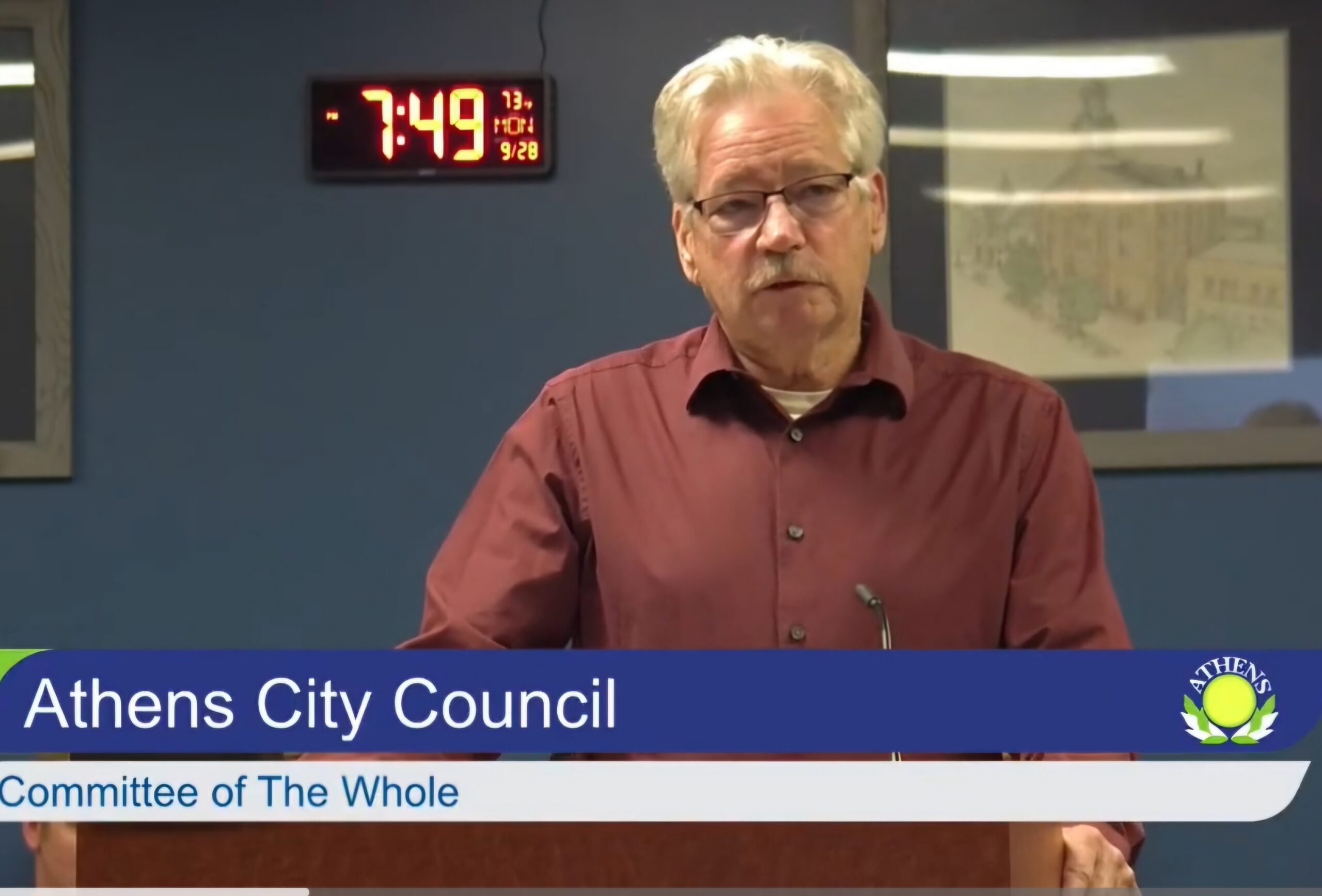
ATHENS, Ohio –– Flooding once again took center stage Monday during Athens City Council committee meetings, where Mayor Steve Patterson announced the measures the city plans to take to address water damage from recent storms and mitigate future issues.
Heavy rains in June, August and, most recently, on Sept. 21 caused flooding that damaged structures and roads in the city, including on Richland Avenue and East State Street.
Among the plans Patterson announced Monday is a new program for the city’s sanitary sewer system.
The Sanitary Sewer Backflow Prevention Program would reimburse East State Street area residents for the cost of installing backflow prevention units, Patterson said. The units are designed to separate stormwater runoff from sewer system water, which flooded houses and businesses this summer.
The city will use smoke tests to find breaks in sanitary sewer lines next week, Patterson said, from Monday, Oct. 5, to Friday, Oct. 9. The Engineering and Public Works Department will begin on the East Side, near East State Street and Madison Avenue.
Patterson said the city’s marijuana dispensary sales tax will fund the Backflow Prevention Program, which is expected to cost $8,000 per month. Additionally, the city will start a Climate Resiliency Fund, also to be funded by the marijuana dispensary tax. The city receives $36,000 monthly from the tax, he said.
Dredging underway
Patterson addressed concerns raised at the council’s meeting on Sept. 28 by two council members, who said they didn’t think the city was working quickly enough on flood mitigation.
“Interestingly, we have been at work, we being our street crews, have been at work for over two weeks on Coates Run, removing debris, doing dredging at the bridges, widening basins on both sides of bridges, and that work continues,” Patterson said Sept. 28.
Patterson showed video clips of dredging behind Sweeney’s Appraisals at 521 Richland, next to Classic Gold Real Estate at 530 Richland, and along one of the bridges near the Stop-N-Cop Drive Thru at 362 Richland.
The basin is being widened in the area to “somewhat contain” floodwater better, Patterson said.
Businesses that powerwashed their properties following the floods will receive a credit on the sewer portion of their bills, he said.
Hydrology expert weighs in
Natalie Kruse Daniels, a hydrology expert and director of Environmental Studies at Ohio University, had previously recommended that the city purchase flood barriers to protect Richland businesses as needed. The city has ordered 240 feet of lightweight, portable barriers that will be stored at the Richland Avenue fire station, Patterson said. The barriers.
“We will have them at the ready if we know that we are going to get a significant, heavy rain event and deploy them to the businesses,” Patterson said.
At Monday’s meeting, Daniels said that dredging is not a long-term solution because floods will continue to occur as the result of climate change. The Coates Run watershed that runs parallel to Richland and is about 3 square miles, she said. Of that area, she said, 41% forested, 33% developed, and 10% covered with impervious surfaces, such as parking areas.
Ridgetop development and highway construction on Richland where it meets Pomeroy Road, known as the South Y, affect how water flows through the watershed, which is fed by natural tributaries and manmade basins, Daniel said.
Heavy amounts of debris and the “slumping of the slope from the embankment on the highway” confine channels designed to move floodwater along, and numerous culverts along Richland convey water through much faster than normal flow, contributing to flash flooding, Daniels said.
Daniels described the Sept. 21 flood as a 2-year event (occurring every two years, on average). The Aug. 11 flooding can be considered a 50-year event, and June 18 flooding as a 500-year event, she said.
When a big storm occurs, she said, the likelihood and extent of flooding often depends on how saturated the ground is from previous rain.
In addition to temporary, portable flood barriers, as part of the short-term solution, Daniels also recommended data-driven flood alerts to inform the best time to deploy the barriers.
Grassy areas, such as across from the Dairy Barn and at Richland Avenue Park, can serve as bioretention areas for water, she said.
In the long term, Daniels said, large detention basins or tanks could be placed in areas such as the former Morrison Elementary School, now Morrison Center. Patterson said the city is exploring the option, but that such tanks would potentially cost “tens of millions” of dollars and need bond financing.
Daniels said the West Side also could benefit from vortex hydraulic sediment separators in upland storm areas and sewer systems to trap and retain debris from stormwater runoff.
Residents speak out
Members of the audience gave statements about the impact of recent flooding, as well as their own mitigation recommendations.
Mike Noel, an architect who owns the Morrison Center, said he has experience with large underground storage tanks and believes the building’s parking lot may be suitable for one.
Noel said this month’s flooding is the worst he has seen in 45 years, and that water inundated 80% of the building’s floor area.
“We did not get [sand] bags put up quick enough to protect a couple of the doors and water came in at that particular time,” Noel said.
Mark Spezza, owner of Classic Gold Real Estate, said his office has flooded three times this year. He described problematic “choke points,” such as the bridges at the South Y, which quickly accrue branches and other debris during heavy rains.
Spezza said there is also a 150-foot wide hill slip behind the Classic Car Wash, where the city removed a large concrete abutment from the property that contributed to rapid flooding along Coates Run, he said.
Council member John Staser, 2nd Ward, said he has spoken to people affected by flooding, who told him they do not receive relevant information from the city in a timely manner.
“They call the city or send an email into the city and feel like they’re not getting timely communication back, or they’re emailing me and saying ‘Hey, you know I’ve tried to get in touch with the city and I can’t,” Staser said.
Uptown event closure fees proposed
The Transportation Committee heard from Deputy Service-Safety Director Andrew Chiki about proposed fees for special event closures in Uptown Athens. The amount of a fee would depend on the number of blocks to be closed, whether the organization requesting closure is for-profit or nonprofit, and whether extra services like electric hookup and an electrician would be needed. The fees would likely range from a few hundred dollars for an event taking up just one block and not needing extra services, to a large event taking up several blocks and needing electrical services, which could cost $700 or more, he said.
Chiki said the fees are not intended to fully cover the cost of services for a special event street closure because the amount needed would be prohibitive. Instead, he said, the idea is to recoup some of the city’s costs.
Beth Clodfelter, At Large, read a list of special events in 2026 and how much the city could have earned if fees had been charged. The total was nearly $5,000.
Daniel DeLuca of the Uptown Tavern Association said what the city is proposing makes “a lot more sense” than what he had heard, initially.
“It’s really about community building,” DeLuca said. “I really want to drive that home.”
Michael Wood, 3rd Ward, said the city must consider how street closures affect business owners. Wood said he knows of one store owner who calculated losses of $20,000 from a weekend-long street closure outside his business.
Patterson said the cost to the city of the Halloween Block Party, before the city took over event planning, was between $60,000 and $80,000 “easily” for costs including extra law enforcement officers on hand. Now, the city can set its own schedule and rules for things such as street cleaning.
The proposal remains in committee.
Athens City Council’s next meeting will be 7 p.m. Monday, Oct. 5 at Athens City Hall, Council Chambers, third floor, 8 E. Washington St. Meetings are also streamed online. Regular sessions are on the first and third Mondays of the month; committee meetings are on the second and fourth Mondays.
