
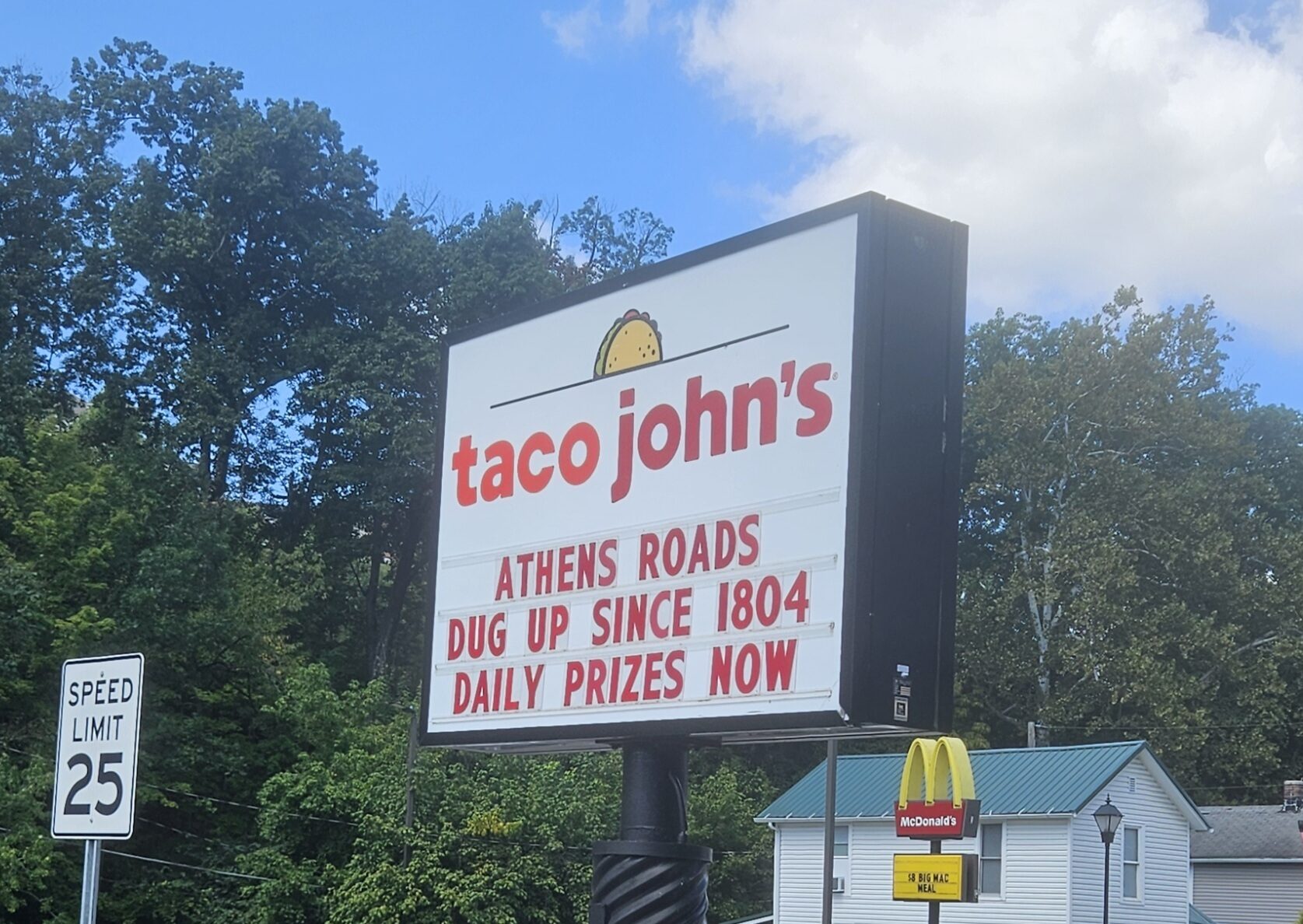
ATHENS, Ohio — Almost two weeks after torrential rain flooded several parts of the city, mitigating and protecting against future flooding dominated Athens City Council’s Committee of the Whole meeting Monday night.
Audience members spoke about recent damage from principal flooding that occurred the morning of Aug. 11 from both the Richland Avenue corridor and the East State Street area.
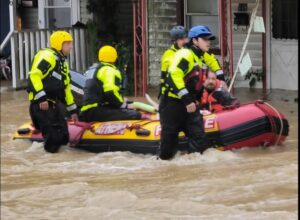
Anytime you have 3 to 5 inches of rain, Mayor Steve Patterson said, flash flooding will occur, as it did Aug. 11.
Patterson said he met with Richland Avenue business owners Aug. 19 at the Richland Avenue fire station, with council members in attendance. The meeting was productive in setting flood mitigation priorities, he said.
Council member Alan Swank, 4th Ward, noted that “the civility in the room was what public discourse is all about,” he said.
That meeting sparked emerging plans for flood containment, Patterson said. In the short term, he said, the city will dredge underneath all Richland Avenue bridges and some culverts as well starting in September.
“Things do need to dry out a little bit, or else we’re just pushing muck from one side to the other, and that’s not effective,” Patterson said. Although the city dredged last year, he said that access to properties limited the city’s ability to remove sediment under several bridges. Those included one at the north end of Richland near the Stop-N‐Cop Drive Thru Carryout, 362 Richland Ave., and another on the south end near the Marathon gas station, 542 Richland Ave.
The “mid-range plan,” Patterson said, is to install “industrial strength trench drains,” which is a more expensive undertaking. The city has identified strategic locations for their placement, he added.
The city is looking for the best type of trench drain to avoid impeding bicyclists, he said.
The “long-range plan,” Patterson said, “is to explore putting in some large, deep detention tanks” along the Richland corridor.
“That’s going to be expensive, but it’s something that we’re exploring,” he said.
To address flooding on East State Street, he said, the city plans to conduct smoke testing to determine if and where groundwater is infiltrating storm drains and sewer mains. The public will be notified when smoke testing takes place, he said. Older homes may see smoke coming from their downspouts, he noted.
“It’s certainly going to have an odd look when we do that level of examination in that area,” Patterson said.
She asked the mayor to get information “out front” if projects involve road closures. Patterson said smoke testing of itself on East State will not require road closures, unless a major need is uncovered.
Patterson added that the dredging under bridges on Richland Avenue, set for September, should not involve major traffic disruptions. Richland Avenue is currently closed to traffic at Dairy Lane through Sept. 10 while a new sewer line and lift station is installed.
Patterson said overall, flooding on the South Side is a multi-faceted problem that involves many roads that can have water flow downhill that impacts the Richland Avenue corridor. One such street is Lamar Drive, where catchbasins must be examined to determine if they work or if they must be repaired.
Patterson also said he is looking at placing a line item in the city budget to address flood mitigation.
Public speaks on Richland flooding
When the floor was opened to the public, the first to speak was Natalie Kruse Daniels, a hydrology expert who holds doctoral degrees in civil engineering and geosciences.
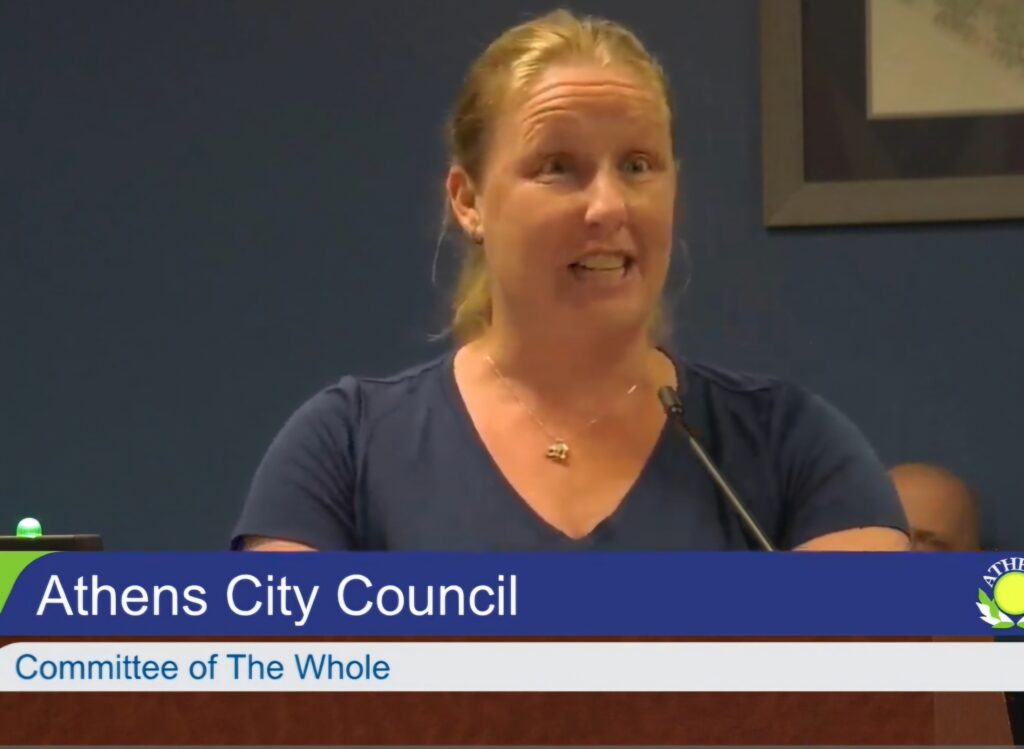
Warmer sea surface temperatures produce more atmospheric moisture, resulting in “really intense rainfall events” that are increasing, said Kruse Daniels.
“We expect to see these events again,” Kruse Daniels said.
Kruse Daniels advised the U.S. Army Corps of Engineers during their study of the Richland corridor. The Independent has requested a copy of the report from the city.
The way Richland bridges are constructed, Kruse Daniels said, makes the water rise several inches where the Purple Chopstix restaurant is located, at 371 Richland Ave. The eatery has been particularly hard hit by floods in June and on Aug. 11.
Bridges are normally constructed based on factors like traffic levels, Kruse Daniels said.
“That doesn’t sound like much but a couple inches matters,” Kruse Daniels said, noting that 2 inches are the difference between flood waters getting into Purple Chopstix’s dining room vs. only the patio.
The city needs to look more at sediment management in the watershed as a whole, Kruse Daniels said. Temporary flood barriers can help businesses like Purple Chopstix “that are expected to flood,” she added.
Paul Isherwood, At Large, said he liked the idea of temporary barriers to protect businesses — similar to movable barriers seen alongside highway construction — because they are lightweight, stackable and can be interlinked. Kruse Daniels said temporary flood barriers are designed so they cannot be turned over.
Mitigation plans also require dredging and an examination of parking requirements, because paved surfaces that are impervious to rain prevent water from being absorbed into the soil, Kruse Daniels said. Bridge construction must be designed to prioritize hydraulics so peak flood discharges can pass through.
Frank Fugate, who owns the property next to the Marathon station at 536 Richland Ave., said most plans discussed will not work because too much development has occurred in the flood plain. He said that previous highway construction is causing the hill behind the former Morrison Elementary School to slip, creating “choke points” where flood water accumulates rapidly.
“I don’t want to see this get swept under the rug,” Fugate said.
Mark Spezza, who co-owns Classic Gold Real Estate at 530 Richland Ave., said “more and more rainwater has run down Richland Avenue” since the U.S. 33 bypass was built in the early 2000s.
“These on-and-off ramps have created acres of additional rainwater pouring onto the entrance of Richland Avenue,” Spezza said. “You can stand there in a storm and watch the water pour down these ramps onto Richland Avenue. This is really where the flooding starts.”
He and his wife Diane have owned the building — which is certified to be just 1 foot above the floodplain, he said — for 35 years. The building first started flooding in July 2013, he said. Since then, the building flooded in June 2020 as well as on June 18 and Aug. 11 this year.
While the damages have amounted to $9,000, “the real cost is the disruption of my business.”
Silt and debris has built up on Coates Run “so that even a modest rainstorm can overwhelm the bridge capacities,” Spezza said.
Comments on East State Street flooding
Heather Eubanks, a homeowner at 283 E. State St., said she and her husband bought their house in 2021 and made their first call to the city in June 2022 concerning the sanitary sewer in front of their home.
In June this year, Eubanks said water from the sanitary sewer “poured into our basement at 4:15 in the morning, flooding our entire finished basement.”
“Our bedroom was down there,” she said.
Because the water contained sewage, “all of our belongings that were under 6 inches of standing water and sewage could not be salvaged. Our furniture, our belongings all had to be disposed of,” she said.
The flooring had to be removed and the walls cut four feet from the floor to deal with the damage, she said. The family’s bill for restoration was $17,000, she said.
“We’re not sure where to go from here,” Eubanks said. “Our concern is paying large amounts of money to refinish our basement again, when we’re not sure there isn’t an issue and this wouldn’t happen again.” She added that her family wants assurance from the city that the sanitary sewer system is working properly.
Athens resident Jack Stauffer, an Elmwood Place resident and master plumber, said his own plumbing knowledge has helped save his home from sanitary sewer-related flood damage that should be the city’s responsibility.
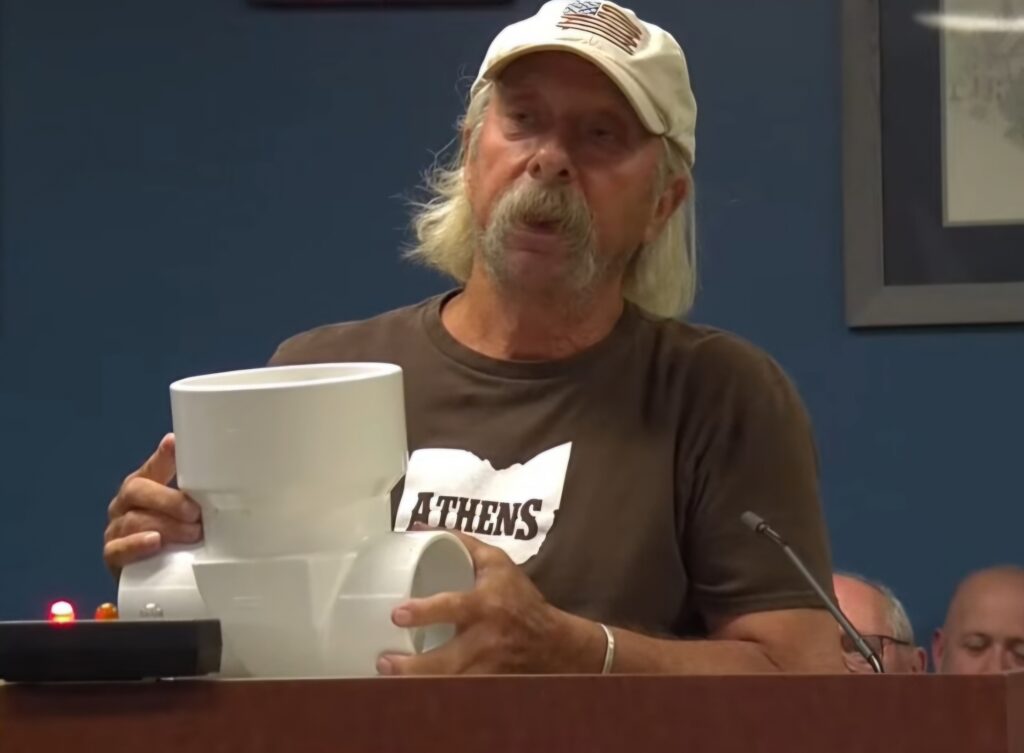
“A lawyer I am not,” Stauffer said. “But in my 31 years of experience, I have always been under the impression that property owners’ responsibility stops and starts at the city right-of-way, or the curb line, on any given street that your house faces.”
Stauffer said those with sanitary sewer lines near their curbs that clog “means the city’s line is plugged up, and not the homeowner’s line is plugged up.”
Stauffer said he purchased and remodeled his home in 2015. That June, his basement flooded where the sanitary sewer line backed up in the washing machine standpipe. The lines were “overwhelmed with rain and stormwater, infiltrating the sanitary sewer system, and backing up into my house and flooding it.”
Because he knows plumbing, Stauffer said, he ran out to the street, uncovered the clean-out plug and took it off, which kept flooding of his home to a minimum.
Council member Jessica Thomas, At Large, said homeowners can install drainage wheels to handle storm water.
Stauffer said he worked with the city in 2015 to mitigate damage from plugged sanitary sewer lines affected by stormwater flooding at his Elmwood Drive home. The solution involved a device known as a backflow valve that separates stormwater from his sewer line.
At first, Stauffer said, the city asked Stauffer to pay for and place the device himself on his property. But Stauffer said he was able to convince the city to do the backflow value installation on city property near his house. The device must be serviced every six months, he added.
Stauffer praised the city for doing an “excellent” job of placing a backflow valve, which retails at about $270 per unit, at the clean-out location at the edge of Elmwood Place.
“This device has not allowed one drop of water to come into my house in the last 11 years,” Stauffer said. “This is what saved me.”
Due to Labor Day, Athens City Council’s next regular meeting is Tuesday, Sept. 8 at Athens City Hall, Council Chambers, third floor, 8 E. Washington St. Meetings are also streamed online. Regular sessions are on the first and third Mondays of the month; committee meetings are on the second and fourth Mondays.
