
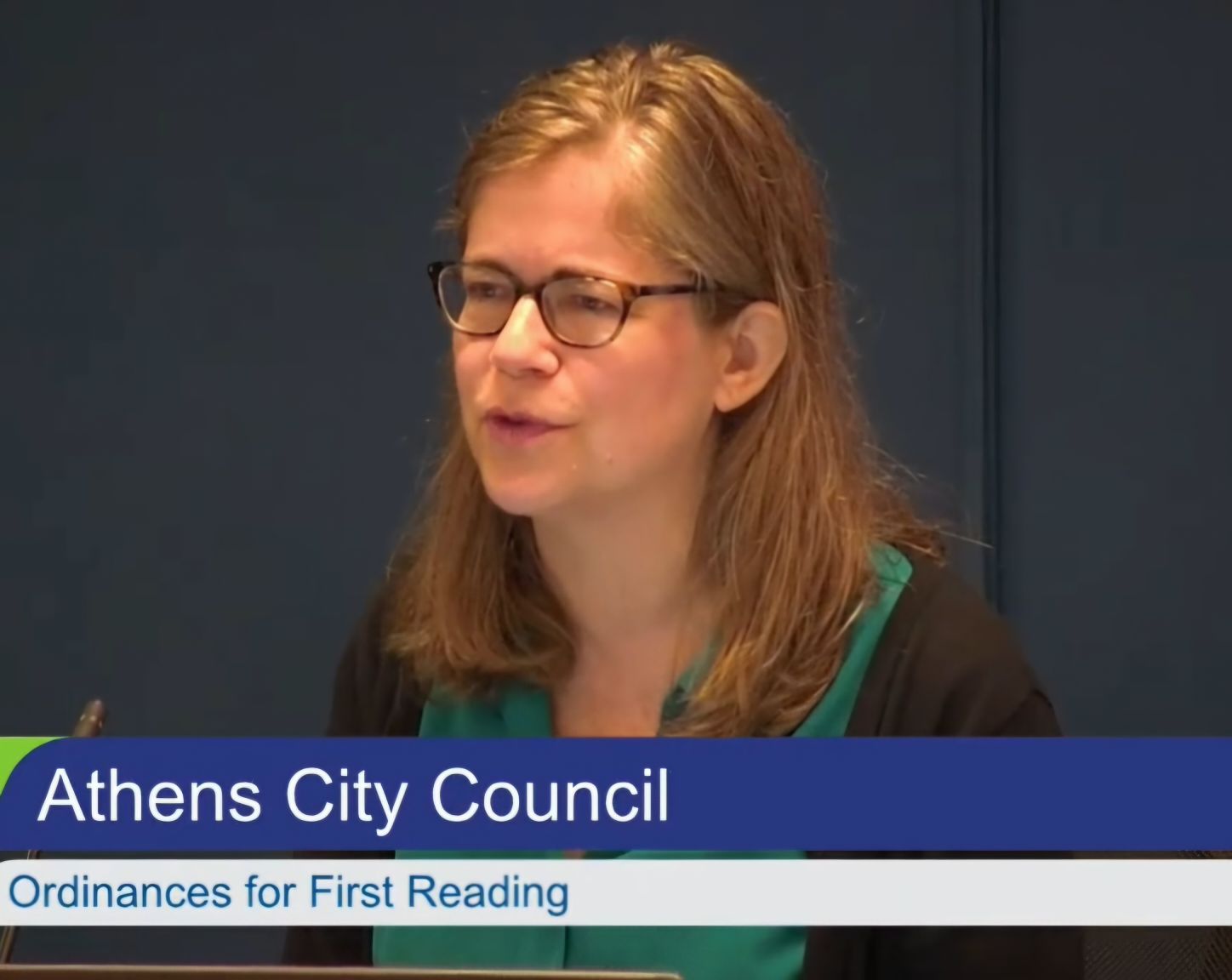
ATHENS, Ohio — Sewer rates for Athens residential, commercial and industrial customers will increase 4% in 2027, Athens City Council decided Monday. The council opted to hold off — for now — on a proposal to pass a multi-year plan for rate increases.
At its Oct. 5 meeting, council discussed a multi-year plan of rate increase options developed by Service-Safety Director Andy Stone. That plan would increase sewer rates by 4% in 2027 and again in 2028, and then 2% each of the next three years through 2031.
Stone said the increases would cover anticipated costs and debt service while keeping the sewer fund balance above $20 million. It would be more efficient to pass one multi-year package than to come back every year for another rate increase, he said.
On Monday night, council member Jessica Thomas, At Large, said a multi-year plan would require changes to the city code, which would take eight weeks of legislative process to complete. It’s too late in the year to complete a plan covering sewer rate increases over the next four or five years, she said.
The council voted unanimously to un-table and adopt Ordinance 81-26.
Currently, Athens’ average household monthly rate is $53.93. A 4% rate increase would increase that average to $56.09 per month in 2027.
Stone has said that the city will need to consider rate increases to address the need for expanded sewer infrastructure. That is due in part to taking on new customers, with 1,100 sewer accounts coming from outside the city through agreement with Athens County.
Fees proposed for special event street closures
The council heard first reading of ordinances 95-26 and 96-26, which would establish fees for special Uptown events requiring street closures of one or more square blocks. The city has never charged fees for such closures. Currently, 13 Uptown events require street closures.
Beth Clodfelter, At Large, said the fees are set according to a matrix developed by Assistant Safety-Service Director Andrew Chiki. The matrix uses a multiplier based on the area to be closed and the type of entity seeking the closure. Local nonprofit and community service organizations would pay less; for profits would pay more.
Clodfelter said the fees would help the city recoup about one-third of the actual costs the city incurs when its street crews put bags on meters, erect barricades, and perform other on-site tasks.
Separate fees would be charged for electrical hookups and inspection ($150), electrical service ($50 per event day) and food truck vendors ($200) to cover code compliance. Fees for extra police and fire personnel and other unanticipated event expenses would be charged at-cost.
“If anyone is a festival organizer, I would recommend that you read this one fairly carefully,” Clodfelter said.
Thomas, At Large, said the fees as proposed overall are standard for college towns and are probably long overdue. However, she added that any residential street closure could negatively impact already congested city streets during the school year.
The most criticized item in the fees matrix was a $300 charge for a one-block residential neighborhood gathering. Alan Swank, 4th Ward, said that would discourage neighborhoods from holding events.
Swank also asked if it’s necessary to close Uptown streets for 13 yearly events. The comments he hears about them, he said, run the gamut from “great idea” to “it kills my business.”
Swank noted that the 13 events planned for this year would have generated about $3,890 under the matrix. That seems too little to make it worth the time and effort of city staff to determine and collect fees, he said.
Council members also discussed concerns raised by resident Rob Delach in an email received a few hours before the meeting.
Delach said the proposed $100 late fee should be considered only if event organizers have a clear deadline for submitting applications. He suggested 100 days in advance of the event because it is easy to remember.
Delach also said nonprofit groups should be allowed to assist neighborhood residents with events. He added that gaining neighborhood approval from more than 50% of affected residents to hold a gathering would be advisable.
Council members said they would take Delach’s concerns into consideration.
In other business, before Monday’s meeting, the council held three public hearings, each given 15 minutes of time for a description and public comments.
Neighborhood Corridor Overlay Zones
The first hearing concerned the city’s proposal to create Neighborhood Corridor Overlay Zones, additional sets of code that apply regulations to a specific designated area. The council’s Committee of the Whole discussed Neighborhood Corridor Overlay Zones at the Sept. 14 committee meetings.
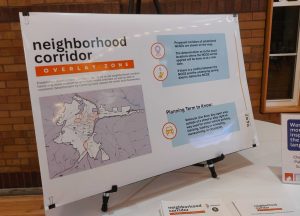
No one from the audience spoke of the topic during Monday’s meeting. City Planner Meghan Jennings previously has said her office received 415 comments, concerning more opportunities for small businesses, sidewalk improvements, and emphasis on multi-use buildings.
After the hearing, Jennings said the council can begin to work on selecting specific parts of the city for an Neighborhood Corridor Overlay Zones — such as the West Side, where West End Ciderhouse, Stewart MacDonald and Miller’s Chicken create an opportunity for enhanced foot traffic.
Annexation
The next public hearing regarded the city’s agreement with Athens County to annex 29.5 acres of Athens County Children Services property.
The annexation is sought because Children Services will soon open a new building at its location on Stonybrook Drive. The annex will expand city water and sewer lines to the property while generating income tax payments from 85–100 employees on the site, Swank said.
The southern portion of the property will be zoned B-3, general business, and the northern part of the property above Hillcrest Drive zoned R-1, single family residential.
Council heard the first reading of ordinances 100-26 and 101-26 on the annexation Monday.
Welcome Home Ohio
The third public hearing covered the Welcome Home Ohio Planned Unit Development at 93 Hudson Ave. The city announced the project in December 2024, when it received a $2 million grant to construct eight affordably priced homes.

The three-bedroom, two-bath homes are expected to be valued at $230,000, but will be sold for $180,000 each. Eligible home buyers must earn less than 120% of the area’s median income as determined by the U.S. Department of Housing and Urban Development. For 2026, HUD lists median income for Athens County as $88,900.
Mayor Steve Patterson noted that one of the eight homes will be Americans with Disabilities Act-accessible, and that all will have solar panels on rooftops to save on energy costs.
To prepare for the project, the city purchased some adjoining property from the American Red Cross and moved a storage garage to Kenny Drive, Swank said.
Swank called the Welcome Home Ohio houses a fine opportunity for first-time homebuyers to establish real equity and wealth. “And once you’re in, you’re in,” Swank said.
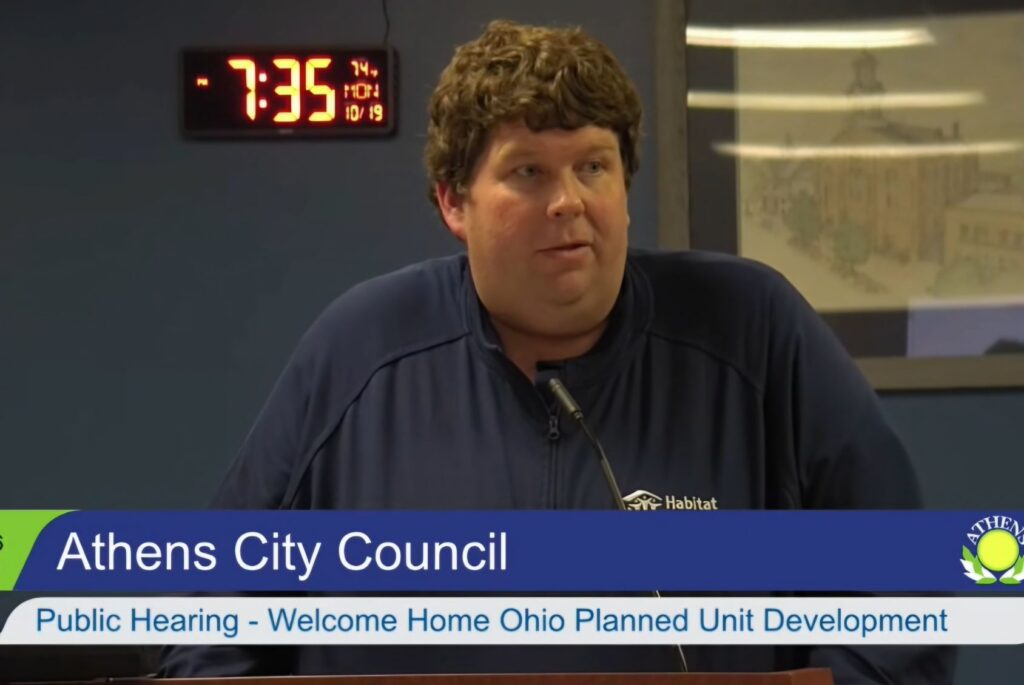
During public comment in the hearing, Kenneth Oehlers, executive director of Habitat for Humanity for Southeast Ohio, noted that the average age of a local homebuyer is 40.
Oehlers praised the city for deciding to proceed with their Welcome Home Ohio project when, he said, other municipalities have returned the money to the state because “this isn’t going to pencil-out.”
Patterson expressed regret that some cities decided not to proceed with Welcome Home Ohio homes.
“But you know what, at the end of the day, this is Athens,” Patterson said. “We take on challenges, and we’ll sit there and figure out how to get it done, and done correctly, and we’re doing it.”
In other action Monday, the council:
- Adopted on third reading Ordinance 89-26, which authorizes the city to pursue tax liens against homeowners and/or their lessees who fail to dispose of solid waste and have received more than five citations of violation with no remedial action taken.
- Suspended the rules and adopted Ordinance 93-26 to approve payment of a Then and Now Certificate involving a payment of $22,000 to Prokos Rentals for Stimson Avenue sewer line repairs.
- Suspended the rules and adopted Ordinance 94-26, which establishes the Athens City Comprehensive Plan Review Advisory Commission and increases its members from seven to nine. The increased membership is in order to increase the number of non ex-officio voting members within the city from three to five.
- Suspended the rules and adopted Resolution R-07-26, which accepts the county property tax rates estimated for 2027 by the Athens County Budget Commission. The estimated city portion of property tax next year is about $1.24 million based on inside millage from Athens Township and Canaan Township.
Athens City Council’s next meeting will be at 7 p.m. Monday, Oct. 26 at Athens City Hall, Council Chambers, third floor, 8 E. Washington St. Meetings are also streamed online. Regular sessions are on the first and third Mondays of the month; committee meetings are on the second and fourth Mondays.
