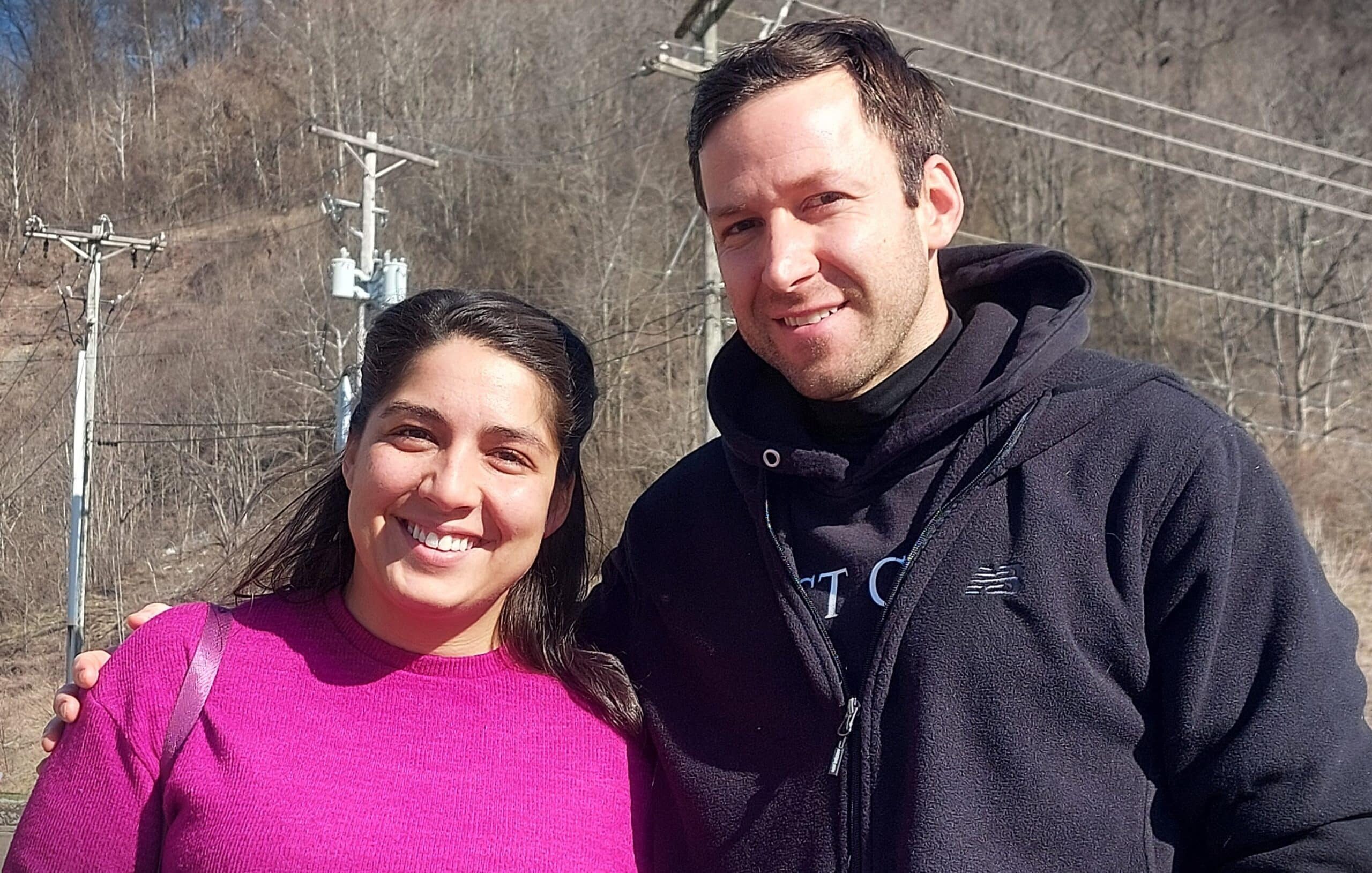
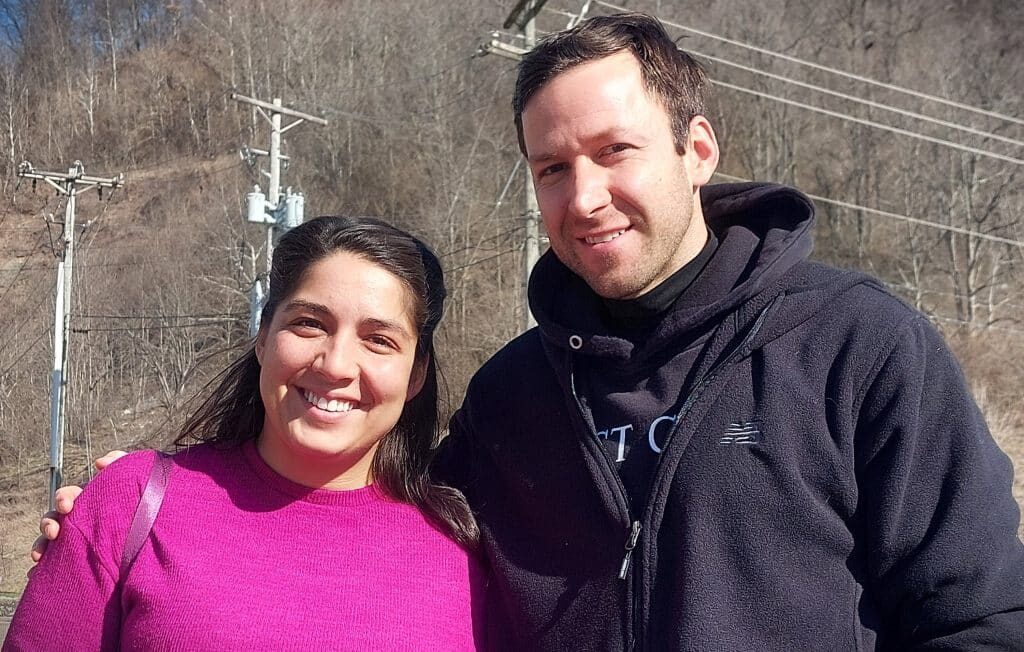
ALBANY, Ohio — Loammi “Elijah” Yazdani-Isfehani preaches occasionally at a small church in McArthur, where an “Appeal to Heaven” flag hangs beside him.
Two years ago, he spent 10 days in prison over his actions in the United States Capitol on Wednesday, Jan. 6, 2021. Since then, his political convictions haven’t faltered. He regularly broadcasts his views on YouTube, and from the pulpit.
During a recent sermon, streamed on Facebook on Sunday, Feb. 9, Elijah spoke of his support for Trump and said:
This is a spiritual fight. This is a spiritual war. And when it comes to the performance of the gifts of God and the body of Christ, God’s not looking for those who will flee. God’s not looking for those of double mind and double heart. He’s looking for somebody that will stand up for him and stand in the face of the pressure of the world, the flesh and the devil. When the whirlwind turns on and everything says, ‘run,’ who shall stand for the Lord? Who’s gonna stand up?
Senior Protestant Scholar Matthew D. Taylor, of the Baltimore-based Institute for Islamic, Christian, and Jewish Studies, said that Elijah’s language in his sermon, and the flag flying beside the pulpit, both connect him to a political-theological trend called the New Apostolic Reformation.
“In their theology, they believe in spiritual warfare,” Taylor said. “They believe that there are demonic and Satanic forces that are united in opposition and trying to thwart the will of God.” (The NAR has three levels of spiritual warfare.)
While its individual adherents may not be aware of the specific history of the NAR (Taylor said its language and symbols have become cultural memes), the movement’s ideas have spread rapidly in recent years and have grown in influence, from Trump’s administration to religio-political groups in Southeast Ohio.
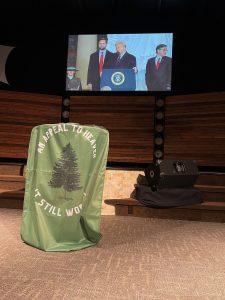
Elijah’s experience is an example of NAR’s mainstream expansion.
He’s one of three Athens County siblings who were convicted for their role in what is known as J6, and were among the more than 1,500 participants who received pardons from President Donald Trump on Jan. 20 of this year. The siblings — Elijah, Abigail and Loruhamah “Loru” Yazdani-Isfehani — entered the U.S. Capitol building together, alongside a few thousand others, as Congress prepared to certify former President Joe Biden’s election.
All three siblings live in Albany and pleaded guilty to a charge of “Parading, Demonstrating, or Picketing in a Capitol Building” as part of plea agreements, according to court documents.
Elijah faced the harshest sentence: two weeks in federal prison. The other siblings didn’t do any prison time; their sentences involved community service, probation and restitution.
All three received complete pardons in January 2025.
Following their pardons, over French toast and coffee at the Athens IHOP, Elijah and Loru Yazdani-Isfehani told the Independent how the criminal convictions and subsequent pardons affected their lives – and deepened their anti-establishment convictions.
What led them to the Capitol
Loru and Elijah told the Independent that they drove from Albany to Washington, D.C., ahead of Jan. 6, 2021, to see President Trump’s final speech as the country’s 45th president. While she said elections should be determined by “the will of the people, whether it goes against my personal will or not,” Loru also said she was skeptical of the 2020 election results.
According to court records, prior to J6, Elijah also said Trump was “unfairly cheated out of a second term” in 2020.
For both siblings, these beliefs are intrinsically tied to their life experiences. Discussing their motivations to attend J6, the siblings spoke in depth about their Iranian heritage, Christian religious beliefs, and distrust in the political establishment.
The siblings grew up hearing stories from their Iranian-American father and their grandpa, who they said was a high-ranking military general in Iran who fled the country after the Iranian revolution in the late 1970s. Elijah and Lori said these stories attuned them to the dangers of government oppression and political violence.
“[Our grandpa] used to take us on long walks and talk to us — and he was obviously the wisest, smartest man,” said Loru. “He would always tell me, ‘I see things that make me scared that America will someday lose their freedom like Iran did.’ And so, it’s just something I’ve always been hyper-vigilant, hyper-aware of.”
They grew up in Columbus, in an area Loru described as “the hood.” The siblings eventually moved to Athens County, in Albany, where their mother is from, and served as caretakers for her in the last years of her life.
In both Columbus and in Athens County, the siblings encountered poverty and seemingly intractable problems.
“We definitely saw the poverty and to me, it’s like: OK, it never gets better,” regardless of who is in office, Loru said. That’s part of the reason, Loru said, “I actually kind of hate politics” – because she has voted for both Democrats and Republicans without seeing changes to the core problems she has seen facing her communities.
Generalized distrust of government institutions was a core driver of J6, said Jon Lewis, a research fellow at George Washington University’s Program on Extremism who has studied the insurrection.
Lewis told the Independent that the crowd was composed of many groups who might disagree with one another sharply on various issues. However, “in that moment, they have a common enemy — they are all distrustful of the government,” Lewis said.
Indeed, while Loru and Elijah shared core foundations that led them to the Capitol on Jan. 6, 2021, they expressed substantially different political beliefs on a range of questions. Loru said she does not support Israel in its war on Gaza, while Elijah expressed strong support for Israel. Loru supports abortion “up to a certain point,” while Elijah is “very against that,” Loru said.
On other issues, the siblings aligned. They both expressed support for Trump’s plans around immigration and the mass deportation of undocumented people.
Of his father’s immigration, Elijah said, “He did it the right way.”
Another thing the siblings have in common is their devout Christian faith. For Elijah, at least, his faith was a major driver for his participation in J6.
He said God gave him “heads-up about some of the shady things that were gonna happen that election [in 2020]. … He literally gave me — call me crazy — he gave me advanced knowledge and awareness of what was going to happen in 2020 and 2016.”
Some NAR figureheads put forth “prophecies” about Trump, Taylor said — the fulfillment of which was perhaps a goal of some J6 attendees. These ideas, Taylor explained, are fomented online on social media, and at church.
Taylor said that religious prophecies about the election contributed to the development of conspiracy theories about the election outcome within the Christian far-right. For this group, the turn from prophecy to conspiracy became “the groundswell building up to Jan. 6,” Taylor said.
Lewis said the popularization of conspiracy theories by those with power or influence also played a role.
“It’s not just your crackpot neighbor,” Lewis said. “It’s your local elected official who’s been putting this out; it’s your local sheriff who lives down the street, who is a person of authority, and is also telling you that, like, the Democrats are bringing in millions of migrants to steal the election.”
The events of Jan. 6, 2021

Loru said she and her siblings had no intention to “stop the verification of the election” on Jan. 6, 2021. Instead, she said the siblings primarily went to Washington that day to see Trump speak and followed the crowd to the Capitol to continue their sightseeing.
Loru said the siblings had no idea that, in entering the Capitol, they were doing anything wrong.
“There were no barricades — there was nothing like that, all there was, was a huge group of people walking,” Loru said.
Loru and Elijah both indicated that they were “let” into the building. “And then when we get up there, we’re kind of standing up there, and somebody’s like, ‘Hey, the cops opened the doors and said, ‘You guys can come in,’” Loru said.
The two siblings maintained that they were never told directly to leave the Capitol.
However, a statement of offense in Loru’s case says that the siblings heard protestors say the purpose of going to the Capitol was to “stop the steal.” Additionally, the government’s sentencing memorandum states there were barricades before the Capitol, and that no members of the crowd were authorized to enter. The memo points to recorded evidence of officers making statements, such as “Nobody can come in,” as the siblings entered the building and officers directly telling the siblings to leave the Capitol building.
As Lewis pointed out, though, “You can’t fact-check your way out of a deep-state conspiracy. … It’s not a coincidence that the right-wing media ecosystem has spent the last four years telling them that they are being targeted, that all of these things that they think are happening really are happening, and that it’s all part of some conspiracy against them.”
The sentencing memo says the siblings spent 37 minutes inside the building. While there, Loru said they joined “with this huge group of people that was praying for Biden and the new administration, and we were praying for wisdom and hope for them.”
Toward the end of their time in the building, police tear-gassed the crowd. “It got pretty chaotic,” Loru said.
According to the sentencing memo, the siblings attempted to remain in the building despite the tear gas, ignoring further commands to leave the building. An officer “physically pushed” Elijah in the direction of the exit, also physically directing Abigail, the memo says.
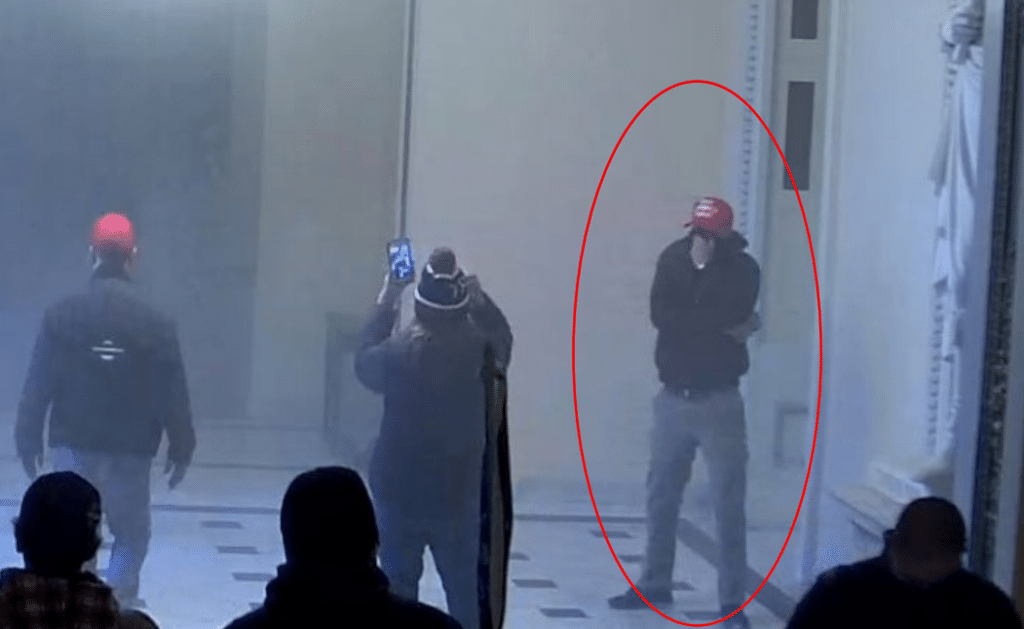
“When they finally opened the doors, like, you couldn’t control if you got pushed out,” Loru said. “It was like this huge rush. And like, I literally got carried out.”
Afterwards, the city implemented a curfew. On their drive home, the siblings saw media reports of what happened at the Capitol.
“We were like, ‘What the heck was going on?’ Because it wasn’t … what we saw,” Loru said. “I thought, initially, things were gonna calm down, and people were gonna realize it wasn’t what everyone was trying to say it was.”
Lewis said that the media narrative around J6 played a role in deepening the anti-establishment sentiment of many protestors, including non-violent offenders.
“Folks who are … reading stuff about them calling them terrorists, saying that they’re violent extremists — that’s only going to push mainstream folks deeper down that rabbit hole,” Lewis said.
Criminal proceedings and convictions
Elijah said that on May 3, 2021, Federal Bureau of Investigation and U.S. Marshals Service agents showed up at his workplace, frisked him and informed him that he had a warrant out for his arrest for trespassing the Capitol on Jan. 6, 2021.
He said a friend turned him in to the FBI for a $1,000 Visa gift card. (The Independent has not yet heard back from the FBI Cincinnati office to verify this.)
“I got Judas’d,” Elijah joked.
Each of the three siblings was sentenced to 100 hours of community service each, two years’ probation, and to pay $500 in restitution. According to Farrah Wylde, executive assistant for the Federal Correctional Institution, Ashland, Elijah served his two-week sentence from Jan. 3–13, 2023; he was released the Friday before a federal holiday (Martin Luther King Jr. Day), per prison policy.
Elijah said he spent his first few days in isolation, in a cell with only a Bible.
“They wouldn’t let me in the yard because I was a ‘domestic threat,’” he said. “It was a very, very tough experience. … In a direct way I was able to preach the gospel to everybody on that block, because they would talk to me. They called me ‘MAGA.’”
The siblings felt “railroaded” by their plea agreements, Loru said.
“Our mom was dying from cancer, and they told us, ‘If you don’t take the plea deal, you’re going to see a minimum of three years of prison,’ and we couldn’t afford to miss out on that time with her,” Loru said.
Lewis said the Isfehani-Yazdani siblings’ J6 cases mirror others in that many defendants ultimately took plea deals to avoid much harsher sentences.
For Loru, though, having faced a lighter sentence doesn’t change the ongoing anger she feels toward the justice system over her prosecution.
“It makes me angry … because I’m like, we did nothing wrong, and they came after us, and they made it so much worse for [my mother],” Loru said. “When they sent [Elijah] to prison, she was so stressed out about that.”
Lewis said that the criminal proceedings against those who entered the Capitol on J6 helped harden their anti-government sentiment.
“Every single individual, and I would say especially that the nonviolent offenders, are individuals who have been given a pretty significant grievance against the government,” Lewis said. “It creates that cognitive opening for those world views to harden.”
From the point of view of many J6 defendants, Lewis said, “people who are not your friend — the out group — people who are … not a largely white, largely Christian in-group — they are trying to take this country, this election, away from you, and they are going to come after you and take everything you care about as soon as that happens.”
The impact for the siblings was deeply personal.
Loru said her coworkers began treating her differently after they discovered her J6 charges, which led her to feel alienated from them.
“People just automatically assume if you were there, you’re just some nut job, right-wing,” she said. “I’ve had views that people would consider liberal, and other people consider conservative. I’m independent.”
Both she and Elijah, who are working toward nursing degrees at Hocking College, were pulled into a meeting and informed that they may not be able to obtain licensure due to the convictions.
“I used to have some type of faith in the justice system,” Loru said. “I saw the corruption, but I used to think, if you’re truly innocent, it will prove your innocence. I don’t believe it anymore.”
Pardons
Loru said the siblings didn’t know if they were included in Trump’s pardon until her attorney called.
“I do feel like getting pardons [is] kind of justification for people like us that really didn’t have a choice,” Loru said.
Elijah and Loru both speculated that their pardons may help reverse the reputational damage of their convictions, and ease their paths toward becoming nurses.
Lewis said that some J6 participants were vindicated by Trump’s pardons. He noted that such vindication from institutions or figures known for their credibility — such as the president or Congress — may make it easier for people to fall prey to misinformation, extremism and conspiracy theories related to J6.
NPR reported on Friday, Feb. 11 that since Trump’s pardons, the U.S. Department of Justice has removed information about J6 from public access — an event that has prompted attorneys representing news organizations to seek legal action.
Correction: A previous version of this article incorrectly stated the dates of Elijah’s incarceration. It has since been corrected. We apologize for this error and any confusion it may have caused.