

The deadline to register to vote in the Nov. 3 general election is Oct. 5. Find more information via the Athens County Board of Elections.
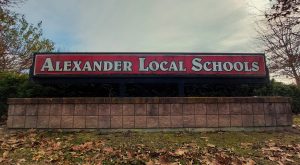
ALBANY, Ohio — The Alexander Local School District is proposing a 0.75% income tax levy to help raise more than $1 million dollars for its schools, which have shed dozens of staff positions due to budget deficits. Voters will decide on the levy Nov. 3.
The earned-income levy is the latest in a series of revenue-generating proposals made by the school district in recent years. In 2023 and 2024, voters rejected two efforts by the district to renew a 1% income tax levy, first passed in 2019 after numerous attempts. That levy failed five times between late 2016 and 2019.
School officials and supporters of the current levy proposal hope the quarter-of-a-percent reduction may help encourage voters at the ballot box.
“I’m excited that we’re asking just for what we need,” said William Hampton, the district’s superintendent. “We’re not asking for extra. No frills.”
Hampton, who was appointed to a five-year term as superintendent in 2022, told the Independent that the district has cut an estimated 35 positions during his tenure and that more would be necessary if the levy fails.
The district’s funding has remained stagnant for nearly 20 years, he said, while costs have increased, leading to a $1.5 million shortfall. The income tax levy seeks to fill this gap over the next five years.
An information sheet circulated by the district cites its enrollment at more than 1,300 students, and says the schools maintain a $20 million budget. Hampton told the Independent that the schools employ an estimated 185 people.
“We’re doing everything we can to be efficient and to be good stewards of the community’s money,” Hampton told the Independent. “We just need a little more to maintain the things we have.”
While Hampton is optimistic that the levy will pass, he warns that the district will need to make “some significant reductions” if voters reject the fundraising measure. He is also aware of a history of opposition to levies in the area.
In 2019, after multiple failures over three years, a 1% levy passed by a single vote. But efforts to renew that levy faced hurdles and rejections, while the school district reduced staff and cut an education program for gifted students. When the levy renewal failed in 2024, Hampton said he was “surprised and disappointed by the lack of support from our community.”
Alexander Board of Education President Stephen Crook supports the levy, but acknowledges that the rising cost of living affects how people vote.
“They’ve been taxed to death. Gas prices, grocery prices, I get it,” Crook told the Independent. But he cautioned that another 10 to 15 positions could be cut if the levy fails. Passage also would help keep athletics fees down and allow busing to continue as normal.
“Without this levy, our school will be in a really tough position to provide kids with the education and the experience that they deserve and that we all received growing up in this district,” Crook said. But he is not sure it will succeed.
“I’m kind of at a coin flip,” he said.
On social media, dueling groups in favor and in opposition to the levy have staked out their positions.
Say Yes to Alexander, a pro-levy Facebook group with nearly 500 followers, posts numerous infographics and statistics in support of the school-backed increase.
Then there is Say NO to Alexander, an anti-levy group with nearly 200 followers, that is less active but continues to add new members. “The levy failed!” posted one excited member in 2024. The Independent contacted the administrator of this group via Facebook message Sept. 15, but did not receive a response by press time.
Both Crook and Hampton told the Independent that the district’s budget challenges are not due to internal financial mismanagement, but instead due to cuts in state funding for public education.
Policy Matters Ohio, a nonprofit research group, found that Ohio has underfunded public education by more than $2.7 billion and “repeatedly reduced the state share of public school funding.” As of June, more than 100 public school districts across the state are projecting cash shortfalls.
But the Ohio Department of Education and Workforce says its budgets through fiscal year 2027 include “record investment” in public education. The state claims it spent more money on primary and secondary education in fiscal year 2025 “than at any other time in state history,” exceeding $13 billion.
However, the agency’s own figures show that more than $1 billion of that funding went to voucher programs. Nearly half of that went to the Education Choice Expansion program that funds private school tuition. Another $1+ billion went to charter schools.
