
CHAUNCEY, Ohio – Growing up to 4 feet in length and native to the Eastern United States, the American Eel is the only freshwater eel found in North America. What’s more: they might even be in Athens County waterways.
Located adjacent to downtown Chauncey and spanning 63 acres lies Southeast Ohio’s very own American Eel Preserve. Made possible by the Hocking River Commission, the American Eel Preserve does much more than solely preserve the American Eel’s natural habitat: it is also a haven for ecological restoration caused by destructive agricultural practices.
Despite the preserve’s title, there exists little proof of actual eel activity in the preserve, with less than five eels sighted in the Hocking River since the 1940s. Due to this, rather than focusing on eels in particular, the preserve aims to improve river quality, in which eels (along with other native species) could thrive.
From freshwater U.S. waterways, the elusive American Eel travels thousands of miles downstream to the Sargasso Sea in the Atlantic Ocean to breed, according to the U.S. Fish and Wildlife Service. To return to their native waterway, the eels must voyage through up to a dozen dams and locks. Such barriers present human-made challenges for the eels and contribute to declining American Eel populations.
For an eel to reach Southeast Ohio, it would have to travel about 1,760 miles from its breeding site — making it all the more important for the eels’ local waterways to be clean and inhabitable.
“People think that salmon are so special because they swim 50–100 miles,” said Dan Imhoff, project manager of the preserve and treasurer of the Hocking River Commission. “That’s amateur stuff!”
The Hocking River Commission initially purchased the land for the preserve in 2022 with a grant from H2Ohio, a statewide initiative attempting to clean and restore Ohio’s waterways, Imhoff said.
He named the preserve after hearing about sightings of several American Eels in the Hocking River. Today, the preserve’s nomenclature is visible on an on-site informational sign, accompanied by an image of the American Eel itself.
Before current restoration efforts, over-tilled soil and eroded river banks dominated the preserve’s landscape. The river’s biggest pollution problem is sedimentation, Hocking River Commission President John Wryst explained. Sedimentation is the erosion of river banks into waterways, a process which can cause water to appear murky, silty, or filled with excess harmful nutrients.
To combat this erosion, the commission planted thousands of trees alongside the Hocking River’s banks within the preserve.
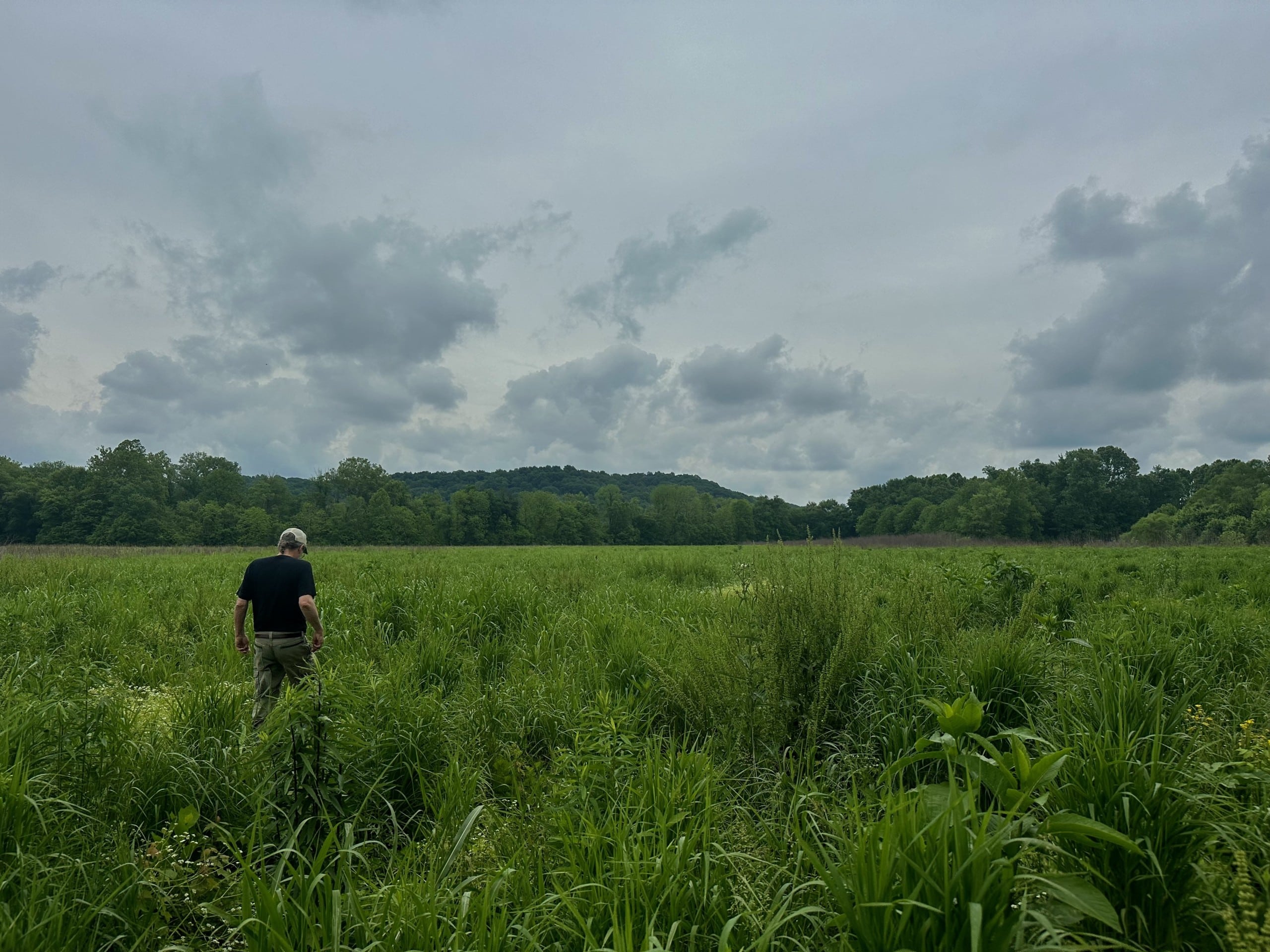
The preserve is densely propagated, with small tree sprouts visible roughly every several feet and blooming pollinator-attracting plants filling in any empty space. Walking through the dense vegetation requires a steady foot, so as not to crush any of the newly sprouted plants.
“It’s been a big project,” said Ron Cass, vice president of the Hocking River Commission. “Actually, it’s Southeastern Ohio’s biggest pollinator plot.”
Over the last two years, the Hocking River Commission has planted approximately 850 pounds of pollinator-attracting seeds and more than 14,000 native trees.
“Ideally, we’d like to see about 100 feet of [riparian forest],” Imhoff said. “By farming right next to the river, you increase soil load to the river, which we usually think of as bad. … Please don’t [farm] right up to the stream.”
The preserve faces several challenges — especially the presence of invasive species.
“The No. 1 challenge is Johnson grass,” Imhoff said.
While walking through the preserve, Cass and Wryst pointed out said Johnson grass, further emphasizing the plant’s ability to spread across sunny, open fields. Even after hours of cutting the grass and spraying it with herbicides, it continues to push out native species, creating a problem only solvable by continuous effort and time, they said.
Cass and Wryst said that, in future years, the Johnson grass will lose its ability to thrive, as newly planted trees will block sunlight across greater portions of the preserve. However, for now, the grass remains a frustrating challenge.
Ecological restoration is a lengthy process requiring hours of work that doesn’t yield large-scale tangible results for decades. But the goal for the preserve is clear: “40 years from now, if you plopped down in this forest, it would look the same as 400 years ago,” Ron Cass said.
“We want to return it to a native riparian forest,” Imhoff said.
The Hocking River Commission also intends to increase public access to the preserve through hiking trails and a potential river access point.
“Our goals are conservation, preservation, education, [recreation] and use of the Hocking River,” Wryst said. Furthermore, Imhoff expressed a desire for the preserve to someday gain arboretum status, which would protect the preserve from any future regressive farming or logging practices.
The preserve aims that by 2065 it will host dozens of native trees and pollinators and a thriving aquatic ecosystem – complete with the American Eel. After all, 1,760 miles is a long journey to call Chauncey home.
For further information or questions, contact hockingriver@gmail.com.
Note: A previous version of this story stated that Johnson grass in the preserve was sprayed with pesticides; it has been updated to reflect that the grass is specifically sprayed with herbicides.