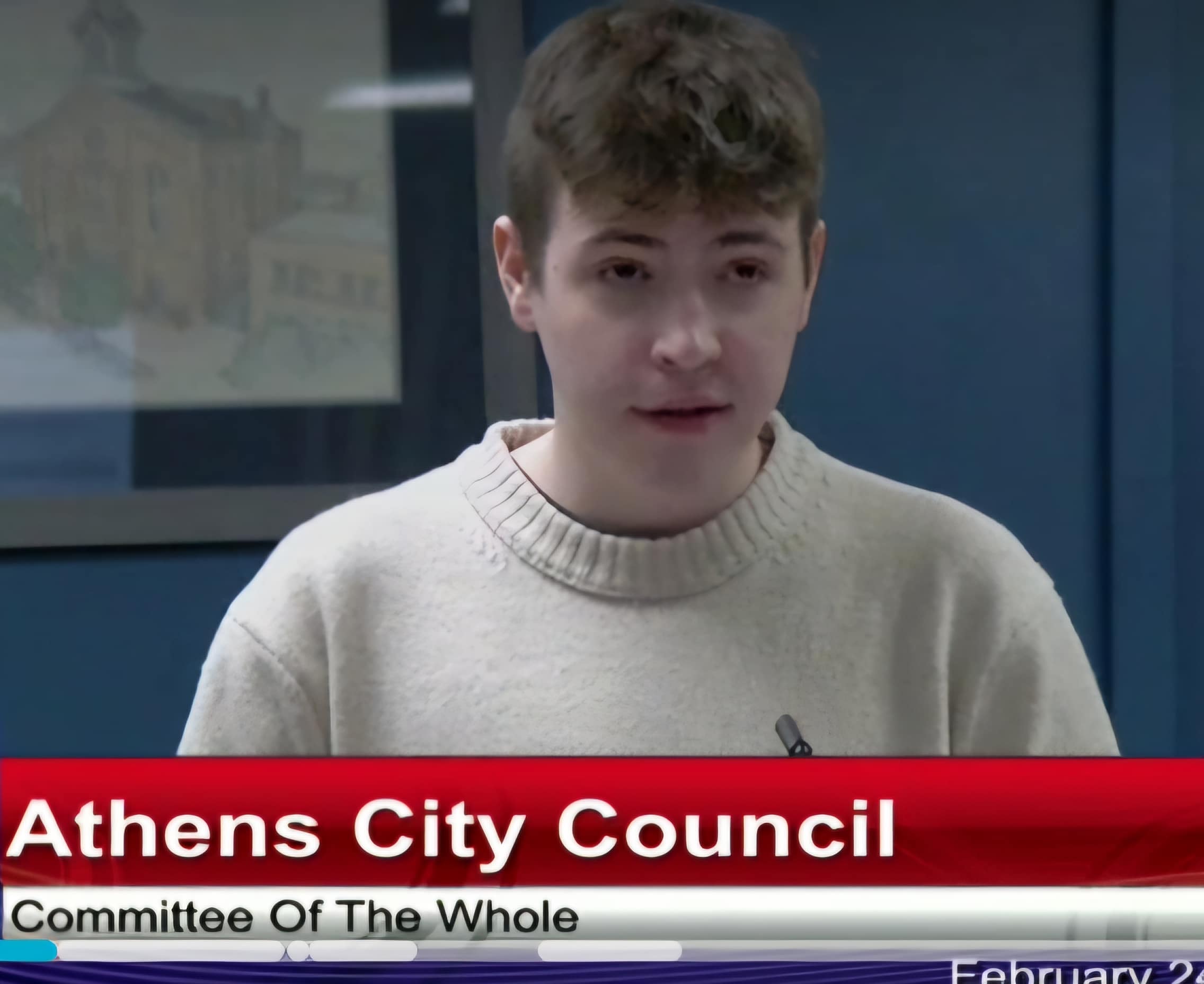
ATHENS, Ohio — Meeting as a whole during the Athens City Council committees meeting Monday, councilors expressed support for a resolution declaring the city’s desire to be a “safe haven” for individuals seeking gender-affirming healthcare.
The resolution, brought forward by an Ohio University student group, also encourages adopting policies to make that a reality. The resolution could be passed by council as early as the March 3 council meeting, councilors said Monday.
Councilors stated, however, that they must confer with Law Director Lisa Eliason before they can pass the proposed resolution put forward by the Young Democratic Socialists of America – Ohio University chapter, to ascertain any liability for the city such support would have.
The student’s resolution may conflict with Ohio’s House Bill 68, known as “Ohio Saving Adolescents from Experimentation Act.” HB 68 banned gender-affirming healthcare for transgender youth and also banned transgender girls and women from competing in sports.

Speaking for the YDSA-OU group on Monday, OU student and member Liam Syrvalin said Athens could provide “safe haven” status for transgender and nonbinary individuals from state laws that risk damaging their physical and psychological well-being.
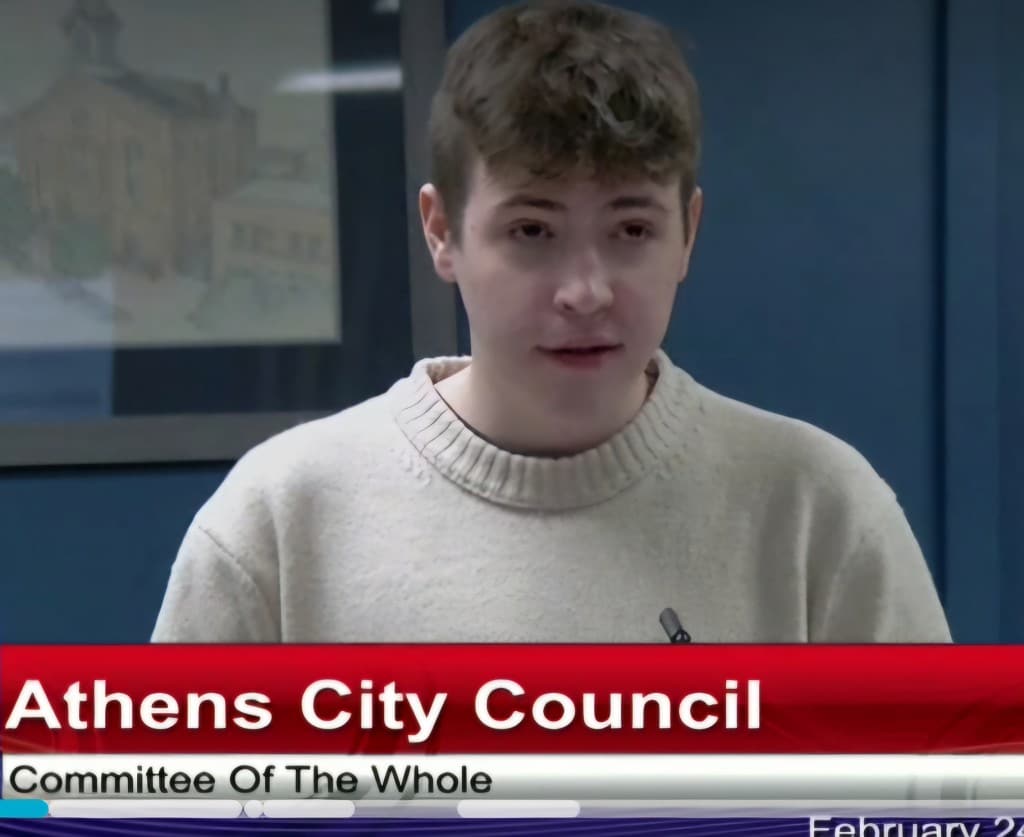
“I am here today in fear: fear that my fellow neighbors are on their way to being legally shoved back in the closet; fear that my classmates are going to have their physical and mental resources stripped away from them; fear that my friends are going to have their personal lives subjected to the hatred of legislators and politicians who, quite frankly, have an ideological wish to eliminate my friends from existence,” Syrvalin said.
Athens has always been a beacon for embracing diversity and inclusion, Syrvalin said, so providing protections for individuals seeking gender-affirming healthcare already falls within the city’s commitment to that effort through its 2040 Comprehensive Plan.
As drafted, the safe haven resolution would see the city resolve to “advocate in favor of formal decriminalization of gender-affirming care and against the criminal prosecution or imposition of administrative penalties on an individual or organization for providing, seeking, receiving, or assisting those seeking or receiving gender-affirming healthcare.”
Syrvalin said the group has turned to city of Athens leadership because once-fictional, Orwellian discrimination against the healthcare rights of young adults has come into reality with House Bill 68.
And that is despite the fact that medical studies, such as an 18-month study from The Journal of the American Medical Association, have found that gender-affirming hormone therapy caused reductions in anxiety and depression symptoms among those treated, Syrvalin noted.
“The time has come to put into place local protections, both rhetorical and legal, that would halt the formalized legislative push of transphobia in our state and in our nation,” Syrvalin said.
Other Ohio cities, such as Cleveland Heights, have passed similar “safe haven” resolutions that support gender-affirming healthcare, and “Athens is the type of place to have this kind of resolution,” Syrvalin said. “We are a diverse community and one which celebrates that fact.”
Another speaker, Odhrain Underhill, noted that the Trevor Project in 2024 found that “anti-trans laws correlate with a 72% increase in suicide attempts.”
“Please don’t make this place turn into a town that people wish to leave and never return to,” Underhill said. Underhill added that Athens being a “safe haven” city “will literally save lives.”
Council member Solveig Spjeldnes, 1st Ward, said the only issue she has with the proposed resolution are the potential “legal ramifications” it may have if found to be in direct conflict with state law. Law Director Eliason was not present Monday.
The resolution’s proposed language came with assistance from the American Civil Liberties Union of OU’s Campus Action Team. Spjeldnes said it contained “great” language.
Council member Beth Clodfelter, At Large, said she will vote yes on such a resolution, while adding, “My only concern is how the state of Ohio will react to make us a little bit of a target for those Republicans.”
Protections for transgender and nonbinary persons weren’t discussed in the community 20 years ago, said council member Micah McCarey, At Large, who attended a recent YDSA-OU meeting on related topics.
But the Athens and Ohio University communities have come a long way since then, and he said Athens has already shown a capacity to be a “safe haven city.” The city can further its commitment to diversity and inclusion by providing resources that allow young people to be happy and successful in life, he said. He added that young people should have the opportunity to make decisions in consultation with their physicians and in some cases, their parents.
Council member Alan Swank, 4th Ward, called civic engagement “the cornerstone of a strong democracy, in a civil society.”
“Your presence here tonight is a testament to both of those principles,” he said.
However, Swank said stand-alone resolutions are “statements of belief” that “may or may not manifest in concrete actions.” He said it would be even more meaningful to have the resolution incorporated into the 2040 Athens Comprehensive Plan, which the council adopted in 2020.
The resolution could become part of Principle 8, which is to be inclusive of all persons regardless of race, creed, color, sex, sexual orientation, gender identity or expression, national origin or ancestry, marital or familial status, religious beliefs, age, disability, or economic status.”
Swank suggested the city’s community relations commission be engaged to develop language incorporating the “safe haven for gender-affirming healthcare” language into guiding Principle 8. That would be more powerful and longer-lasting than a stand-alone resolution, he added.
Support of tax-exempt municipal bonds
Another resolution came before the council “declaring support for the preservation of the federal tax exemption of municipal bonds.” The resolution notes that the tax-exempt municipal bond market is a widely used source of funding capital for states and local governments, particularly in the area of financing public infrastructure. They were incorporated into the tax code in 1913.
Currently, the city saves hundreds of thousands of dollars each year because municipal bonds are exempt from federal taxes.
The resolution also states: “tax-exempt bonds offer borrowers a multiplier effect of 2.11, meaning that for every dollar, borrowers achieve $2.11 in borrowing cost savings, thereby demonstrating the efficiency and effectiveness of this exemption in facilitating infrastructure improvement.”
Tax-exempt municipal bonds have been used by the city “in funding the building of our Community Center, the widening of our East State Street corridor, upgrading our Wastewater Treatment Plant, and more recently the building of our Municipal Pool and new Fire Station Headquarters,” the resolution reads. It also “encourages” the Ohio Congressional Delegation to assist in preserving tax-exempt status for municipal bonds.
City Treasurer Josh Thomas said the Ohio Municipal League contacted the city about support for developing such a resolution, with Auditor Kathy Hecht and council member Jessica Thomas, At Large, becoming involved.
The city pays between 3% and 5% interest on its municipal bonds, with the city to pay $756,156 in bond interest, Josh Thomas noted. Without the federal tax exemption on municipal bonds, the rate could be up to 2.5% higher – or $453,000 more this year without the exemption.
Clodfelter asked Josh Thomas if the cities’ federal tax-exempt status on municipal bonds were “under attack.” He deferred to his wife, council member Jessica Thomas, At Large, who said “under attack” might be a bit strong of a term, but that states and municipalities need to voice their concerns on the issue as the federal government may seek to end the tax exemption, if left unchecked by opposition.
Spjeldnes called the idea of ending the federal tax exemption “another unfunded mandate” that would leave cities in the position of finding it difficult to fund public infrastructure projects without tax relief.
Treasurer Thomas said since three-quarters of public infrastructure investment comes from states and cities, and only one-quarter’s worth from the federal government, “These projects just won’t get done” if the tax exemption is removed, he said.
In other matters Monday:
- The planning and development committee forwarded to the council a right-of-way use permit request for a homeowner at 145 Grosvenor St., so that a fence can be constructed to halt a used, grass-filled alley on the property.
- The safety services committee moved forward Fiber Project No. 347, so that phase 4 construction can proceed at a cost of $450,000 on fiber optic lines extending from the city south along Court Street into the south part of the city to access traffic lights, while also forwarding to the council the project closeout of Dairy Lane Project No. 317, which involves $200,000 to be spent on completion of infrastructure, such as bricks and sidewalks.
- The finance and personnel committee forwarded receipt of a Northeast Ohio Public Energy Council grant in the amount of $7,337, which the council receives periodically. The city is a NOPEC member, Swank said, and receives a “great rate” on natural gas aggregation at 59.9 cents per 100 cubic feet.
Athens City Council’s next regular meeting will be at 7 p.m. on Monday, March 3, in Athens City Hall, Council Chambers, third floor, 8 E. Washington St. Meetings are also available online. Regular sessions are on the first and third Mondays of the month; committee meetings are on the second and fourth Mondays.
Correction: A previous version of this story misspelled Syrvalin’s and Underhill’s names and mistakenly identified Underhill as a member of YDSA. We regret the errors.