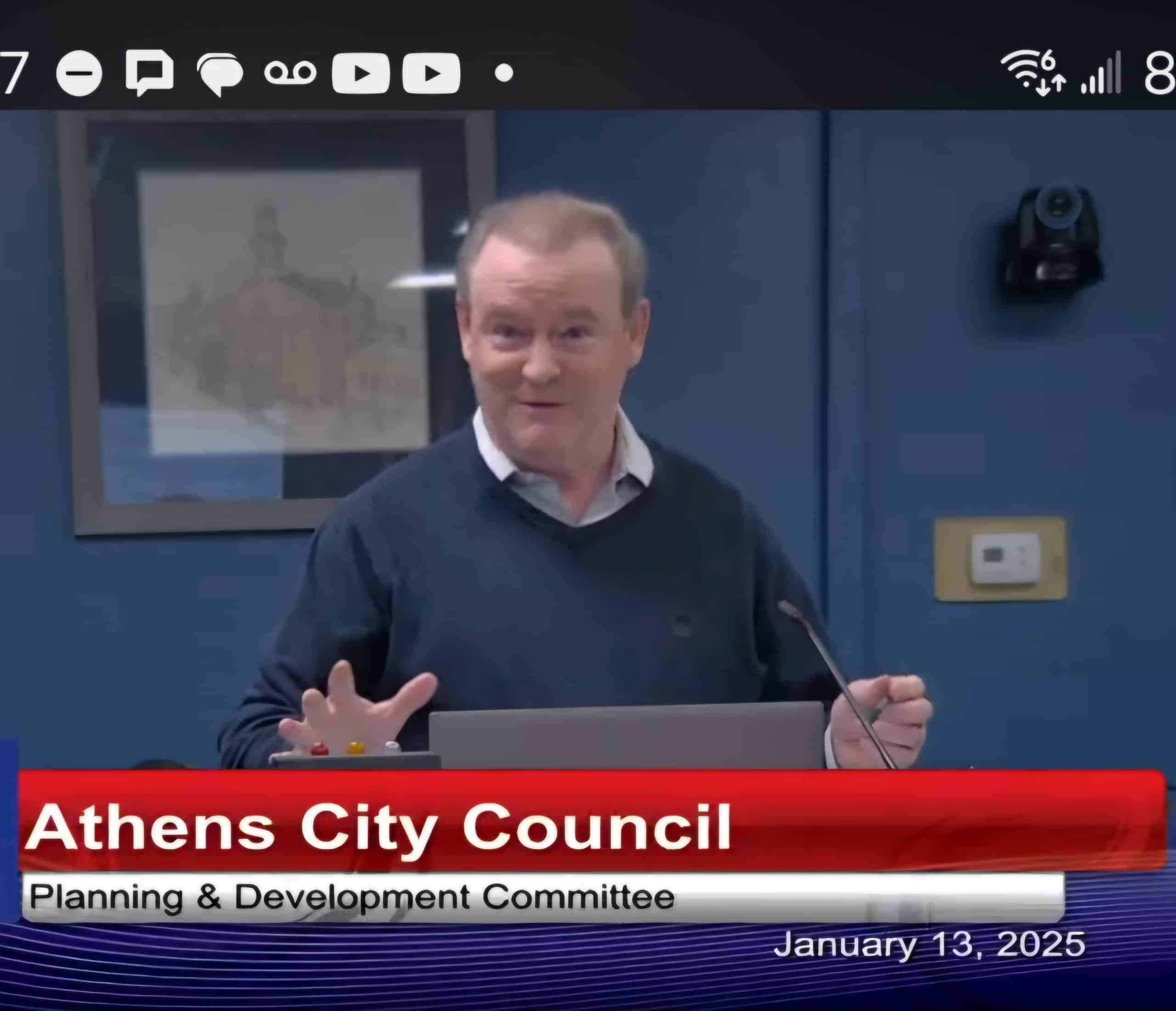
ATHENS, Ohio — Housing was a major topic at a Monday night’s Athens City Council meeting, with discussion of a new affordable housing project; news that a planned project is on hold; and a pitch from a local real estate developer to build more affordable housing.
At a combined regular and committee meeting, the council heard first reading of an ordinance that would authorize an agreement with Community Building Partners, LLC, to develop and build 14 single-family homes in the city.
The project is underwritten by a $2 million grant the city received in November 2024 from the state’s Welcome Home Ohio program. Community Building Partners will receive a developer fee of $10,000 per unit, according to the agreement.
The project description attached to the grant award calls for construction of eight three-bedroom homes on the site of the former West Elementary on Central Avenue by Nov. 1, 2026. A future second phase would see construction of an additional six units on Grosvenor Street and Hudson Avenue.
However, council member Alan Swank, 4th Ward said that those sites weren’t set in stone.
“The state got a little ahead of the ball game and identified the spots they wanted,” Swank said. “I’m not sure if they drove down here or talked to anybody, but that’s fine — we’re not bound to what they suggested.”
Athens City Service-Safety Director Andy Stone did not immediately respond to request for comment regarding the accuracy of Swank’s statement.
Each unit would cost approximately $250,000 to build and would sell for $130,000 to $150,000, Swank said. The proceeds of the sales would fund further construction, he added.
According to the multi-property listing service realtor.com, the median home sale price in the city of Athens was $287,500 in December 2024.
Under the program terms, each home would have a deed restriction barring sale to anyone who earns more than 80% of the county’s annual median income as determined by the U.S. Department of Housing and Urban Development.
“These have to be homes that are going to be homes for many, many, many years — not turned into rentals in the next three, five, 10 or even 15 years,” Swank said.
However, the Welcome Home Ohio guidelines say that the homeowner can rent out the property after five years.
The ordinance will have its second reading at the council’s next regular meeting on Tuesday, Jan. 21.
Other housing projects
Meanwhile, a proposed housing project near Monticello Village apartments on Hooper Street has stalled.
Hill Tide Partners of South Carolina had asked the city to rezone the area from R-1, single family residential, to R-3, multi-family residential for the project.. During the meeting of the Planning and Development Committee Monday, Swank said Hill Tide had withdrawn its request pending upcoming changes to Ohio’s Low-Income Housing Tax Credit Program.
The project involves construction of 50 to 80 apartments on 18 acres at 111 Hooper Street.
Hill Tide Partners may bring its proposal back sometime between February and April, Swank said.
Use of LIHTCs also was the subject of a presentation by David Funk of Capstone Property Management.
LIHTC projects offer developers a dollar-for-dollar reduction in federal taxes for building affordable housing projects. Developers front the costs of construction in exchange for tax credits of 4% or 9% of the project cost. In addition, the developer earns project fees and reaps the profits from leasing or selling the housing units.
And projects in Athens County are especially attractive to developers using LIHTC, Funk said, because the state and federal governments offer additional incentives to encourage projects in Appalachia.
“There’s a reason why all of these developers are chasing these projects in Athens County — they’re lucrative,” Funk said.
A LIHTC project underway in The Plains, Funk noted, will earn Woda Construction of Columbus nearly $6.6 million in developer fees and construction profit — none of which will be spent in Athens County.
Big development firms like Woda, Hill Tide and Spire Development have an edge in obtaining tax credits from the Ohio Housing Finance Agency, Funk said, because they have more experience in such projects.
“LIHTC is very much a closed house of developers,” he said. “It’s a pretty small group, and it’s not a club that wants to have other people come in and compete against them.”
In the past eight years, 12 LIHTC projects have created 595 housing units in Athens County — “probably the highest number of LIHTC projects per capita in the state of Ohio,” Funk said. But none of them had local participation, so the county has lost an estimated $282 million in local economic impact, he said.
“The affordable housing that’s being created is fantastic, but it’s tended to take jobs away from the local builders,” he said.
“But what if all this work had gone to them?” Funk asked. “We’d probably have a vibrant community of builders, a vibrant community of local suppliers.”
Funk suggested that the city create a public-private partnership to support local developers in pursuing LIHTC projects.
“If done right, there’s enough resources here, enough income coming off these projects, to create an endowment fund,” he said. “Imagine what one could do with $6 million off one single project, in terms of furthering other affordable housing initiatives in Athens County.”
There are no models for such an initiative, he said.
“This would be really creative, to put forth this kind of partnership,” he said.
Patterson said he and Service Safety Director Andy Stone had met previously with Funk and seen the same presentation.
“I think that this would be really interesting, to be able to pull together various entities that might be interested in trying to apply for LIHTC themselves,” he said.
The Athens County Foundation could bring stakeholders together, he added.
Solveig Spjeldnes, 1st Ward, chairs Affordable Housing Commission and said it could become involved in supporting such a partnership, including through identifying site locations. She suggested a land trust could potentially be used for projects, too.
Athens City Council’s next regular meeting will be at 7 p.m. on Tuesday, Jan. 21, in Athens City Hall, Council Chambers, third floor, 8 E. Washington St. Meetings are also available online. Regular sessions are on the first and third Mondays of the month; committee meetings are on the second and fourth Mondays.