ATHENS, Ohio — Athens City Council can’t pay its nearly $100,000 membership fee to the Outdoor Recreation Council of Appalachia council of governments because its general fund has fallen below the statutory threshold.
At its meeting Monday night, the council heard the first reading of Ordinance 0-45-24, introduced by Councilman Michael Wood, 3rd Ward.
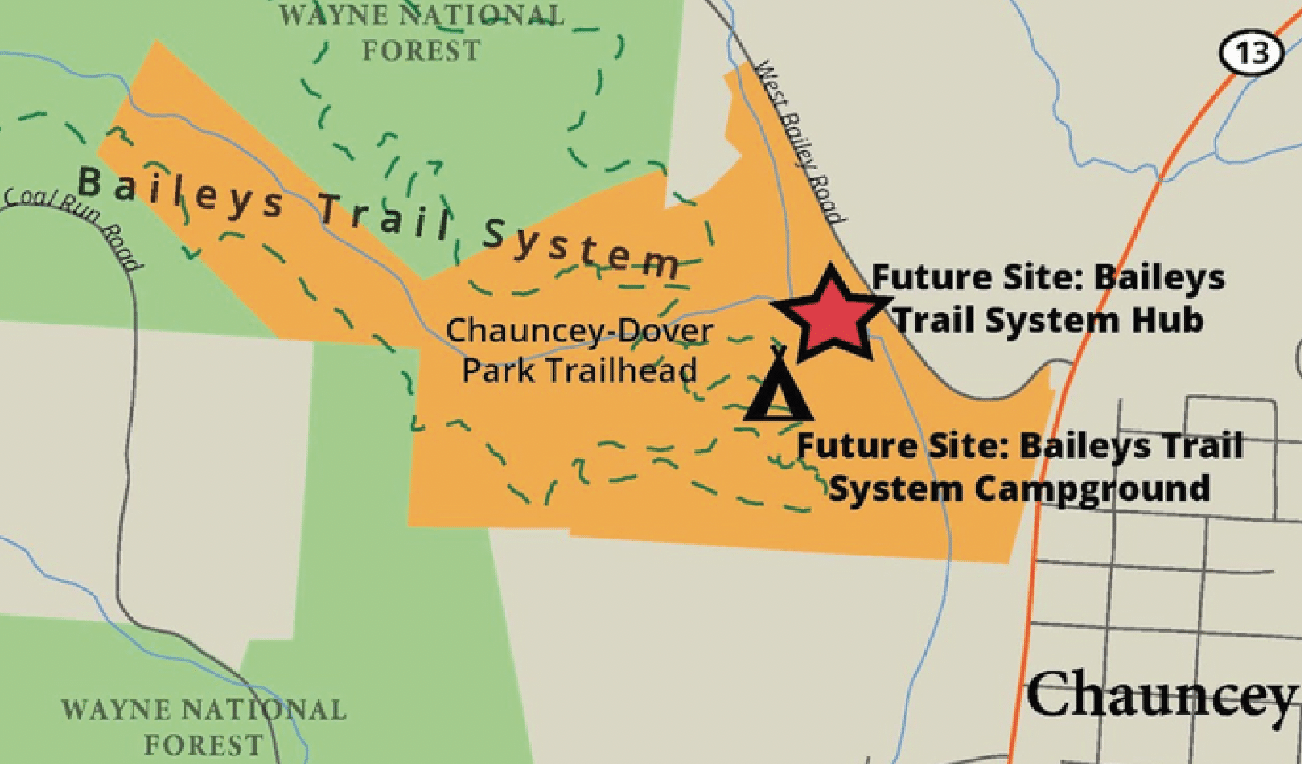
The ordinance authorizes the mayor to pay the 2024 $90,000 membership fee to ORCA from the city’s transient guest tax, which is paid into the general fund. The membership fee supports the Baileys Trail System, which ORCA manages, and “other recreational activities.”
“I think that this is a great way that we can show support for an excellent project,” Wood said. ”I think that it is also important that we stress that this is money that we’ve already appropriated. And this is simply making it not contingent on the county commissioners element of it.”
Wood described the membership fee as a “proactive” and “cheap” way to support local business.
“I think that this should be something that we should do very quickly,” Wood said. “It’s a great way for us to support businesses, our local environment and our tourism.”
Council member Alan Swank, 4th Ward, moved to table discussion of the ordinance, citing an April 5 email from Athens City Auditor Kathy Hecht, who asked for “a hold on any future general fund appropriations and any budgeted non-operating expenses until the fund balance increases to at least 9%” of its annual operating expenditures.
The ORCA membership fee is a non-operating expense, Swank said.
“I’m so glad that you brought up your concerns, member Swank,” Wood said. “Because it’s not $40,000 for the soccer nets, or a million dollars for the fire truck. But again, I think there’s clear language in here that addresses that issue. And we can proceed to have this discussion.”
In her April 5 email, Hecht informed the council and Mayor Steve Patterson that the unappropriated balance of the general fund has dropped to 6% of annual operating expenses. City policy sets a minimum threshold of 7.5% of annual operating expenses.
“I cannot stress enough the fact that the City cannot continue to spend funds as we have in the past,” Hecht wrote. “Once the General Fund is depleted, we will have no other options but to cut services to our community.”
In all, the city spent more than $360,000 more than it expected to in 2023. According to WOUB, these were medical expenses. The Independent reached out to Hecht for clarification.
There is no direct line between the fund balance and the specific added costs for last year, Hecht said in an email Thursday.
“The budget grows every year with inflation and increased personnel costs,” Hecht said in an email. “If our revenue doesn’t increase at the same rate, we cut into our available carryover. We are not in trouble fiscally, however, best practices would have us cutting back on our spending early in the year to prevent issues later on. There will always be unexpected costs that come up. We have to be aware of what our obligations truly are.”
Having a smaller-than-required financial cushion could affect the city’s bond ratings, Swank said.
“When we talk about bond ratings, one of the things the bond companies consider is, are we following our policies?” Swank said. “If we were to spend this money today, we would continue to be out of compliance with our policy, which potentially could affect our bond rating … The worse the bond rating is, the higher the interest rate. Consequently, the more the citizens of Athens need to pay in taxes.”
Tabling the discussion could kill the discussion altogether, Athens resident Rob Delach told the council.
“Who knows when it’s going to come back up,” he said. “We have a tobacco licensing ordinance that was tabled last year, you might recall. And where’s the discussion about that? Zero. There has been no discussion.”
However, Swank’s motion to table the ordinance failed on a 5–2 vote, with Swank and Jeffrey Risner, 2nd Ward. on the losing end.
To pay or not to pay
Mayor Steve Patterson pointed out that the purpose of Wood’s proposed ORCA legislation is to “decouple” the language of the 2019 ordinance that makes the city’s ORCA membership contingent upon the county’s. In January, the Athens County Board of Commissioners declined to renew its membership fee, due to budget constraints.

However, the language in the new ordinance drops this contingency, rather stating the city should participate as an ORCA member “provided the proceeds of such taxes are sufficient, legally available, and lawfully appropriate for the purpose.”
“As I’m reading that language, as was indicated with our requirement, our own policy, at this point in time, I cannot pay that,” Patterson said. “It doesn’t mean that council can’t approve this. Council could approve this, if you so choose. But … I can’t pay an expense if it is in violation with our own policy, when it comes to being solvent as a community.”
City Service Director Andy Stone pointed out that because the city collects its transient guest tax throughout the year, it may not have enough money to pay a $90,000 fee in January.
“Right now, it would not be legal for us to technically pay that money, because it would violate our own policy that we set in 2011,” Stone said, referencing the city’s policy on its general fund balance.
Wood said that the city has “a clear path to success” on funding for its ORCA membership fee, and that the city shouldn’t “act until we have the money.”
Council member Micah McCarey pointed out the city’s stock in “recreation and tourism, in general.” It is the city’s second highest priority in its Athens 2040 comprehensive plan, “right underneath renewable energy.”
Spjeldnes said she would rather see the city use its unappropriated funds to support businesses that are being affected by construction on West Union Street.
“One of our most important responsibilities right now is to do what we can for West Union and those businesses,” Spjeldnes said. “And if we’re going to spend some extra money, I’d rather see it go to alleviate their business concerns, and worry about Baileys Trail later on.”
Spjeldnes and Swank said they have reached out to officials and agencies about assistance with the West Union Street construction project and support for the business, but to no avail.
Wood said the city’s support for ORCA isn’t a zero-sum game.
“I think it’s not a robbing-Peter-to-pay-Paul situation,” Wood said. “We’re not discussing taking money away from Union Street in any way, shape, or form. … Nobody’s suggesting that we violate our principles, nobody’s suggesting that we change on the 7%. We’re saying once that fund comes in, we keep our earlier approved commitment and support this project.”
McCarey inquired about Spjeldnes’ and Wood’s points about West Union businesses, asking if funds from transient guest taxes could “even hypothetically be used for some purpose that would support businesses on Union Street.”
Stone said the answer is technically yes, because the tax goes into the general fund.
“It’s unrestricted, and you could spend it to buy hot dogs, if you wanted to,” Stone said. “To answer your question, is it legal to do that? Yes, it is legal to do that. Is it appropriate to do that? Not in my opinion.”
Swank suggested that even though the $90,000 is already appropriated, the city may have to scramble to come up with the funds — especially in the event that the city is hit with an unexpected expense.
“But there’s a lot more to this that the public doesn’t know,” Swank said. “And I think there are ways that perhaps that $90,000 that we’re being asked to give isn’t really needed.”
Swank was out of office when the Independent contacted him Wednesday and Thursday for follow-up questions.
The ordinance will appear on second reading in two weeks.
Athens City Council’s next meeting will be Monday, April 22 at 7 p.m. in Athens City Hall, Council Chambers, third floor, 8 E. Washington St. Meetings are also available online. Regular session is the first and third Mondays of the month; committee meetings are the second and fourth Mondays.
Update: This story has been updated since initial publication, to include comments from the auditor.